


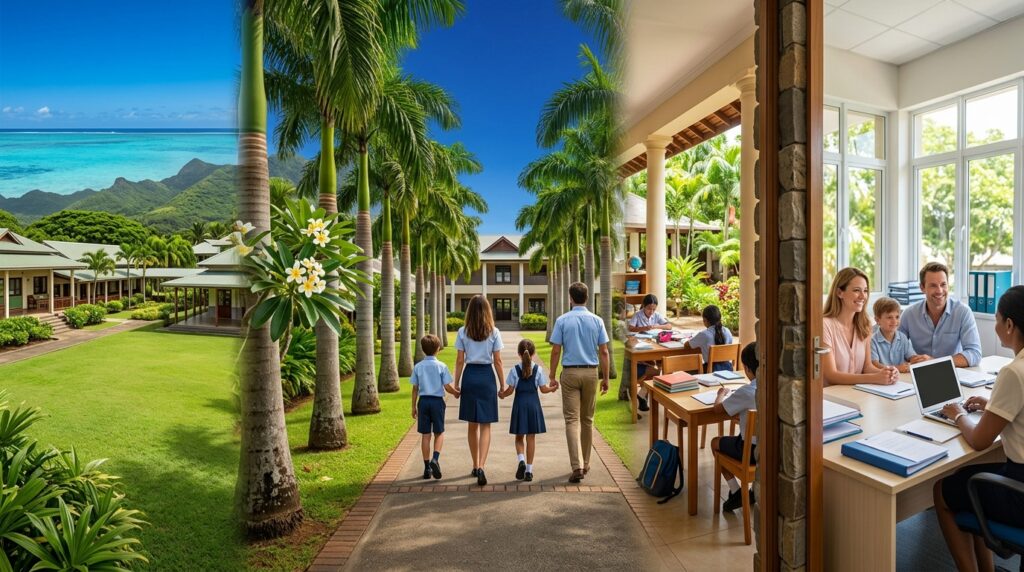
Schools in Mauritius: International and French School Fees, Enrolment and Term Dates
International, French or Mauritian state school: 2026-2027 fees taken from each school’s official schedule, term dates, enrolment steps, entrance tests and where to live near the school.
Schools in Mauritius fall into three systems, and the choice sets both the budget and the arrival date. Fee-paying international schools teach IB or Cambridge programmes: at Northfields, an international school in the north of the island, the 2026-2027 expatriate fee runs from Rs 311,300 a year in Year 1 to Rs 656,700 at the end of secondary school. The five accredited French schools start their year in late August and charge Rs 156,000 to Rs 262,450 a year for 2026-2027, depending on the level, the stream and the family’s nationality, and up to Rs 390,610 at the Lycée des Mascareignes. In the Mauritian national system, secondary school is taught in English and the state-school year runs from January to October.
One condition comes before everything else: the child’s right to reside. The Lycée des Mascareignes and the École du Centre will not enrol a child who entered Mauritius on a tourist visa, even temporarily. Then come pre-registration, the application file, entrance tests and payment of the first fees, which secures the place.
The three school systems in Mauritius
IB and Cambridge international schools
Four Mauritian schools are listed in the IB World Schools directory of the International Baccalaureate Organization:
- Clavis International Primary School: IB Primary Years Programme (PYP), on two campuses, at Mount Ory (Moka) and at Beau Champ, in the east;
- Le Bocage International School, at Mount Ory (Moka), for ages 11 to 18: Middle Years Programme, Diploma Programme and Career-related Programme, with Cambridge IGCSE in Forms 4 and 5;
- Northfields International School, at Labourdonnais (Mapou): IB Primary Years Programme and Diploma Programme, with IGCSE at secondary level;
- Westcoast International Secondary School, at Cascavelle, in the west: IGCSE, then the Diploma Programme.
Pupils in the Mauritian system also sit Cambridge examinations, the School Certificate and the Higher School Certificate. To choose between IB, Cambridge and the French curriculum, see our comparison of the IB, Cambridge and French programmes; to draw up a shortlist, see our method for comparing international schools in Mauritius.
The five accredited French schools
Mauritius has three schools under agreement with the Agency for French Education Abroad (AEFE) and two partner schools, which together teach more than 5,000 pupils, most of them Mauritian, according to the French Embassy. All of them are accredited (homologuées): their teaching matches that of French state schools. They share the same calendar, from late August to early July.
- Lycée La Bourdonnais, in Curepipe: from pre-school (maternelle) to terminale (Year 13, Grade 12), the only school that covers the whole of schooling.
- École du Nord, in the village of Labourdonnais, at Mapou: from petite section (Nursery, Preschool) to troisième (Year 10, Grade 9).
- École du Centre – Collège Pierre-Poivre, at Helvetia (Saint-Pierre): from petite section to troisième.
- Lycée des Mascareignes, at Helvetia (Saint-Pierre): from seconde (Year 11, Grade 10) to terminale, with a dedicated enrolment route for pupils coming from the École du Nord and the École du Centre.
- École Paul et Virginie, in Tamarin: from petite section to CM2 (Year 6, Grade 5).
The Mauritian national system
Mauritian schools follow the Nine-Year Continuous Basic Education reform: six years of primary school, from Grade 1 to Grade 6, ending with the Primary School Achievement Certificate (PSAC), then seven years of secondary school, from Grade 7 to Grade 13. The National Certificate of Education (NCE) assesses pupils in Grade 9, the Cambridge School Certificate concludes Grade 11 and the Cambridge Higher School Certificate Grade 13. In Mauritius these examinations are run by the Mauritius Examinations Syndicate.
At primary level, the core curriculum combines English, French, mathematics, science, history and geography, and an Asian language, Arabic or Kreol Morisien. At secondary level, all lessons are taught in English except language classes, and French remains compulsory. The Ministry of Education points out that secondary education has been free since 1977 and compulsory up to the age of 16 since 2005; secondary schools (colleges) are state, grant-aided private or fee-paying private.
For admission to the Mauritian system, the ministry provides an application form, with a section for children of non-Mauritian parents, which is decided on by the National Equivalence Committee, responsible for equivalences up to secondary level. The file includes, among other documents, the residence permits of the parents and of the child.
Three different school calendars
Plan the arrival date around the school you are aiming for: the French schools and Northfields start the year in late August, while Mauritian state schools, according to the ministry’s 2026 calendar, and Westcoast start it in January.
| Schools | School year | First day | End of year |
|---|---|---|---|
| Mauritian state schools | 2026 | 12 January 2026 for entry classes, 13 January for the others | 30 October 2026, end of the third term |
| Accredited French schools | 2026-2027 | 28 August 2026 | 2 July 2027 |
| Northfields International School | 2026-2027 | 20 August 2026 (24 August for Year 12), welcome day for new pupils on the 19th | 2 July 2027 |
| Westcoast International Secondary School | 2026 | 14 January 2026, welcome day for new pupils on the 13th | 13 November 2026 for Forms 1 to 3, 20 November for Forms 4 and 6 |
Arriving in July or August lets a child start the year with the French schools or Northfields; arriving in December, with the Mauritian system or Westcoast. In between, the child joins a class mid-year if a place is left: the École Paul et Virginie, for example, enrols throughout the year as long as places remain.
How to enrol your child, step by step
1. Sort out the child’s right to reside
The French schools that publish their procedure require proof of the right to reside. For non-Mauritian families, the Lycée des Mascareignes and the École du Centre require the child to be named explicitly on a parent’s residence permit; the Lycée La Bourdonnais asks for the parents’ Residence Permit or Occupation Permit; the École Paul et Virginie accepts a residence or work permit, the Premium Visa or the approval in principle of the Economic Development Board (EDB), to be provided before the start of the school year, and warns that these procedures take at least one to three months depending on the case. The Mauritian ministry’s form asks for the parents’ permit and the child’s. How to bring a spouse and children is explained in our article on the dependent permit in Mauritius.
2. Get in touch early
Places are limited in some schools. For 2026-2027, the École du Nord reported waiting lists in grande section (Year 1, Kindergarten), in CM2 and in sixième (Year 7, Grade 6), and asks families considering a move to Mauritius to get in touch well before they arrive, even when the plan is not settled. Enrolling from petite section secures the place for the whole of schooling there, and a “long-term” reservation fee of Rs 40,000, an advance on tuition fees that is forfeited if the family withdraws, holds a place in petite or moyenne section (Reception, Pre-K). For secondary school at the Lycée La Bourdonnais, pre-registration is done online, one form per child. Northfields and Clavis offer campus visits by appointment before an application is submitted.
3. Put the file together
The lists published by the Lycée La Bourdonnais, the École du Centre, the École Paul et Virginie and the Mauritian ministry largely overlap:
- the child’s birth certificate, or the family record book;
- the latest school reports and the school record;
- the certificate of removal from the previous school, called a Transfer Certificate or Leaving Certificate in the Mauritian system;
- the parents’ passports or identity documents;
- proof of address in Mauritius, such as a lease or a utility bill;
- the residence or work permit, or the visa on which the stay is based;
- in the event of separation or divorce, the document setting out custody of the child;
- the health record with up-to-date vaccinations, requested by the Lycée La Bourdonnais.
Proof of address raises a sequencing problem: the school asks for it, while the home is often chosen according to the school. The ministry’s form even provides for a specific proof of residence for high-demand Mauritian schools. The sequence that avoids the deadlock: obtain a pre-registration, then rent in the school’s area, then complete the file.
4. Sit the entrance tests
Most schools that publish their procedure assess a child who is changing systems:
- École du Nord: fee-paying placement tests for pupils who come neither from an AEFE school nor from the French state system;
- École du Centre: a skills test if the child does not come from an accredited school;
- École Paul et Virginie: French and mathematics tests from CE1 (Year 3, Grade 2) for pupils coming from another system;
- Northfields: the Cognitive Abilities Test (CAT4), which the school arranges at the current school of international applicants, followed by a decision from a committee that accepts, accepts conditionally, places on a waiting list or declines;
- Westcoast: entrance tests after submission of the reports for the last two years, a recommendation letter from the school, the birth certificate and the passport;
- Clavis: an hour of classroom observation for the youngest, a language and mathematics assessment at primary level.
For a pupil enrolled in Grade 7 or an equivalent level, the Lycée La Bourdonnais offers a bridging class: one semester from January, then entry into cinquième (Year 8, Grade 7) the following school year, without repeating a year. It costs Rs 8,000 a month in 2026-2027.
5. Pay to confirm the place
The place is secured only once the file is accepted and the first fees are paid. The École du Nord and the École Paul et Virginie set this as a condition; at the Lycée des Mascareignes, the enrolment of a family not yet living in Mauritius only takes effect once the first-enrolment fees are paid and the residence permit obtained; Northfields allows two weeks after the letter of acceptance to pay the entry fee and the deposit. In most of the published fee schedules, these entry fees are non-refundable.
School fees in Mauritius for 2026-2027
The amounts below come from the fee schedules published by the schools for 2026-2027, or for 2026 at Westcoast. They are in Mauritian rupees, per child and per year, excluding meals, transport and activities.
| Type of school | Annual tuition fees | Entry fees |
|---|---|---|
| Northfields International School, expatriate rate | 174,900 in Pre-Nursery, 311,300 in Year 1, 605,000 in Years 7 to 11, 656,700 in Years 12 and 13 | From 17,900 to 72,400 depending on the level, plus a refundable deposit equal to three months of tuition (78,600 in Year 1, 166,000 in Years 12 and 13) |
| Westcoast International Secondary School, non-citizen rate 2026 | 318,000 in Forms 1 to 3, 334,800 in Forms 4 and 5 (IGCSE), 385,200 in Forms 6 and 7 (IB Diploma) | 3,700 for the application and entrance exam, 70,000 registration, deposit of 79,500 to 96,300 |
| Accredited French schools: Lycée La Bourdonnais, École du Nord, École du Centre, École Paul et Virginie | From 156,000 in pre-school to 226,000 in upper secondary (Lycée La Bourdonnais); up to 262,450 in the international section at lower-secondary level for a family that is neither French nor Mauritian (École du Nord) | Free in petite and moyenne section at the École du Nord, otherwise 40,000 to 74,000 depending on the school and the level, before discounts; 70,000 at the Lycée La Bourdonnais for a pupil who is neither French nor Mauritian |
| Lycée des Mascareignes (seconde to terminale) | From 234,410 for a French or Mauritian family in the standard stream to 390,610 for other nationalities in the international section; 333,885 in the Sport Études stream | 100,000 first-enrolment fee, except for pupils coming directly from the École du Centre or the École du Nord |
| Mauritian state schools | Secondary education free since 1977 according to the ministry; the conditions for a foreign pupil are not specified | Not specified |
At the indicative rate published by the Bank of Mauritius on 17 September 2026, between 53.57 and 55.45 rupees to the euro, Rs 226,000 is roughly €4,100 to €4,200, and Rs 656,700 roughly €11,800 to €12,300.
What changes the bill
- Nationality: the École du Nord charges Rs 224,600 for primary school to a family that is neither French nor Mauritian, against Rs 191,175. Northfields keeps a markedly lower Mauritian rate, Rs 211,200 in Year 1, for Mauritian pupils, including families in which one parent is Mauritian or has lived in Mauritius for more than six years.
- Payment schedule: at the École du Centre, families coming from abroad pay per term, on 19 August, 4 December and 5 April; at the École Paul et Virginie, in three instalments when neither parent is Mauritian, against eleven monthly payments otherwise.
- Annual increases: the École du Nord warns that its fees are raised every year, by 5 to 10%, and tuition fees at the Lycée La Bourdonnais rose by 5 to 8% depending on the level between 2025-2026 and 2026-2027.
- Siblings: a 10% reduction for three children at the Lycée La Bourdonnais, a 15% reduction for three children at school together at the École Paul et Virginie, a 7.5% discount on the second child at Northfields.
- Transport: the École du Nord runs no transport service and refers families to private van companies, which allocate places in order of application; at the École du Centre, school buses are run directly by the parents.
- Exams and support: at Northfields, external examination fees for Year 13 are not included and English as an additional language support is charged extra at secondary level; at Westcoast, IGCSE and IB Diploma fees are paid by the parents.
French families only: AEFE school grants
A child of French nationality attending an accredited school can obtain an AEFE school grant, subject to income conditions and a wealth ceiling. The child must live in Mauritius with the family, be at least three years old in the calendar year of the school start and be registered, like the parent who applies, on the register of French nationals living abroad. Paid directly to the school, the grant covers all or part of tuition and enrolment, sometimes transport and textbooks, never extracurricular activities; it cannot be combined with benefits from the French family allowance fund (CAF).
The application is separate from the school enrolment and is made on the Scolaide platform or at the consulate. The main round runs from January to March for the following school year; a second committee, in October and November, only considers families who arrived after the deadline, those whose financial situation has changed significantly and requests for review. When an employer contributes to school fees, see also how to negotiate your expatriation package.
Where to live, depending on the school
Choosing the school before the home avoids signing a lease far from the school you want. The schools mentioned fall into four areas:
- the north: the École du Nord and Northfields, at Mapou, near Grand Baie;
- the west: the École Paul et Virginie in Tamarin, from petite section to CM2, and Westcoast International Secondary School at Cascavelle; no accredited French school there offers lower or upper secondary, and a child who continues in French moves to Mapou, Helvetia or Curepipe after CM2;
- the central plateau: the Lycée La Bourdonnais in Curepipe, the École du Centre and the Lycée des Mascareignes at Helvetia, Le Bocage and one Clavis campus at Moka; it is the only area where a child can follow the whole French track, from pre-school to the baccalauréat, as well as the whole IB track, without leaving it;
- the east: the second Clavis campus, at Beau Champ.
Healthcare, commuting, climate and rents in each area are compared in our guide to living in Mauritius with children. Securing the school place, then renting in the area before considering a purchase, limits the risk of choosing the wrong neighbourhood: see our advice on renting in Mauritius with children and our long-term rentals in Mauritius, which can be filtered on the “near schools” criterion.
French families only: returning to school in France
According to the French Ministry of Education, pupils from an accredited school join a state school or a state-contracted private school in France without a placement exam, or another accredited school abroad, subject to available places.
After a school that is not recognised by the French ministry, which is the case for the international and Mauritian schools, entry into a French state collège (lower secondary) or lycée (upper secondary) goes through an exam that determines the class. Organised by the head of the receiving school, it covers the main subjects common to both curricula. The other steps of the return are covered in our article on returning to France after living in Mauritius.
Which school, depending on your situation
You are aiming for an international track in English
For a foreign family, international school fees exceed Rs 300,000 a year from Year 1 at Northfields and from Form 1 at Westcoast, and a later move into a French state school would go through the entrance exam for collège or lycée.
You are a French family planning to return to France
An accredited school keeps continuity with the French system and allows a grant application for a French child. The area follows from the children’s ages: up to CM2, the north, the west and the centre each have their French school; for collège, aim for Mapou, Helvetia or Curepipe; for lycée, Helvetia or Curepipe.
You are arriving mid-year
Check available places first. For a French child who arrives after the deadline of the main round, a grant application is still possible before the second committee. Once the place is secured, our advice on helping your child settle into a new school and our guide to extracurricular activities for children take over.
You have not chosen your area yet
Start from the school rather than the home. Our guide to living in Mauritius with children helps you choose the area, and our page on moving to Mauritius covers the other steps of the arrival.
Sources and verification
- Ministry of Education and Human Resource (Mauritius): 2026 school calendar, primary education, secondary education, National Equivalence Committee and form for admission to a school in Mauritius, accessed 17 September 2026.
- Mauritius Examinations Syndicate: 2026 PSAC, NCE and Cambridge examinations, accessed 17 September 2026.
- Agency for French Education Abroad (AEFE): accredited schools in Mauritius (in French), accessed 17 September 2026.
- French Embassy in Mauritius: French education in Mauritius and school grants (in French), accessed 17 September 2026.
- French Ministry of Education, Éduscol: accreditation, principles and procedure and schooling for pupils returning from abroad (in French), accessed 17 September 2026.
- International Baccalaureate Organization: directory of IB World Schools in Mauritius, accessed 17 September 2026.
- Lycée La Bourdonnais: secondary enrolment, useful documents and 2026-2027 fees, practical information and 2026-2027 calendar and bridging class, accessed 17 September 2026.
- École du Nord: enrolment, tuition fees and financial regulations, 2026-2027 fees and school transport, accessed 17 September 2026.
- École du Centre – Collège Pierre-Poivre: enrolment and 2026-2027 tuition fees, accessed 17 September 2026.
- Lycée des Mascareignes: enrolment and 2026-2027 financial regulations, accessed 17 September 2026.
- École Paul et Virginie: enrolment procedure and 2026-2027 fees, accessed 17 September 2026.
- Northfields International School: admissions procedure, 2026-2027 fee schedules and 2026-2027 calendar, accessed 17 September 2026.
- Westcoast International Secondary School: 2026 admissions and fees and 2026 calendar, accessed 17 September 2026.
- Le Bocage International School: admissions, accessed 17 September 2026.
- Clavis International Primary School: admissions, accessed 17 September 2026.
- Bank of Mauritius: indicative exchange rates for the rupee, accessed 17 September 2026.
Further reading
Go further on the subject
Other articles to take your thinking further.
International Schools in Mauritius: IB, Cambridge or French
Compare IB, Cambridge and French programmes: fees, admission, languages, reviews to choose an international school in Mauritius.

Studying in Mauritius: Universities, International Schools and Scholarships
Studying in Mauritius: universities, international schools, courses, fees, student visa, accommodation, scholarships, and tips for expatriates and…
Which international school to choose in Mauritius: A wise choice for your children’s future
Discover international schools in Mauritius, their educational programs, and the benefits of a multicultural education.
All new property developments in Mauritius
Discover new developments in Mauritius and explore opportunities tailored to your real estate project.
Tamarin Real Estate: Buy or Rent
Tree Valley — new villas in Black River
Tree Valley Residences in Rivière Noire, on the west coast of Mauritius: 24 contemporary 3-bedroom villas with private pools.
Planning a property project?
Let’s talk about your project in Mauritius
Westimmo guides you through the analysis, selection and securing of your property project in Mauritius.