


Median asking prices, recalculated regularly from our listings; no median is shown below eight listings

Property market
Property prices and rental yields in Mauritius: town by town
Asking prices, town by town, taken from the properties for sale at Westimmo, with the method for reading them and the one for calculating a rental yield.
The prices below are recalculated regularly from the properties Westimmo offers. For an accurate valuation of a property or a neighbourhood, speak to an agent.
Updated
regularly,
from our listings
regularly,
from our listings
Key points
The essentials, in five points.
By property type, then town by town
Beach, acquisition scheme, estate: the three factors that set the price
A toise is 3.8 m²; gross yield is the annual rent divided by the price
A purchase in an approved scheme can, under conditions, qualify for a residence permit
01 Our listings
Average property price in Mauritius: what our listings show
The median asking price of each property type, its central range and its floor area, recalculated regularly from the properties offered by Westimmo.
Snapshot of 15 November 2026: 167 Westimmo listings published in Mauritius. These are asking prices, not agreed sale prices, and they describe our stock rather than the whole Mauritius market.
| Property | Listings | Median asking price | Middle half of listings | Median floor area | Median price per m² |
|---|---|---|---|---|---|
| Villas and houses | 79 | Rs 54.9 million≈ €1,040,000 | Rs 32.1 to 98.8 million | 298 m² | Rs 190,000 |
| Apartments | 50 | Rs 26.5 million≈ €503,000 | Rs 21.6 to 39.3 million | 146 m² | Rs 194,000 |
| Penthouses | 22 | Rs 71.8 million≈ €1,361,000 | Rs 39.7 to 105.4 million | 240 m² | Rs 286,000 |
| Land | 10 | Rs 10.7 million≈ €203,000 | Rs 9.2 to 29.7 million | 1,841 m² | — |
| Other properties (townhouses, duplexes…) | 6 | Fewer than 8 listings: no median published | |||
Medians are published from 8 listings; the snapshot is refreshed every week. Floor area is living area. Among the properties for sale, 101 out of 167 fall under a scheme open to foreign buyers (PDS, IRS, RES or R+2).
02 Town by town
Property prices town by town
The same survey, town by town: number of listings, median asking price, central range and median floor area.
| Property | Listings | Median asking price | Middle half of listings | Median floor area | Median price per m² |
|---|---|---|---|---|---|
| Tamarin | 45 | Rs 45.7 million≈ €867,000 | Rs 25.1 to 76.2 million | 300 m² | Rs 194,000 |
| Black River | 30 | Rs 76.9 million≈ €1,458,000 | Rs 41.8 to 97.5 million | 255 m² | Rs 260,000 |
| Grand Baie | 9 | Rs 27.6 million≈ €523,000 | Rs 20.9 to 37.6 million | 145 m² | Rs 192,000 |
| Pereybère | 8 | Rs 17.5 million≈ €331,000 | Rs 12.3 to 25.2 million | 190 m² | Rs 89,000 |
| Bel Ombre | 6 | Fewer than 8 listings: no median published | |||
| Flic en Flac | 6 | Fewer than 8 listings: no median published | |||
| Pointe d'Esny | 4 | Fewer than 8 listings: no median published | |||
| Belle Mare | 3 | Fewer than 8 listings: no median published | |||
Medians are published from 8 listings; the snapshot is refreshed every week. Floor area is living area.
Two points govern how this table should be read. First, a median is published only from eight listings: a town with fewer appears with its number of listings and a note to that effect, never with a fragile figure. Second, the survey describes Westimmo's stock, not the whole island market: a town that is well represented with us is not necessarily the cheapest or the most expensive on the island, only the one where we have the most properties to show.
For a specific town, neighbourhood or programme, our local guides take this table further: Tamarin, Black River, Flic en Flac, Grand Baie, Péreybère, Bel Ombre, Belle Mare and Pointe d’Esny.
03 Reading the table
How to read these prices
Three reference points for comparing properties with one another, without being misled by a few exceptional villas.
The median
The listing in the middle: half the properties are cheaper, half are dearer. It is a better guide than an average pulled upwards by a few exceptional villas.
The central range
It shows where most of the listings sit.
The price per m²
The price per m² of living space lets you compare properties of different sizes.
An asking price is the price shown on the listing, before negotiation. It differs from the signed price, the one that appears in the deed of sale, and the gap between the two varies with the property, the seller and the moment. This page shows only asking prices: it indicates a market level, it does not predict the price of a transaction.
The price per m² is calculated on living space. It compares two apartments or two villas in the same town well; it compares a villa with a garden and an upmarket apartment poorly, since the latter’s value lies in the beach, the services or the estate as much as in the square metres. For a plot of land, the area is counted in toises and the price per m² only makes sense once the conversion has been made: that is the subject of the next section.
One last habit: look at the number of listings before the median. A median calculated on eight properties and one calculated on forty-five are not equally solid, and the table always shows the sample size next to the figure.
04 Reading method
Reading a price: toise, m² and acquisition scheme
Three traps come up again and again for buyers comparing listings: the unit of area, the area used, and the scheme that governs the purchase.
The toise is the unit of area for land in Mauritius: one toise is 3.8 m². A plot advertised at 40,000 rupees per toise therefore costs about 10,500 rupees per m², that is, the price per toise divided by 3.8. Conversely, a 380 m² plot measures 100 toises. Land listings use one unit or the other; converting before comparing avoids taking a plot for half as expensive as it really is. The land price guide gives the full conversion and prices by region.
| Data | Calculation | Result |
|---|---|---|
| Area of 100 toises | 100 × 3.8 | 380 m² |
| Area of 500 m² | 500 ÷ 3.8 | about 132 toises |
| Price of 40,000 rupees per toise | 40,000 ÷ 3.8 | about 10,500 rupees per m² |
The area used is the second trap. The price per m² of a villa or an apartment is calculated on living space, that of a plot of land on the plot area. A villa with 300 m² of living space on 1,800 m² of land does not have the same price per m² depending on which area you divide by. When two listings seem inconsistent, the first check is the area on which the price per m² was calculated.
The acquisition scheme is the third. Non-Mauritians gain full ownership through approved schemes (PDS, IRS, RES, Smart City) or through an apartment in a G+2 building. These properties include amenities — security, golf, services — and are priced above a typical Mauritian family home. Comparing the price of a PDS property with that of a house outside any scheme means comparing two different products. The page PDS, IRS, RES, R+2, Smart City: how to buy explains what each scheme opens up and to whom.
Before making an offer, ask for these three things for each property: the unit and area on which the price is calculated, the acquisition scheme that applies, and how the property compares with other listings in the same area. An agent on the ground will check them with you: contact Westimmo.
05 What sets the price
Three factors set the price in Mauritius, coast by coast
That is why an estate with services, such as Bel Ombre, cannot be read like an open seaside area, such as Pereybère.
Distance to the beach
Seafront commands a high price, especially in the West and the North.
The acquisition scheme
PDS/IRS schemes open to foreigners include amenities and services that place them above the local market.
The estate
Golf, security, hotel-style services.
These three factors do not weigh the same from one coast to the next, and that is what makes the town-by-town table more telling than an island-wide average. In the West, Tamarin and Black River have the deepest supply, from small units to prestige villas: price dispersion is wide there, and the central range matters as much as the median. In the North, in Grand Baie and Péreybère, distance to the beach and the standing of the residence make the difference. On the East coast, around Belle Mare, direct beach access and the scheme dominate. In the South, Bel Ombre is organised as an estate, whose price includes its facilities.
Seafront deserves a reading of its own: the premium paid on purchase is visible in the listings, but resale value depends on real access to the beach, on aspect and on what the estate’s rules allow. The guide beachfront property in Mauritius covers these points in detail.
One rule guards against many mistakes: compare within the same area, the same property type and the same scheme. Two properties of the same size twenty minutes apart can show very different prices without either being out of line with the market.
06 The official index
What the official residential price index says
Statistics Mauritius publishes a quarterly index of the prices of homes actually sold: the best thermometer of the trend, provided you know what it measures.
Read the Statistics Mauritius publication →The Residential Property Price Index (RPPI) of Statistics Mauritius tracks the change in prices of houses and apartments that have actually been transacted, with 2019 as base 100. Its first-quarter 2026 release gives 240.9, against 237.7 in the fourth quarter of 2025, an increase of 1.3%, and 1.0% up on the first quarter of 2025. These figures are provisional: the body revises them as deeds are processed.
What the index measures: an overall trend, calculated on sales actually completed and adjusted for the composition effect. What it does not measure: the price of a specific property, town or segment, nor the asking prices of listings. So it cannot tell you whether a Tamarin programme is fairly priced, or whether a Bel Ombre villa is open to negotiation. For that, you need to go back to the town-by-town table and to an agent who knows the area’s recent sales.
07 Rental yield
Rental yield: gross, net, and how to calculate it
Yield is calculated in three steps; the gap between gross and net comes down to weeks without a tenant, running costs and fees.
Yield simulator →Gross yield is the annual asking rent divided by the price of the property. It is the figure found in listings and brochures, and the most flattering one. Net yield first deducts the weeks of vacancy, then the service charges, insurance and maintenance, then the letting fees, and relates the remaining income to the price, or more honestly to the total cost, acquisition costs included. Tax is not included: the rate depends on your other income.
| Step | Calculation | Result |
|---|---|---|
| Property price | example data | Rs 10,000,000 |
| Asking rent | Rs 50,000 × 12 months | Rs 600,000 per year |
| Gross yield | 600,000 ÷ 10,000,000 | 6,0 % |
| Rent actually received | 600,000 × 48 ÷ 52 (4 weeks of vacancy) | about Rs 553,800 |
| Annual costs | example data | Rs 120,000 |
| Net income before tax | 553 800 − 120 000 | about Rs 433,800 |
| Net yield on the price | 433,800 ÷ 10,000,000 | about 4.3% |
Two remarks on this example. Here the net yield is nearly two points below the gross, before letting fees and tax. And a calculation on the total cost gives an even lower figure, since acquisition costs are added to the denominator.
On the market for properties open to foreigners, the ratio of rent to price is often much lower than on a more modest property: the price follows the international market, the rent follows the local market. Our page Investing in Mauritius publishes the ratio measured on our listings, with the date of the survey and the number of properties in each line, and offers a simulator where you enter your price, your rent, the vacancy and your costs. This ratio combines two different samples — the properties let are not the ones for sale — and does not replace a property-by-property calculation, which you can ask Westimmo for before a purchase.
The details of the calculation are on the page rental yield in Mauritius. The long-term rental market and the seasonal rental market do not follow the same rules: rent, vacancy and management fees all differ. The guide to maximising your investment takes this chapter further.
08 Foreign buyers
Foreign buyers: what these prices mean
Prices are the same for everyone; what changes is what a non-Mauritian can buy.
PDS, IRS, RES, R+2, Smart City: how to buy →Approved schemes
Non-Mauritians gain full ownership through the approved schemes: PDS, RES, IRS and Smart City.
G+2 apartments
In a building of at least two floors above the ground floor (G+2, often called R+2), with a minimum eligibility price for non-citizens (at least Rs 6 million, with the prior authorisation of the EDB under its guidelines): Westimmo confirms the threshold in force before any offer.
Residence permit
A purchase in an approved scheme can qualify for a residence permit, under the conditions of the Economic Development Board: the amount invested, the family members concerned and the steps to take are checked with Westimmo before you commit.
09 Long-term rental
On the long-term rental side
Rents depend on the town, the size of the property and the estate’s services. The West (Tamarin, Black River, Flic en Flac) and the North (Grand Baie, Pereybère) have the largest supply.
All our long-term rentals →10 Going further
Explore the market
Our properties, our new programmes and our guides, to move from prices to your project.
 All new programmes, region by regionDevelopers’ projects, coast by coast→
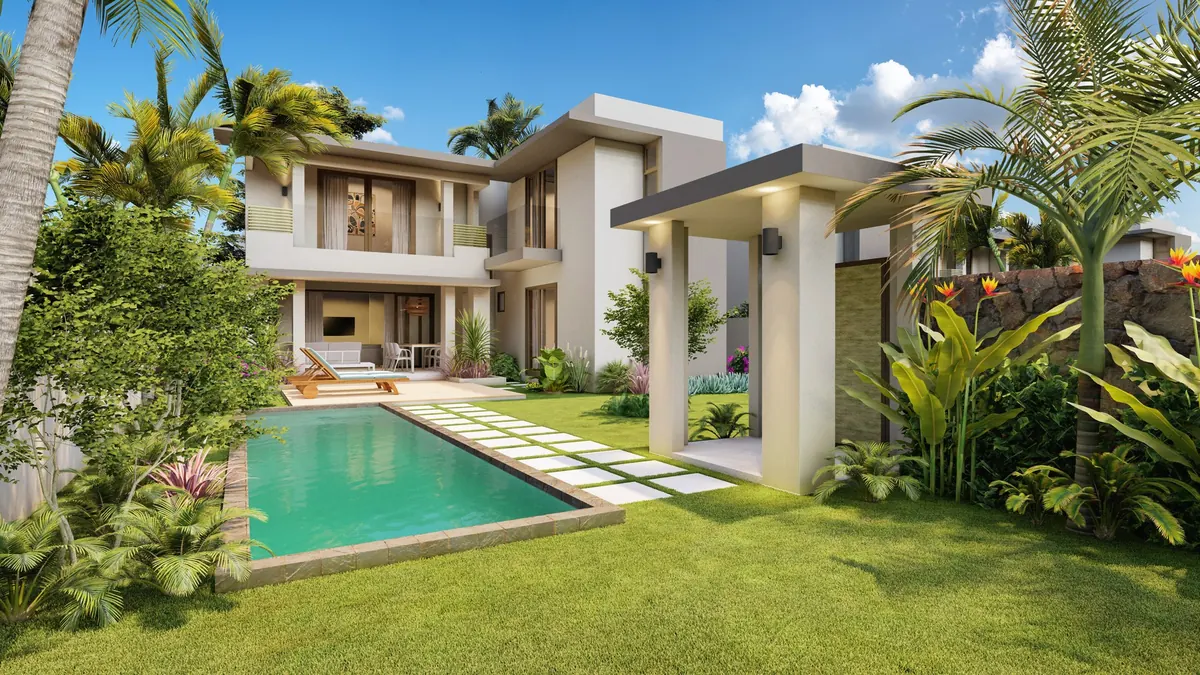 All our properties for saleVillas, apartments, penthouses and land→
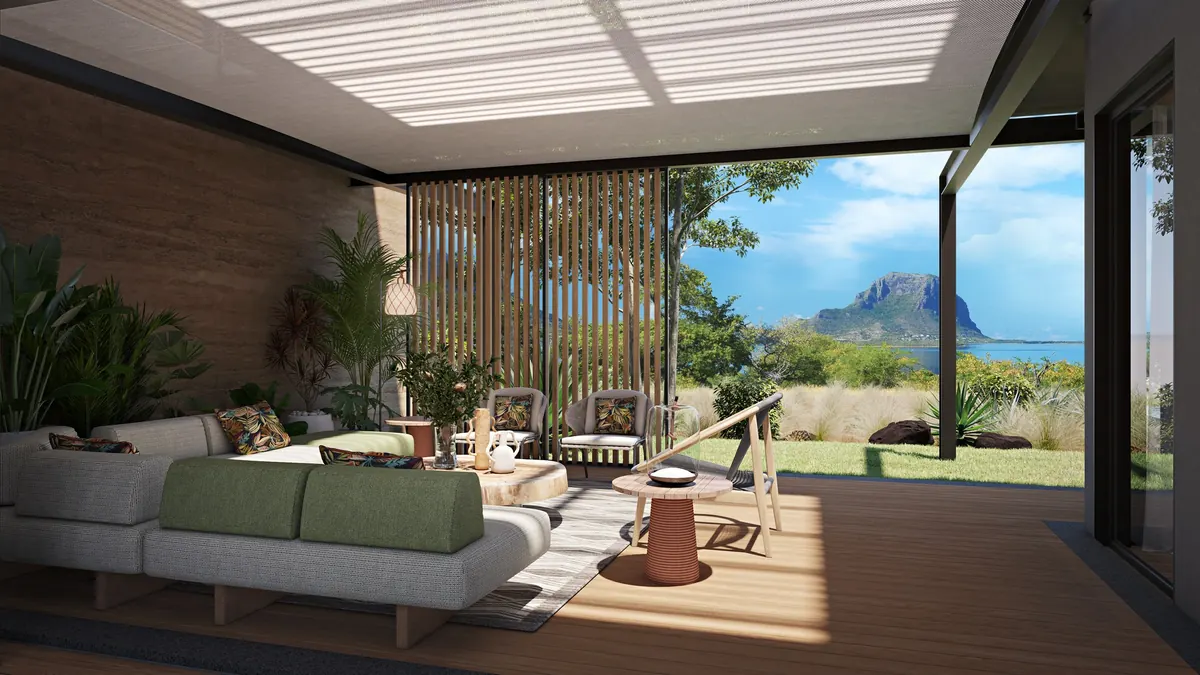 Investing in Mauritius: the guideThe investor’s guide→
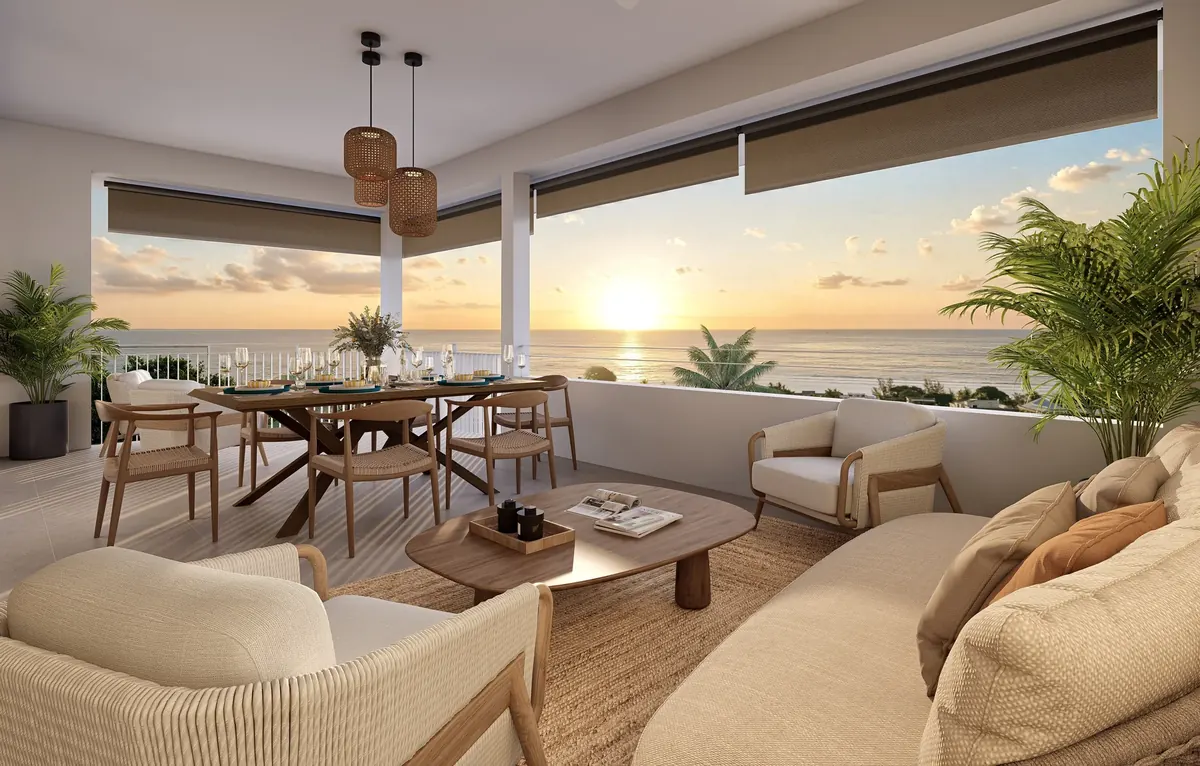 Properties open to foreignersPDS, IRS, RES, Smart City and G+2→
 Land prices, region by regionThe toise explained→
 Our long-term rentalsYear-round, furnished or unfurnished→
11 Frequently asked questions
Your questions on prices and yield
Short answers, before you commit.
Frequently asked questions — property prices and yield in Mauritius
On the properties offered by Westimmo, the median asking price of a villa, an apartment and a penthouse is shown in the table at the top of this page, recalculated regularly. The segment open to foreigners — PDS, IRS, RES and Smart City schemes, G+2 apartments — includes amenities and is generally priced above a typical Mauritian family home.
The median price per m² of living space, for each property type, is shown in the table at the top of this page, based on our current listings. The seafront, the estate’s services (golf, security, hotel-style services) and the acquisition scheme explain most of the gap between two properties of the same size.
On the East coast, the price depends first on direct beach access and on the scheme. The town-by-town table above gives the number of our listings in Belle Mare and, from eight listings, their median price; the Belle Mare guide presents the area and its current properties.
The ranking of towns by median price is shown in the table at the top of this page, kept up to date. The entry point depends on the area, the property type and the acquisition scheme; the West, in Tamarin and Black River, offers the widest range, from small units to prestige villas.
No, prices are the same — but foreigners buy mainly in approved schemes (PDS, IRS, RES, Smart City) and G+2 residences, segments with services that are priced above the standard local market. A purchase in an approved scheme can qualify for a residence permit, under the conditions set by the Economic Development Board; Westimmo tells you those of the scheme you are considering.
As everywhere, there is room for negotiation, especially on resales. On new programmes, the leverage lies rather in the terms (payment schedule, included amenities). Our role as an agency on the ground is precisely to show you the right price, property by property.
No. The prices on this page are asking prices, taken from current listings before any negotiation. A signed price appears in the deed of sale and may differ from it; this is why none of the figures on this page is presented as a completed transaction price.
A median is published only from eight listings. Below that, a few properties are enough to shift the figure, and it would describe those properties rather than the town. The table then shows the number of listings and the note “Fewer than 8 listings: no median published”.
The toise is the unit of area for Mauritian land: one toise is 3.8 m². To get a price per m², divide the price per toise by 3.8; to get an area in toises, divide the m² by 3.8. The land price guide details the conversion and prices by region.
Gross yield is the annual asking rent divided by the price of the property. Net yield first deducts the weeks of vacancy, the costs and the letting fees, then relates the remaining income to the price, or better to the total cost, acquisition costs included. The simulator on the page Investing in Mauritius performs this calculation with your own figures.
The RPPI of Statistics Mauritius tracks the change in prices of houses and apartments actually transacted, base 2019 = 100. It reached 240.9 in the first quarter of 2026, against 237.7 in the previous quarter, an increase of 1.3%, and 1.0% over one year; these figures are provisional. It measures the general market trend, not the price of a property or a town.
The schemes that open purchase to non-citizens mainly involve new upmarket properties: their price follows the international market, their rent follows the local market. The ratio of rent to price is therefore lower than on a more modest property. Our role is to work it out for you property by property, before you sign.