

Sega Dance Lessons in Mauritius: Where to Actually Take One
There's no dedicated sega dance school in Mauritius, but real options exist: hotel sega nights, the Beachcomber ravanne workshop, the Beau Bassin school, and the Festival International Kreol.
There is no dedicated dance school in Mauritius that only teaches sega to the public — that school simply does not exist. What does exist are three real options: the weekly sega nights held by most hotels, the ravanne workshop run by the Beachcomber group, and the ravanne school of the Abaim association in Beau Bassin, which has welcomed visitors since 1986. Traditional Mauritian sega has been inscribed since 27 November 2014 on UNESCO’s Representative List of the Intangible Cultural Heritage of Humanity.
What sega tipik actually is
Sega tipik grew out of the heritage of enslaved Africans and Malagasy people brought to Mauritius during the colonial period. Sung in Creole, it was originally a way to voice exhaustion and homesickness after long days of forced labour, before evolving over time into an expression of joy and Mauritian identity. The dance is built on small steps, moving hips and hands, over a tempo that speeds up gradually through the song. Three instruments carry it: the ravann, a hand-held drum, the maravann, a shaken seed box, and the triyang, a metal triangle.
According to UNESCO’s own inscription file, sega tipik is transmitted “through both formal and informal means”, mostly through participation and direct imitation of more experienced dancers. That is largely why there is no structured dance school comparable to a salsa or tango class: sega is mostly learned by living it, within families and at gatherings.
Where you can actually take a lesson
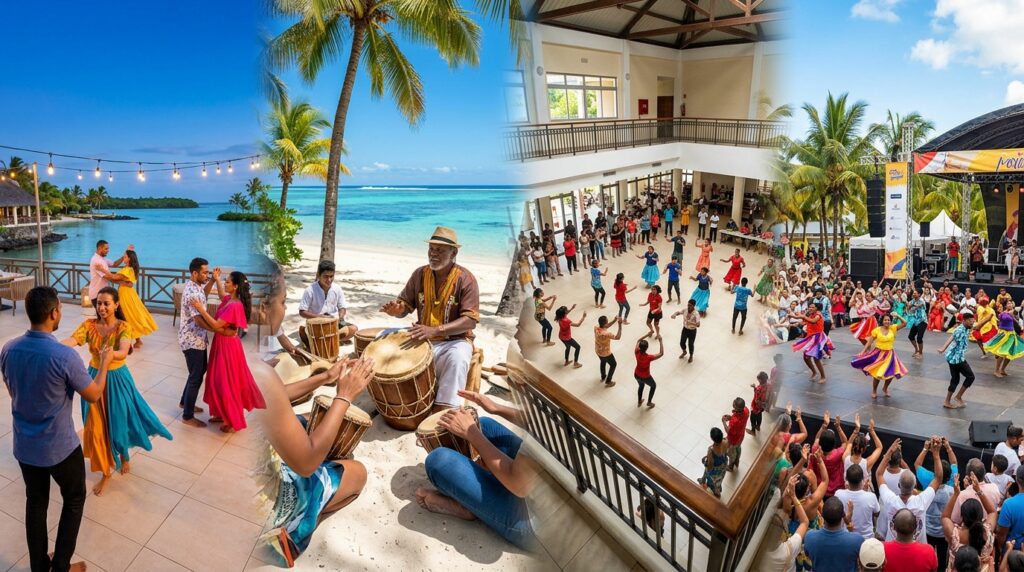
Almost every beach hotel runs a weekly sega night: a group of dancers performs, then invites guests to join them on the floor. It is not a structured lesson, but it is the simplest way to watch the basic steps and try a few moves with no commitment.
Under its Beautiful Local Hands social programme, the Beachcomber hotel group runs a workshop in several of its properties, led by artisans trained in Bambous: participants learn six different hand-tapping techniques on the ravann, then have the option to buy the instrument they made. The sales fund a children’s music school in Rivière Noire.
Founded in 1986 in Cité Barkly, Beau Bassin, the Lekol Ravann run by the Abaim association is the island’s first ravanne school. It teaches the instrument itself and the basics of sega tipik to children and adults alike, Mauritians and foreign visitors included. It is the closest thing to a genuinely structured lesson, well away from performances staged for passing tourists. The association can be reached on (230) 489 4006.
The Festival International Kreol, the yearly gathering
Every year, the Ministry of Tourism and the Mauritius Tourism Promotion Authority organise the Festival Internasional Kreol, bringing together sega tipik evenings, pirogue regattas and culinary showcases across several coastal sites. The most recent edition ran from 5 to 7 December 2025, opening at Mont Choisy, followed by a “Sware Sega Tipik” evening at Trou d’Eau Douce on 6 December, and closing at the Mahebourg waterfront. It is the densest opportunity to watch sega performed by traditional groups outside a hotel setting.
What to know before you try it
Sega is danced barefoot or in light sandals, hips low and steps small and sliding, with feet never lifted high — the arms follow the movement of the hips rather than leading it. The tempo builds through the song, and most of the learning happens by watching, then imitating directly, exactly as UNESCO’s own inscription file describes. Keeping the dance’s origin in mind — born from the pain of slavery before becoming a symbol of joy — also helps in approaching a sega night with the right perspective: it is not simply a brochure version of local folklore.
Depending on your situation
You are visiting for a week or two: your hotel’s sega night, ideally combined with a ravanne workshop, is enough to leave with a genuine first taste.
You have been living in Mauritius for a while and want a regular activity that connects you to local culture: the Abaim Lekol Ravann in Beau Bassin is the most serious route. Other weekend ideas for residents follow the same logic — stepping outside routes built for tourists.
You are settling in with children: the December Festival International Kreol is a good way to introduce them to Creole culture as a family, alongside the extracurricular activities available in Mauritius. Sega is only one expression of that heritage: the page on Mauritian culture and traditions places the dance within a wider picture, as does the calendar of festivals and celebrations on the island.
Frequently asked questions
Is sega tambour from Rodrigues the same dance as Mauritian sega tipik? No. These are two distinct traditions, each inscribed separately by UNESCO: Mauritian sega tipik in 2014, sega tambour of Rodrigues in 2017. The latter is played on a Rodrigues-specific drum, in a different rhythmic style unique to that island.
Is sega tipik the only Mauritian Creole tradition recognised by UNESCO? No. Geet-Gawai, a Bhojpuri pre-wedding song tradition, was inscribed in 2016. Mauritius holds several distinct cultural expressions recognised by UNESCO, carried by different communities on the island.
Do you need to book a hotel ravanne workshop in advance? In most cases these workshops follow each property’s own schedule rather than a fixed permanent slot, so it is worth checking with reception or the entertainment team as soon as you arrive.
Sources and verification
Planning a property project?
Let’s talk about your project in Mauritius
Westimmo guides you through the analysis, selection and securing of your property project in Mauritius.