


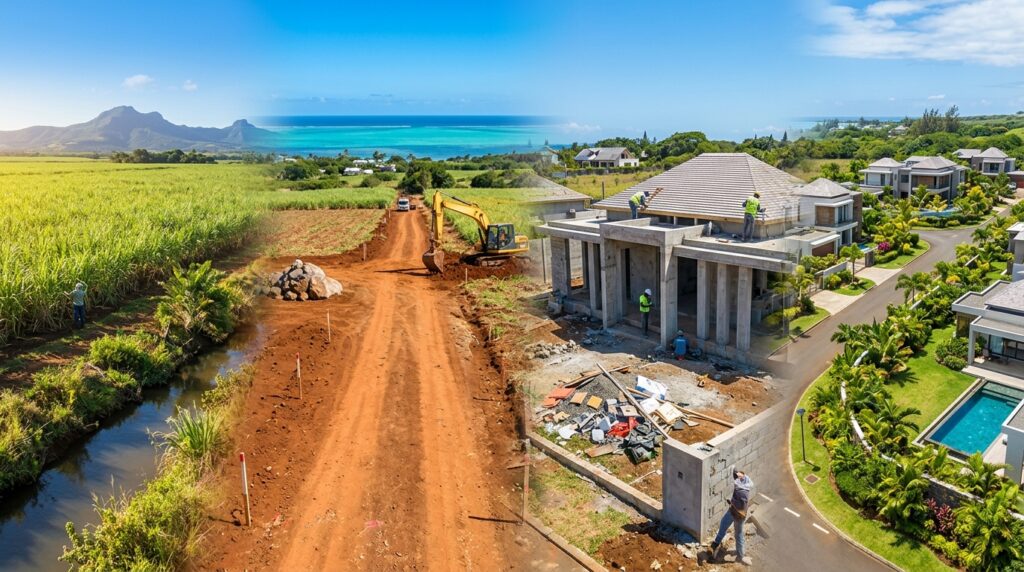
Converting Agricultural Land in Mauritius: Permit, Tax and Exemptions
Ministerial authority, a tax of Rs 250,000 to 3,500,000 per hectare and an exemption up to 2 hectares: what Mauritian law says about converting agricultural land.
Agricultural land in Mauritius does not become buildable by the owner’s decision alone. The law requires the written authority of the Minister of Agro-Industry and payment of a land conversion tax, unless an exemption applies. The main exemption covers owners whose total landholding does not exceed 10 arpents (4.221 hectares): they may convert up to 2 hectares (4.7392 arpents) without applying for a conversion permit, provided the land lies in an area where development is permitted under the planning documents. Outside the exemption, the tax runs from Rs 250,000 to Rs 3,500,000 per hectare depending on the area converted and the category of the land.
When is a conversion authority required?
The regime sits in Part V of the Sugar Industry Efficiency Act 2001. Section 28 forbids putting agricultural land to non-agricultural use unless three conditions are met: the prior written authority of the Minister, payment to the Registrar-General of the land conversion tax set by the Twelfth Schedule, and, for a non-citizen, a certificate issued under section 3(2) of the Non-Citizens (Property Restriction) Act.
The definition of agricultural land is wider than a working cane field. The consolidated text covers land that is or has been under cultivation, land declared an irrigation area under the Irrigation Authority Act, and land subdivided for agricultural purposes under the Morcellement Act. Cultivation includes sugar cane, tea, food crops such as vegetables and fruit, and medicinal and ornamental plants. A plot left fallow for years can therefore remain agricultural land in the eyes of the law.
The exemption for small landowners
Section 28(4A) lifts the authority requirement for an owner whose land, wholly or partly agricultural, does not exceed 10 arpents in total. There are two routes:
- convert up to 2 hectares (4.7392 arpents) in total, with no conversion permit;
- convert, with the approval of Landscope (Mauritius) Ltd, up to 10% of the land for residential or commercial use.
The second route was added by the Finance Act 2020. According to Landscope’s guidelines, approval is granted only if the remaining 90% carries a valid agricultural project, or if the owner undertakes to place it in Landscope’s land bank for a period not exceeding 10 years, in which case Landscope leases it at an agreed rate.
In both cases, three conditions apply to the land itself:
- it must lie in an area where development is permitted under an outline scheme or the policies of a development plan;
- it must not lie within an irrigation area;
- it must not come from a subdivision made for agricultural purposes.
The 4.221-hectare ceiling is measured across all of the owner’s land, agricultural or not. An owner above 10 arpents does not qualify. An owner of 10 arpents or less who wants to convert more than 2 hectares is exempt for the first 2 hectares and must apply for a permit for the rest, according to the Ministry’s note.
An exempt owner applies directly to the local authority for a Building and Land Use Permit, and to the Morcellement Board if the plot is to be subdivided. The law also waives, for that owner, the fees of section 9 of the Morcellement Act, and, on a sale, the tax under Part III of the Land (Duties and Taxes) Act and the transcription fee. The deed of sale must then contain a declaration by the seller on these conditions. The buyer, and later buyers, are not subject to the conversion procedure. The declaration is written into the deed: prepare it with the notary before signing.
Applying for a conversion permit: procedure and timelines
Beyond the exemption, the owner files the application on the National E-Licensing System, following the Ministry’s guidelines. A typical file includes a copy of the title deed, a site and location plan drawn up by a sworn land surveyor, the owners’ identity cards and, where relevant, an affidavit of succession. The Ministry’s guidelines, older than the current law, still mention registered post to Port Louis: confirm the current channel with the Land Conversion Unit before filing.
The statutory deadlines look short on paper:
- the committee secretary notifies within 3 working days whether the file is complete;
- for an incomplete file, the applicant has at most 8 working days to complete it;
- the Land Conversion Committee gives its advice within 6 weeks of the effective date, meaning the date the file is complete;
- the Minister grants or refuses in writing within 2 weeks of that advice.
The committee brings together representatives of the ministries for agriculture, lands, environment and public utilities, the Mauritius Cane Industry Authority, the Sugar Insurance Fund Board, the Irrigation Authority, the local authority concerned and the Land Drainage Authority. It meets at least once a month. These are the deadlines in the text: they do not include time spent completing a file, and the Ministry does not publish an observed average duration.
The committee assesses each application against six criteria set by section 28(5): the level of sugar production needed to meet Mauritius’s commitments, preserving agricultural land, optimising agricultural production, preventing speculation in agricultural land, respecting outline schemes and planning directives, and preserving irrigation areas. Where an application does not comply with planning policy guidance, it may also direct the owner to amend it into a mixed development, with a defined share of residential, commercial, leisure and social uses.
The land conversion tax: rates and exemptions
The tax is set by the Twelfth Schedule of the Act, in rupees per hectare. There are two categories, depending on the area converted.
| Area converted | Category I | Category II |
|---|---|---|
| Less than 0.25 ha | 250,000 | Nil |
| 0.25 ha to less than 0.50 ha | 500,000 | 50,000 |
| 0.50 ha to less than 1 ha | 1,000,000 | 250,000 |
| 1 ha to less than 5 ha | 2,000,000 | 1,000,000 |
| 5 ha and above | 3,500,000 | 1,500,000 |
Category I applies in particular to a plot that formed part, on 1 January 1991, of a larger agricultural holding exceeding 25 arpents (10.5522 hectares), whether or not subdivided since; to land divided for agricultural purposes where conversion is applied for within 5 years of the transcription of the deed of division; to land owned by a company, société or partnership engaged in buying and selling land; and to Smart City projects under the Economic Development Board Act 2017. Any other agricultural land falls under Category II. The area converted includes stone heaps, in-field access roads and buildings used for agricultural production. Where one person carries out several conversions, the tax due is the difference between the recalculated total and what has already been paid.
The text gives no worked example. Have the exact amount for a given file confirmed by the Land Conversion Unit and the notary before committing, because the category depends on the history of the land.
No tax is payable in a list of cases set by section 29. For an individual, the most common is building a residence for personal occupation on a plot of no more than 450 square metres. The list also includes approved housing schemes of the National Housing Development Company, certain social housing, and some business, education and health projects.
Payment can be spread over 4 equal six-monthly instalments: the first when the authority is granted, the other 3 secured by a bank guarantee or by a privilege registered on the land. Instalments carry interest at 3% a year above the key rate. Without instalments, the tax must be settled within 6 months of the authority, failing which the authority lapses.
After authorisation: the deadlines that cost you the right
The authority does not last indefinitely. Under paragraph 8 of the Twelfth Schedule, the holder must:
- endeavour to obtain all necessary permits, including the Building and Land Use Permit, within 2 years of the authority;
- start the conversion within 6 months of the last permit obtained;
- complete the project, as described in the authority, within 5 years of that last permit.
If work does not start or finish within these periods, the authority lapses automatically. After a lapse, no new application for the same land is considered for 6 months. These deadlines do not apply where the conversion is to build a home for the applicant’s own use or that of an ascendant or descendant.
The building permit is still to be obtained
Conversion changes the land’s use, not its building rights. The Building and Land Use Permit is issued by the local authority, separately from the conversion. The Ministry of Local Government’s guide, in its June 2013 edition, provides that for an agricultural site the application is accompanied either by the land conversion certificate or by a declaration of exemption. For what follows, see how to build a villa in Mauritius.
What this means for a buyer, especially a foreign one
Buying agricultural land counting on a later conversion is a gamble: nothing guarantees the authority, and the tax comes on top of the price. Before signing, a buyer checks three points: whether the plot is classed as agricultural under the law, whether it lies in a development zone or an irrigation area, and whether the seller qualifies for the 2-hectare exemption, which spares the purchaser the procedure.
For a non-citizen, section 28(1)(c) also requires the certificate provided by the Non-Citizens (Property Restriction) Act, in addition to the conversion authority. The general framework for foreigners buying land is set out in can a foreigner buy land in Mauritius. If the land is to be divided into lots, the subdivision procedure comes on top: it is described in buying land in a morcellement. Going prices are covered in land prices in Mauritius and, more broadly, property prices in Mauritius.
Mistakes to avoid
- Building on land still classed as agricultural without authority or exemption: section 28(1) forbids it.
- Assuming a fallow plot is no longer agricultural: the law also covers land that has been cultivated.
- Forgetting that the 2-hectare exemption requires an owner of 10 arpents or less, in a development zone, outside an irrigation area and outside an agricultural subdivision.
- Letting the deadlines run: 6 months to pay the tax, then 2 years, 6 months and 5 years for permits, start and completion.
- Relying on an old version of the law: the text has been amended several times, including by Act No. 18 of 2025, and the version in force should be checked on the laws portal before filing.
Sources and verifications
- Mauritius Revenue Authority: Sugar Industry Efficiency Act 2001, consolidated text (Part V, sections 27 to 29, Twelfth Schedule)
- Ministry of Agro-Industry, Food Security, Blue Economy and Fisheries: Land Conversion Unit
- Ministry of Agro-Industry: guidelines and procedures for submission of application for Land Conversion Permit
- Ministry of Agro-Industry: exemption from application for land conversion permit up to 2 hectares
- Landscope (Mauritius) Ltd: guidelines for conversion of up to 10% of land
- Ministry of Local Government and Outer Islands: Building and Land Use Permit Guide (June 2013)
Planning a property project?
Let’s talk about your project in Mauritius
Westimmo guides you through the analysis, selection and securing of your property project in Mauritius.