


The flamboyant tree in Mauritius: origin, bloom and where to see it
The flamboyant came from Madagascar and blooms for a few weeks from the start of the southern summer. Origin, flowering, where to see it and other emblematic trees.
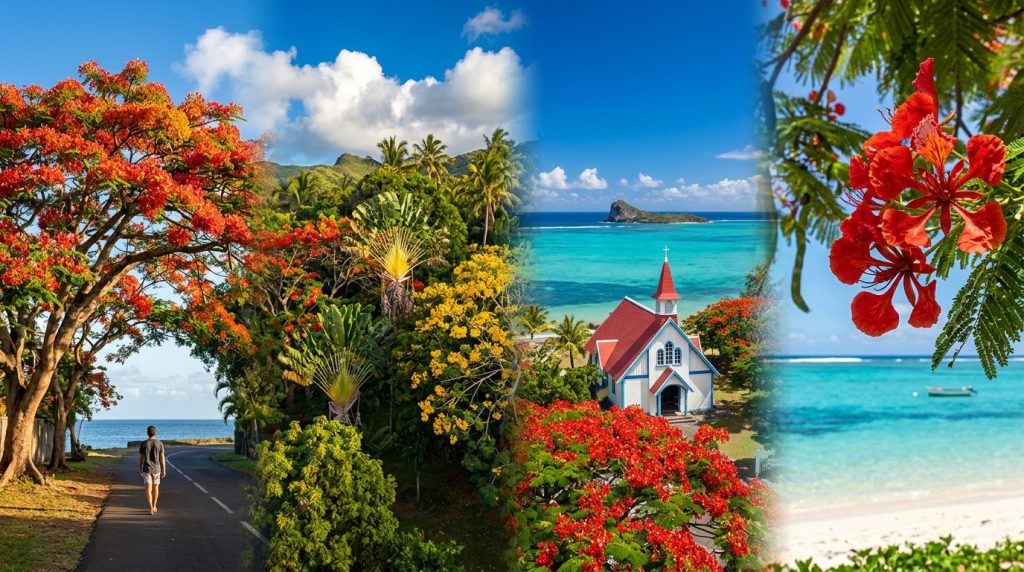
The flamboyant (Delonix regia), also called the royal poinciana, is the tree most closely tied to the Mauritian summer. It bursts into red flower for a few weeks around the end of the year, and some Mauritians call it the “Christmas tree”. It is not native: it comes from Madagascar. It blooms earlier in the north than in the south, and the display does not last long.
Where does Mauritius’s flamboyant come from?
The botanist Wenceslas Bojer (1795–1856) found a flamboyant near Foulpointe in Madagascar in 1824 and sent seeds to Mauritius, to the Pamplemousses garden. Cláudia Baider, who heads the Mauritius Herbarium, confirms the tree’s Malagasy origin. Bojer first took the species for a cultivated plant because it grew near houses, and no other flamboyants were found in Madagascar until 1932.
Bojer also set up the island’s first herbarium, and one avenue in the Pamplemousses garden bears his name. Our guide to visiting the garden covers what you can see there.
When does the flamboyant bloom in Mauritius?
It flowers at the start of the southern summer, for only a few weeks. The red spreads across the north first and reaches the south more slowly, so there is no single date that holds across the island. In January the tree puts out its pale green leaflets again. The flowers drop quickly and carpet the ground under the branches.
The bloom coincides with the festive season. For ideas at that time of year, see Christmas in Mauritius.
Two different flamboyants
Two trees share the name in Mauritius, and people often mix them up.
- The giant flamboyant (Delonix regia) comes from Madagascar and reaches about 10 m. Its broad, fern-like canopy casts deep shade, and it does best in dry, coastal areas. In Mauritius you can find it in red, orange and yellow, with yellow the rarest.
- The dwarf flamboyant (Caesalpinia pulcherrima) comes from tropical America and stands 2.5 to 3 m tall. Its flowers range from orange to pink, sometimes white. You mostly see it in gardens, courtyards and public spaces.
Where to see flamboyants
Flamboyants line streets and shade squares all over the island. A few places to start:
- outside Notre-Dame Auxiliatrice church in Cap Malheureux (see living in Cap Malheureux);
- the square at Saint-François Xavier church in Port Louis;
- the Triolet bus station;
- the road from Médine to Bambous, where the branches meet over the tarmac, and near the Médine sugar mill, a favourite with photographers (see living in Cascavelle and Médine);
- the road down to Albion (see living in Albion);
- Flic en Flac beach, where they give shade (see living in Flic en Flac).
A tree in everyday Mauritian culture
Children have long played with the flamboyant. In “casse-flamboyant”, each player tries to snap the head off a friend’s flower bud without losing their own. The seeds were turned into small instruments like maracas and into other crafts that people still enjoy.
Other trees you will notice in Mauritius
The flamboyant is not the only introduced tree that has shaped the landscape.
- The Indian almond, or badamier (Terminalia catappa), which the Pamplemousses garden describes as a splendid shade tree: its large glossy leaves turn bright red, then yellow, and fall around September.
- The talipot palm (Corypha umbraculifera), from India and Sri Lanka. The Sinhalese prince Ehelepola, exiled to Mauritius by the British in 1825, brought it to the island. The first plant to arrive flowered in the 1920s. Its flower cluster is the largest in the plant kingdom, and the palm dies soon after setting seed. The Pamplemousses garden holds at least eighty palm species, eight of them endemic to the Mascarenes.
- The crape myrtle (Lagerstroemia indica) and teak, two trees from India planted at Pamplemousses. The crape myrtle carries sprays of pink flowers.
- The casuarina, or filao (Casuarina equisetifolia), planted along the coast in the 1970s to protect beaches. It is an exotic species, and its role is debated. A sustainable-development consultant criticises its shallow roots, which hold sand poorly, and a 2022 government-commissioned study says casuarinas can make erosion worse when planted too close to the sea. An oceanographer takes a more measured view: they are not the main cause of erosion, and he would remove them only where the roots are exposed and a tree might fall.
For endemic trees, the Ebony Forest in Chamarel is a better starting point: see our article on the Ebony Forest.
A large tree on your plot: what to check
A flamboyant or an Indian almond shades a house, but a big tree needs watching: branches, roots close to foundations or pipes, and the chance of a fall. On a plot near the sea, look at the casuarinas too: where their roots show, they can come down. Our article on beachfront property explains what to examine on that kind of property.
Before you cut down a large tree, ask the forestry authorities. A 2024 regulation (GN No. 238) requires written authority to cut a protected plant on State land, private forest land or reserves. The text does not list the species it covers, so find out whether your tree is one of them before acting.
Sources and verifications
- L’Express (Port Louis), “Le flamboyant géant et le flamboyant nain”, 23 November 2025, via AllAfrica
- L’Express (Port Louis), “Le filao, un rempart culturel qui fait débat”, 25 December 2025, via AllAfrica
- Beachcomber Magazine no. 6, page 72 (flamboyant, Bojer, Cláudia Baider)
- Beachcomber Magazine no. 6, page 75 (Bojer, Médine, Cap Malheureux)
- Beachcomber Magazine no. 6, page 76 (flowering, locations)
- Sir Seewoosagur Ramgoolam Botanic Garden, “Palms” page
- Sir Seewoosagur Ramgoolam Botanic Garden, “Other Features” page
- Forests and Reserves (Protection of Protected Plants) Regulations 2024, GN No. 238 (FAOLEX)
Planning a property project?
Let’s talk about your project in Mauritius
Westimmo guides you through the analysis, selection and securing of your property project in Mauritius.