


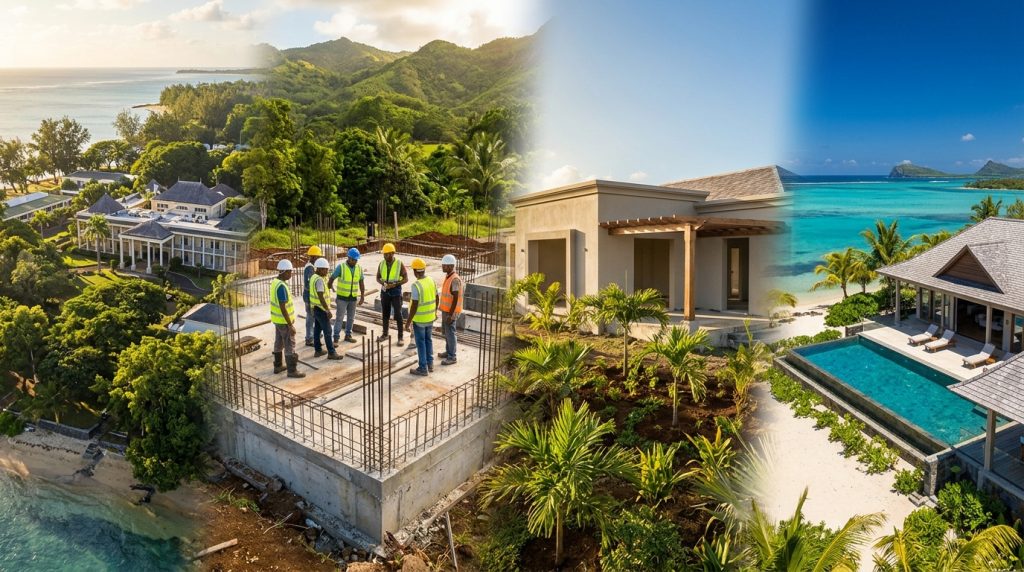
Building a House in Mauritius: Permit, Steps and Budget
What the law requires to build in Mauritius: the BLUP permit, deadlines, registered contractors, occupation certificate and budget pointers.
To build a house in Mauritius you first need a Building and Land Use Permit (BLUP): the law bars any development works without one. The application is free to file, is made online to the district council or municipality, and the permit committee must decide within 14 working days. Once the house is finished, you need an occupation certificate before anyone moves in, or face a fine of Rs 10,000 to 50,000. No official scale gives a price per m², so the budget has to rest on quotes, at a time when the cost index for a single-family house is rising by around 4.5% a year.
The steps of a building project, in order
- Secure the land. A non-citizen cannot buy just any plot: see buying land in Mauritius as a foreigner.
- Check the plot for flood risk, drainage and sewage, and whether it is agricultural land.
- Have an architect draw the plans, then choose a contractor.
- Obtain the BLUP.
- Tell the council in writing before work starts, then build under inspection.
- Apply for the occupation certificate when work ends, before you move in.
Can a foreigner build a house?
Yes, but only on land they are allowed to acquire: a serviced plot in a Smart City, a plot within a PDS or IRS estate, or land held under a long lease. In an estate you also buy into an architectural charter covering heights, materials and build deadlines, so read it before reserving the plot. The three routes are set out in our guide to land for foreign buyers. For a plot in a subdivision, the morcellement permit determines what is actually serviced. Agricultural land cannot be built on without prior conversion.
The building permit: what the law says
Section 117 of the Local Government Act 2011 sets the rule: no development works without a Building and Land Use Permit. You apply through the National Electronic Licensing System to the district council or municipality for the area. The Act states that no application fee is payable, though a fee set by the council is payable when the permit is issued.
The application is assessed against several laws: the Construction Industry Authority Act 2023, the Town and Country Planning Act, the Planning and Development Act, the Environment Act 2024, the Mauritius Fire and Rescue Service Act and the Climate Change Act 2020. The Central Electricity Board, for its part, asks for scaled drawings: a location plan, a site plan, a plan view, two elevations facing the access roads and the sections, all bearing the architect’s signature or seal.
How long does the permit take?
The legal timetable is tight. Within 8 working days of receipt, the council can ask for further documents and must issue an acknowledgement. Where an authority has to give clearance (health, electricity, water, sewage), it has 5 working days, and its silence counts as consent. The permits committee must then approve or refuse within 14 working days, giving reasons for any refusal.
If that deadline is missed by more than 2 working days, the application is deemed approved once the fee is paid, except in certain cases, including land in the buffer zones of the Aapravasi Ghat site. A refusal can be appealed to the Environment and Land Use Appeal Tribunal within 21 days. These are the statutory deadlines: they do not cover drawing up the plans, supplying missing documents or arranging finance. Industry professionals note that several months can pass between design, approvals, financing and the start of work.
The permit lapses after 3 years if nothing has started
A BLUP lapses 3 years after it is issued unless certain works have been carried out. For a ground-level building, the external walls must be raised to at least 600 mm above the floor slab. The Act also counts backfilling the foundation excavations to avoid standing water. Do not take out a permit you do not plan to use soon.
During construction: notice and inspections
The permit holder must tell the council in writing before work begins, follow the permit conditions and comply with the rules of the fire service, the sanitary authority and other bodies concerned. An authorised officer inspects the site regularly in the holder’s presence and records each visit in a log book that both sign. Ask for a copy of these entries: they show the work followed the permit.
Choosing a contractor: CIA registration
Under the Construction Industry Authority Act 2023, no individual or firm may carry out construction works in Mauritius without being registered with the Construction Industry Authority. Only micro-contractors are exempt: citizens carrying out works worth less than Rs 1 million excluding VAT per contract. For a whole house, you will therefore be dealing with a registered contractor. The authority publishes a list of registered stakeholders and a tool for checking certificates. Our guide to hiring a contractor explains who to call depending on the size of the job.
The budget: why there is no reliable price per m²
No official body publishes a construction price per m² for a villa. What exists is an index: according to Statistics Mauritius, as reported by L’Express in April 2026, the input cost index for a single-family house stood at 151.6 in March 2026, against 145.1 a year earlier, a rise of about 4.5%. Labour, ready-mix concrete and aluminium joinery are pushing it up.
A contractor quoted by L’Express in September 2026 puts a mason’s pay at Rs 2,000 to 2,500 a day and says cement rose 5% at the start of the year. Prices do not all move the same way: tiles and granite have eased slightly, as have steel bars over the year. A quote drawn up at design stage may therefore no longer match real costs a few months later.
To set a budget, ask two or three registered contractors for an itemised quote on the same plans, separating structure, finishes, utility connections and the architect’s fees. Agree in writing who bears any rise in material prices after signing: some contractors say they cannot pass increases on once the contract is signed. Keep a margin for the unexpected. To compare with buying, see property prices in Mauritius and new developments: building is not always cheaper than buying a finished house.
What depends on your plot
Three features of the plot affect both cost and permit. In a flood-prone area, the permit may require drainage or a raised building level: see flood risk when buying property. Without a sewer, you must plan for on-site sanitation: see septic tank or sewer. And if you want to generate your own power or collect rainwater, look at the eco-friendly home in Mauritius at the drawing stage. In an approved subdivision, the Act removes the need for clearances from the Central Electricity Board, the Central Water Authority and the Waste Water Management Authority, subject to the conditions of the morcellement permit.
Finishing the build: the occupation certificate
A building erected under a BLUP may not be inhabited, used or occupied without an occupation certificate issued by the council (section 120C). The permit holder applies once construction is complete. For 150 m² or more, the application must come with a clearance certificate issued by the principal agent, confirming the house was built in line with the permit. If the permit has been complied with and any insurance premiums due have been paid, the council issues the certificate within 5 working days. Living in the house without it is an offence, punishable by a fine of Rs 10,000 to 50,000, and the date of the certificate counts as the date of occupation. A future buyer will ask you for it if you sell: see buying an existing house.
Mistakes to avoid
- Paying a deposit on a plot outside the authorised framework, planning to regularise it later: without an approved scheme or authorisation, the sale to a non-citizen is not possible.
- Starting work before the permit, or without giving the council written notice.
- Departing from the approved plans during construction: this is what the architect later certifies, for houses of 150 m² and over.
- Handing the whole house to someone not registered with the CIA.
- Moving in before the occupation certificate.
Sources and checks
- Local Government Act 2011 (consolidated text, sections 117 to 120C) – Mauritius Revenue Authority
- Building and Land Use Permit – Central Electricity Board
- Criteria for Registration – Construction Industry Authority
- Obtaining the Building and Land Use Permit – Mauritius Chamber of Commerce and Industry
- Pression persistante sur le secteur du bâtiment (cost index, Statistics Mauritius) – L’Express via AllAfrica
- Bâtir son logement, un rêve qui coûte de plus en plus cher – L’Express via AllAfrica
Planning a property project?
Let’s talk about your project in Mauritius
Westimmo guides you through the analysis, selection and securing of your property project in Mauritius.