


Sea Turtles in Mauritius: Where to See Them, and What the Law Bans
Two sea turtle species live in Mauritius's lagoons. Where to find them, what the Fisheries Act 2023 bans outright, and why the rule was tightened after a 2022 incident.
Two species of sea turtle live in Mauritian waters, the green turtle most often and the hawksbill more rarely. Swimming with them for recreation, touching them, feeding them or chasing them is a criminal offence, not a grey area: it is written into the Fisheries Act 2023, and an operator who ignores it risks a great deal more than a warning.
The two species you actually meet
The green turtle (Chelonia mydas) is the one most often seen: a shell that can exceed a metre, an olive-brown to greenish colour, and a diet made up almost entirely of algae and seagrass. The hawksbill (Eretmochelys imbricata) is slimmer and easy to recognise by its pointed, hook-like beak, and stays closer to coral heads where it feeds on sponges. Both are listed as endangered by the International Union for Conservation of Nature, which is the reason behind the level of protection they receive in Mauritius.
Where to look
No spot guarantees a sighting: unlike the dolphins of Tamarin Bay, turtles move around according to where they are feeding. Encounters are still more frequent in a handful of shallow, seagrass-rich lagoons: the lagoon at Trou aux Biches, the one at Pereybère in the north, the Blue Bay marine park near Mahébourg, and the bay at Flic-en-Flac on the west coast. A 2013 study published in the Marine Turtle Newsletter, covering 116 sightings recorded between 2009 and 2012 on the southwest coast, placed most encounters at depths under 50 metres, with a particular concentration in Black River Bay, where seagrass beds and reefs form an important feeding ground for both species.
What the law actually bans
The Fisheries Act 2023, which repealed and replaced the earlier 2007 Fisheries and Marine Resources Act, devotes its section 33 to protected species. Section 33(1)(d) bans fishing, storing, landing, selling or possessing a marine turtle, its eggs or its shell, dead or alive. Section 33(3)(a) goes further and targets tourism directly: no one may “take, swim with as a recreational activity, harass, intentionally feed or intentionally kill any marine turtle on shore or at sea.” A written authorisation can lift these bans, but only for scientific, breeding or conservation purposes.
The offence sits at level 3 of the Act’s fine scale, with a legal ceiling of 25 million rupees and up to two years in prison — a maximum, not a routine amount. One distinction matters here: simple possession under section 33(1) can be settled with a fixed penalty of 5,000 rupees, while swimming with or feeding a turtle for recreation under section 33(3) carries no such option and goes straight to full prosecution.
Why the rule was tightened
The ban on swimming with turtles did not come out of nowhere. On 25 January 2022, the ministry then in charge (its fisheries mandate now sits within the Ministry of Agro-Industry, Food Security, Blue Economy and Fisheries) issued a notice after finding that, in the lagoon at Trou aux Biches, around twenty boats were circling the same turtles every day between 9am and midday and again from 4pm to 5pm: operators were feeding them to keep them in place, and swimmers were chasing them to touch or grab their shells and take photographs. The ministry stated plainly that sea turtles are wild animals, not tame attractions. The same ban carries through unchanged into the 2023 Act.
Nesting, now a rare event in Mauritius
Nesting on the beaches of the main island has almost disappeared since the 1970s, driven out by artificial coastal lighting, beach traffic and coastal erosion. The 2013 study cited above records only a single nesting event since then, in 2007 at Gris-Gris beach, and places the real breeding grounds on the outlying islands of St Brandon and Agalega rather than on the mainland coast.
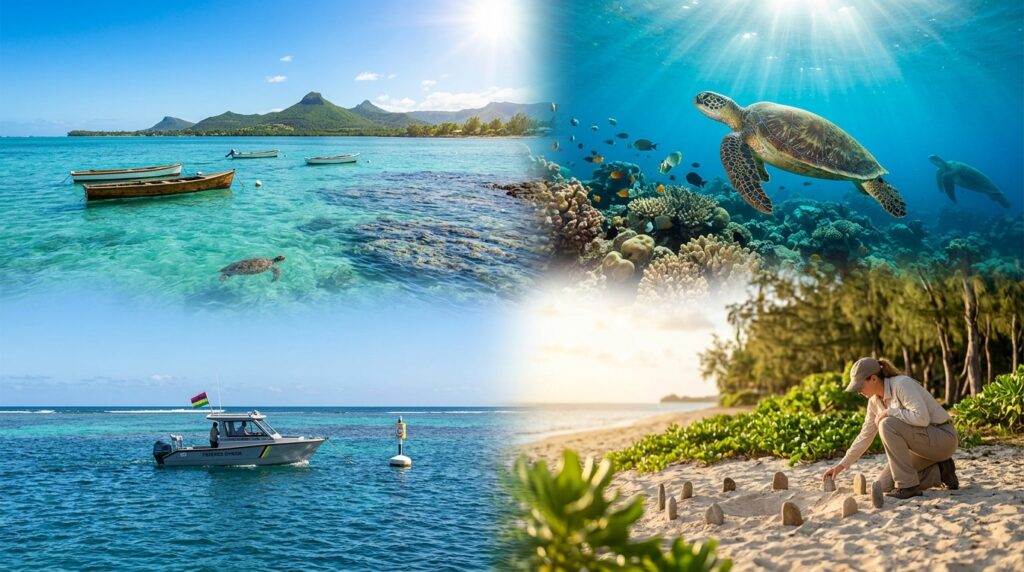
A nest did resurface on 24 February 2026 on a west-coast beach in front of a hotel: a tourist spotted eggs in good condition and reported them to the ministry the next day. The ministry immediately activated the Stranded Mammal and Marine Turtle Action Plan, the national protocol built for exactly this situation: sand was piled over the nest to shield it from sun and predators, the area was fenced off with bars and warning tape, the Fisheries Protection Service organised daily checks morning, noon and evening, and scientific monitoring was scheduled through the roughly 45 days leading to hatching.
Depending on what you are doing
Booking a boat trip in the lagoon: turn down any excursion marketed as a “turtle swim” or a “guaranteed encounter” — the operator offering it is breaking the law, and you become part of the problem. A responsible trip simply observes from a distance, without slowing down over a turtle or cutting across its path.
Snorkelling on your own at a spot like Trou aux Biches or Blue Bay: if a turtle surfaces near you to breathe, stay still and let it move off on its own. Photographing it is fine; following it to get closer is not.
Finding a nest or a distressed turtle on a beach: do not move or handle it yourself unless it is in immediate danger, and contact the relevant authorities straight away rather than dealing with it alone — exactly the scenario the 2026 national plan handled within hours.
Frequently asked questions
Does this law cover the giant land tortoises seen at La Vanille Nature Park or Île aux Aigrettes? No. Those are Aldabra giant tortoises, a land species native to the Seychelles and introduced into Mauritius through conservation programmes. The Fisheries Act only governs marine species; land tortoises fall under separate protected-wildlife rules.
Can a foreign tourist actually be fined? Yes. The law applies to anyone in Mauritian waters, resident or visitor, and Fisheries Protection Service officers have actively patrolled the busiest lagoons since the Trou aux Biches case.
Is there anywhere to see sea turtles legally up close? No site in Mauritius currently allows that in the wild: the only lawful interaction is distant observation while snorkelling or on a compliant boat trip.
Sources and verification
- Mauritius National Assembly — full text of the Fisheries Act 2023, section 33 and the fine schedules (Fourth Schedule, Fifth Schedule)
- Tourism Authority of Mauritius — 25 January 2022 notice banning swimming with, feeding and harassing sea turtles
- Marine Turtle Newsletter — green and hawksbill turtle observations on Mauritius’s southwest coast (2009-2012)
- AllAfrica — discovery and protection of a sea turtle nest on Mauritius’s west coast, 24-25 February 2026
- InforMEA / UNEP — current name of the Mauritian Ministry of Agro-Industry, Food Security, Blue Economy and Fisheries
Planning a property project?
Let’s talk about your project in Mauritius
Westimmo guides you through the analysis, selection and securing of your property project in Mauritius.