


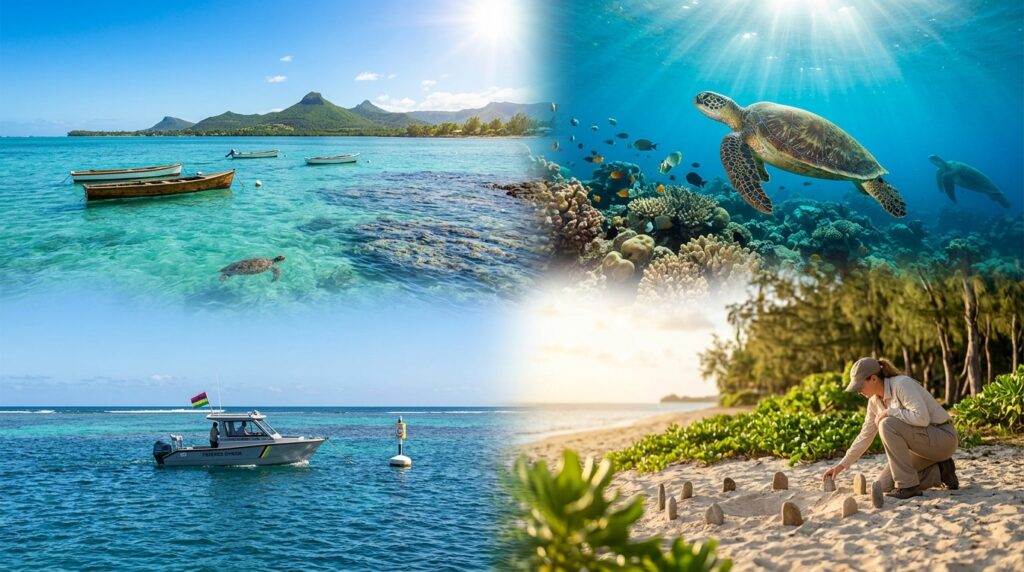
Sea Turtles in Mauritius: Where to See Them and What the Law Bans
Two sea turtle species are found in Mauritius's lagoons. Where to see them, what the Fisheries Act 2023 prohibits, and why the rules were tightened after 2022.
Two species of sea turtle are found in Mauritian waters: the green turtle most often, and the hawksbill turtle less frequently. The law strictly prohibits recreational swimming with them, touching them, feeding them or chasing them. This is stated explicitly in the Fisheries Act 2023and an operator who ignores it risks far more than a simple warning.
The two species found in the lagoon
The green turtle (Chelonia mydas) is the more common of the two: its shell can exceed one metre, its colour ranges from olive-brown to greenish, and its diet consists almost entirely of algae and seagrass. The hawksbill turtle (Eretmochelys imbricata), slimmer and recognisable by its pointed, hooked beak, is more often found near coral heads where it feeds on sponges. Both species are classified as endangered by the International Union for Conservation of Nature, which explains the level of protection they receive in Mauritius.
Where to see them
There is no site where a sighting is guaranteed. Unlike the dolphins of Tamarin Bay, turtles move according to where they feed. Encounters are nevertheless more frequent in a few shallow lagoons rich in seagrass: the lagoon at Trou aux Biches, the lagoon at Pereybère in the north, Blue Bay Marine Park near Mahébourg, and the bay at Flic-en-Flac in the west. A study published in 2013 in the Marine Turtle Newsletterbased on 116 observations recorded between 2009 and 2012 on the southwest coast, found that most encounters occurred at depths of less than 50 metres, with a particular concentration in Rivière Noire (Black River Bay), where seagrass beds and reefs provide an important feeding area for both species.
What the law specifically prohibits
The Fisheries Act 2023which repealed and replaced the former Fisheries and Marine Resources Act of 2007, devotes Section 33 to protected species. Section 33(1)(d) prohibits fishing, storing, landing, selling or possessing a sea turtle, its eggs or its shell, alive or stuffed. Section 33(3)(a) goes further and specifically addresses tourism: no person may take, swim with for recreational purposes, harass, intentionally feed or intentionally kill a marine turtle, on land or at sea. Written authorisation may lift these prohibitions, but only for scientific, breeding or conservation purposes.
The offence falls under Level 3 of the Act’s penalty scale, where the legal maximum is a fine of 25 million rupees and up to two years’ imprisonment – a maximum, not an automatic sentence. One important distinction separates the two parts of Section 33: simple possession under 33(1) may be dealt with by a fixed penalty of Rs 5,000 paid directly, whereas recreational swimming with or feeding a turtle under 33(3) is not eligible for that option and exposes the offender to the full procedure.
Why the rule was tightened
The ban on swimming with turtles did not appear without reason. On 25 January 2022, the ministry then responsible for the matter, now part of the Ministry of Agro-Industry, Food Security, Blue Economy and Fisheries, issued a communiqué after finding that in the Trou aux Biches lagoon around twenty boats were circling the same turtles every day between 9:00 and 12:00 and again between 16:00 and 17:00. Operators were feeding them to keep them in place, while swimmers chased them to touch them, grab their shells or take photographs. The ministry reminded the public that sea turtles are wild animals, not attractions to be tamed. The same prohibition is now written into the 2023 Act.
Nesting, now a rare event on Mauritius
Nesting on the beaches of the main island has almost disappeared since the 1970s, affected by artificial coastal lighting, heavy beach use and coastal erosion. The 2013 study cited above recorded only one nesting event since then, in 2007 on Gris-Gris beach, and identified the remote islands of Saint-Brandon and Agalega, rather than the main coastline, as the true breeding sites.
A nest nevertheless reappeared on 24 February 2026 on a west-coast beach in front of a hotel. A tourist spotted eggs in good condition and reported them to the ministry the following day. The authorities immediately activated the Stranded Mammal and Marine Turtle Action Plan (national action plan for stranded mammals and marine turtles)the national procedure for this type of incident: the nest was covered with sand to protect it from the sun and predators, a perimeter was marked with posts and warning tape, the Fisheries Protection Services began daily monitoring morning, midday and evening, and scientific follow-up was scheduled for the 45 days leading up to hatching.
What to do in different situations
If you are on a boat excursion in the lagoon, refuse any offer advertised as “swimming with turtles” or a “guaranteed sighting”. An operator offering this is breaking the law, and participating supports that offence. A responsible excursion observes from a distance, without deliberately slowing above a turtle or cutting across its path.
If you are snorkeling independently in a lagoon such as Trou aux Biches or Blue Bay and a turtle surfaces near you to breathe, stay still and let it move away on its own. Taking a photograph is allowed; following it to get closer is not.
If you find a nest or a turtle in distress on a beach, do not move or handle it yourself unless there is an immediate danger. Contact the relevant authorities without delay rather than trying to manage the situation yourself – exactly the type of case the national action plan dealt with within hours in 2026.
Frequently asked questions
Are the giant land tortoises seen at La Vanille Nature Park or Île aux Aigrettes covered by this law? No. They are Aldabra giant tortoises, a terrestrial species native to the Seychelles and introduced to Mauritius as part of conservation programmes. The Fisheries Act only regulates marine species; land tortoises are governed by separate protected-wildlife rules.
Can a foreign tourist really be fined? Yes. The law applies to everyone present in Mauritian waters, resident or visitor, and Fisheries Protection Services officers have actively patrolled the busiest lagoons since the Trou aux Biches incident.
Is there anywhere in Mauritius where sea turtles can legally be observed at very close range? No site currently allows this in the wild. The only permitted interaction is observation from a distance while snorkeling or on an excursion that respects the rules.
Sources and verification
- Mauritius National Assembly – full text of the Fisheries Act 2023, Section 33 and the penalty schedules (Fourth Schedule, Fifth Schedule)
- Tourism Authority of Mauritius – 25 January 2022 communiqué on the ban on swimming with, feeding and harassing sea turtles
- Marine Turtle Newsletter – observations of green and hawksbill turtles on the southwest coast of Mauritius (2009–2012)
- AllAfrica – discovery and protection of a sea-turtle nest on the west coast of Mauritius, 24–25 February 2026
- InforMEA / UNEP – current name of the Mauritian Ministry of Agro-Industry, Food Security, Blue Economy and Fisheries
Planning a property project?
Let’s talk about your project in Mauritius
Westimmo guides you through the analysis, selection and securing of your property project in Mauritius.