


Is Swimming with Dolphins in Tamarin, Mauritius, Legal? The Real Answer
Swimming with dolphins remains legal in Tamarin, Mauritius, under strict rules. What the law says, why the Tourism Authority stepped up fines in 2026, and how to spot a legitimate operator.
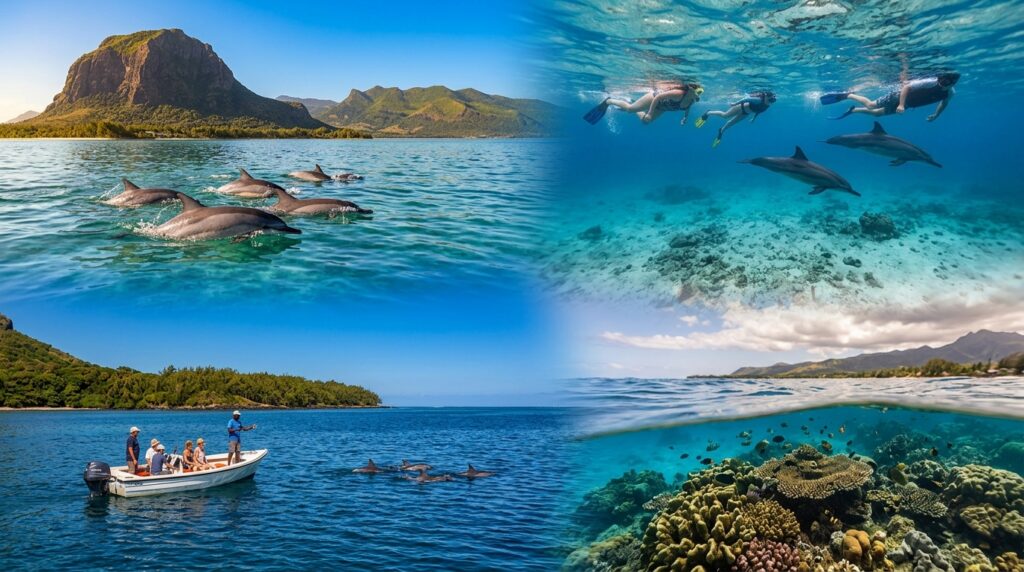
Every morning between 6am and 9am, a resident pod of bottlenose and spinner dolphins comes back to rest in Tamarin Bay after a night of hunting offshore. It is the only place on the island where dolphins show up almost daily, and the only place where swimming with them is legal — but only through an operator holding a certificate issued by the Tourism Authority. Most boats that leave Tamarin beach or Black River before sunrise do not hold that certificate, and the Tourism Authority stepped up inspections through 2026 to crack down on them.
A resident pod, not a staged show
Tamarin Bay owes its reputation to its geography: it opens where the Tamarin River meets the ocean, in a sheltered area where currents concentrate fish. A dolphin community, estimated by local observers at several dozen individuals, hunts offshore at night and returns to rest and play in the bay by day, alternating phases of unihemispheric sleep that let them stay active even while resting. Morning outings never guarantee an encounter: these are wild animals following their own rhythm, not performers on a schedule.
What Mauritian regulation actually says
Swimming with dolphins is governed by the Tourism Authority (Dolphin and Whale Watching) Regulations 2012 (GN No. 154 of 2012, Government Gazette of Mauritius No. 87 of 1 September 2012), still in force and re-published by the Tourism Authority itself. The text sets a prohibited zone within 50 metres of the nearest dolphin, and a regulated zone extending to 150 metres, where boats must keep to no-wake speed. It is forbidden to touch a dolphin, feed it, make noise to attract it, approach it from behind or head-on, or circle a group. Jet-skiing, kitesurfing, windsurfing and diving are banned within 500 metres of a dolphin or whale.
To run a “swimming” excursion, an operator needs a specific licence and a certified skipper who has passed a test on dolphin biology and approach techniques. The boat must fly the Alpha flag, carry a life-saver wearing an approved floatation device, a first-aid kit and an oxygen kit, and hold dedicated insurance. The rules cap swimming at three people in the water at once, life-saver included, and restrict it to the 6am–9am window — boat-based observation, by contrast, remains allowed until noon. Every swimmer must sign a disclaimer and receive a briefing on calm, silent swimming before entering the water.
Why swimming with whales is banned, but not with dolphins
The 2012 regulation draws a clear line between the two activities: it allows swimming with dolphins under strict conditions, but flatly bans entering the water with a whale. Since the mass stranding of dozens of cetaceans on the coast between late August and mid-September 2020 — an event whose exact cause was never firmly established — the Ministry of Tourism has tightened enforcement against “swim with whales” or sperm whale trips, well beyond the original rules. This is a common source of confusion for visitors: swimming with a sperm whale off the south coast remains banned under all circumstances, barring a scientific exemption; swimming with a dolphin in Tamarin Bay remains legal, but only under the conditions above.
The real tourist trap: unlicensed outings
According to the Tourism Authority, sea patrols intensified markedly from the start of 2026: 151 inspections were carried out, leading to 58 fines, nine formal notices and the seizure of one vessel. The most common violations involve whale- or dolphin-swimming trips run by unauthorised companies, some of which openly advertise on social media — the Tourism Authority is now working with the Ministry of Information Technology to get those ads taken down. Niven Muneesamy, the Tourism Authority’s director, warned offenders they risked suspension or outright withdrawal of their skipper’s licence.
That is the real tourist trap: a tout on Tamarin beach offering a cheaper trip, no Alpha flag, no life-saver, a boat that guns straight at the pod so passengers can jump in. These are exactly the practices the 2012 regulation bans — accelerating near a group, circling the animals, exceeding three swimmers — and, according to several licensed operators, the ones that are pushing dolphins away from the most crowded spots.
A debate still unresolved
Swimming with dolphins remains contested among Mauritian stakeholders. NGOs Ecosud and the Marine Megafauna Conservation Organisation are calling for an outright ban, arguing the activity disturbs a population already under pressure from tourism. On the other side, the pleasure-boat operators’ federation (FOPCO) is pushing to keep the activity going under a tighter framework rather than scrap it. Tourism Minister Richard Duval said in early 2026 that a decision would follow consultations, once a joint enforcement unit combining the National Coast Guard, the Tourism Authority and the Fisheries Division was finalised — a plan that, as of spring 2026, was still waiting on budget approval from the Ministry of Finance. No final decision has been announced since. In practical terms: as of publication, the activity remains legal under licence, but nothing guarantees it will stay in the same form in the months ahead.
How to spot a legitimate operator
A few simple checks, before boarding, rule out nearly every bad experience:
- the boat flies the Alpha flag (white and blue, swallow-tailed) as soon as it approaches a pod;
- the operator can produce its licence and the skipper’s certificate without hesitation;
- a life-saver wearing a floatation vest is on board, alongside the skipper;
- no more than three swimmers are ever in the water at the same time;
- a briefing on silent swimming and a liability disclaimer are offered before departure;
- the boat approaches from the side, at no-wake speed inside the regulated zone, never head-on or in a circle;
- no “swim with whales” or sperm-whale trip is offered at all — that alone is a red flag for an illegal operation.
Where and when to go
Departures leave from Tamarin beach or the Black River jetty, very early — typically between 5:30am and 7am, to catch the window when dolphins are still close to shore before heading back out to hunt. Trips last half a day and wrap up by late morning. Dolphins are present in the bay year-round, but their appearance in the shallower zones is never guaranteed on any given day: it is worth allowing several mornings if seeing them is a priority for the trip.
Depending on your situation
You are visiting for a limited stay: book early, directly with an operator displaying a licence and an Alpha flag, and accept that a dolphin-free morning is possible. You already live on the west coast, or are considering it: Tamarin Bay is part of daily life on this coast, on a par with the lagoon or the local surf breaks — the Tamarina estate is one example, a few minutes from the bay. You would rather rent first and test the area before buying: long-term rental in Mauritius makes it possible to live the west coast day to day before committing. You are on the fence for ethical reasons: boat-based observation, without entering the water, remains allowed until noon and limits direct interaction with the animals, with no swimming certificate required. If a trip out to sea makes you think of sharks, our article on sharks in Mauritius explains the real risk. For other outdoor activities on the island, the guide to sports and leisure in Mauritius covers golf, diving and hiking.
FAQ
Can you watch the dolphins without swimming with them? Yes: boat-based observation, without entering the water, is allowed until noon, versus only 9am for swimming, and requires no swimming-specific certificate.
Can children swim with the dolphins? The regulation sets no minimum age, but requires the swimmer to swim unassisted and follow the pre-entry briefing; each operator then applies its own conditions based on the child’s age and ability.
What happens to an operator caught breaking the rules? According to the authorities, penalties range from fines to suspension or outright withdrawal of the skipper’s licence, on top of possible seizure of the boat.
Sources and verification
- Tourism Authority — Dolphin and Whale Watching Regulations 2012 (official text, re-published)
- FAOLEX — Tourism Authority (Dolphin and Whale Watching) Regulations 2012, GN No. 154 of 2012
- Wazaa FM — 151 Tourism Authority inspections since the start of 2026
- Le Mauricien — Swimming with dolphins: a standoff between conservationists and operators
- Île Maurice Tourisme — Swimming with dolphins: Mauritius facing a societal choice
- Convention on Migratory Species (UN) — 2020 cetacean stranding in Mauritius
Planning a property project?
Let’s talk about your project in Mauritius
Westimmo guides you through the analysis, selection and securing of your property project in Mauritius.