


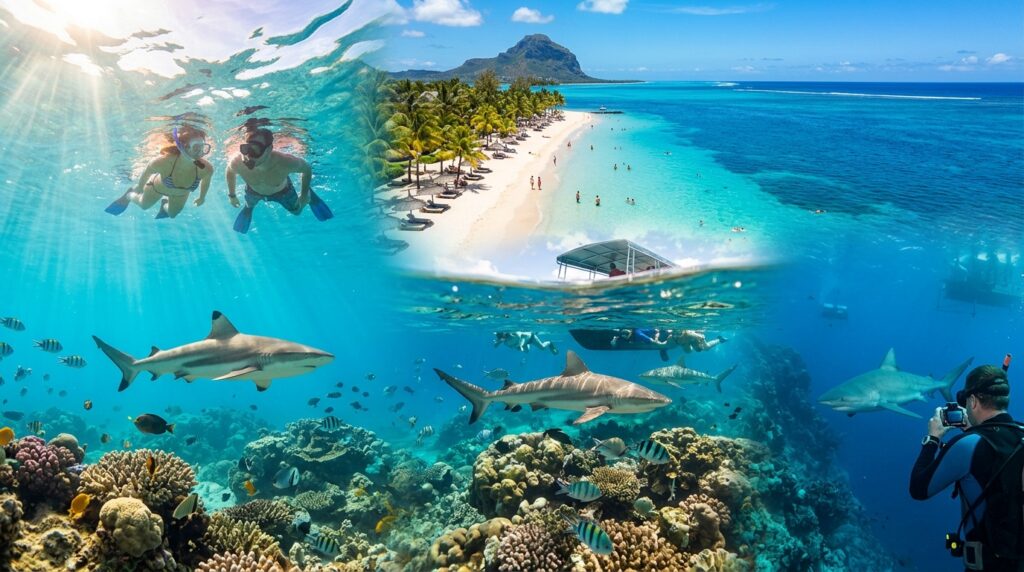
Are There Sharks in Mauritius? Species and the Real Risk to Swimmers
Sharks live around Mauritius, but the risk to swimmers in the lagoon is very low. Species, incident record and practical precautions.
Yes, there are sharks in the waters around Mauritius, but the risk to someone swimming in the lagoon is very low. Public records count about ten incidents in a century and a half, and the only recent one was a minor foot injury in 2017. The species you are most likely to meet in shallow water, the blacktip reef shark, swims away from people. The large species live offshore, beyond the coral reef.
Which sharks live around Mauritius?
Dive guides list around ten species, among them blacktip reef, grey reef, lemon, bull, tiger, mako, oceanic whitetip, hammerhead and whale sharks. They do not share the same waters.
The blacktip reef shark grows to about 1.6 m. It lives in shallow lagoons and on reefs, feeds on fish, cephalopods and crustaceans, and moves off when you approach. The large species (tiger, mako, oceanic) stay mostly in deep water beyond the reef.
The bull shark deserves the most attention, because it can enter a lagoon. Local naturalists also single it out when they call for vigilance.
What does the record of incidents show?
One online catalogue of attacks in Mauritius lists ten between 1864 and 2017, four of them fatal: seven unprovoked and three provoked (fishing or spearfishing situations). Recent cases include a grey reef shark attack on a swimmer at Pointe aux Canonniers in 1999, a bull shark attack on a spearfisher at Belle Mare the same year, and a minor foot injury to a swimmer at Le Goulet in 2017.
These records do not all agree: other publications place the last unprovoked encounter in the 1980s. Take the order of magnitude rather than an exact figure: very few incidents, most of them old.
The latest documented incident did not involve a swimmer. In October 2024, off Tamarin, a tourist grabbed a mako shark by the tail and was bitten in a defensive reaction. No attack on a kitesurfer has been reported in Mauritius.
Why does the lagoon protect swimmers?
The coral reef that rings much of the island acts as a natural boundary: large sharks live offshore and rarely come in. That is the usual explanation for how rare incidents are, and it matches what naturalists observe.
It is not absolute. Hugues Vitry, a Mauritian naturalist who works on marine megafauna, has long warned that the less food there is because of overfishing, the more sharks tend to enter the lagoon. He adds that swimming with dolphins and sperm whales increases exposure to sharks. On that subject, see our article on swimming with dolphins in Tamarin.
How can you reduce the risk?
- Swim and snorkel inside the lagoon, and do not cross the channel or the reef without a guide.
- Avoid dawn and dusk, when sharks are most active.
- Stay out of the water with an open wound.
- Do not swim alone in deep water.
- Never touch a shark, even a small one: the 2024 Tamarin case was a defensive bite.
- Follow the instructions of the coastguard and of licensed operators. The British Foreign Office advises checking that a water-sports operator holds a valid permit from the Ministry of Tourism, that the boat carries enough life jackets and that the captain can contact the coastguard.
For snorkelling spots in the lagoon, see our snorkelling guide. For the small lagoon animals that sting (stonefish, sea urchins, jellyfish), see lagoon dangers and what to do. The lagoon offers far more frequent encounters too, such as sea turtles, and its health depends on its corals.
Are sharks protected in Mauritius?
The Fisheries Act 2023 (Act No. 15 of 2023) has a section titled “Prohibition on removal and sale of shark fins”: the operator of a fishing vessel must comply with the prohibitions on removing and selling shark fins that are prescribed or required by an applicable conservation and management measure. Section 27 also bars setting a purse seine net around a whale shark that has been sighted before the set begins. Breaches are criminal offences.
Internationally, Mauritius has been a party to the Convention on Migratory Species since 1 June 2004 and is listed as a range state under the Memorandum of Understanding on migratory sharks, with the whale shark, great hammerhead, green sawfish and oceanic whitetip among the associated species. A Mauritian fisheries official has told the international press that the country is in favour of shark conservation because sharks are a very important part of the ecosystem.
What this means for you
If you are visiting on holiday, you can use the lagoon without particular worry, with the precautions above. Offshore trips with dolphins or sperm whales should go through a licensed operator.
If you rent or own a seafront property, the shark risk inside the lagoon is low and should not decide which coast you choose. Compare areas with our guide to the best beaches.
If you are still deciding where to settle, water sports are part of daily life. Our area guides, such as Tamarin and Grand Baie, describe what is nearby, and our property price page shows where the market stands.
Sources and checks
- National Assembly of Mauritius: Fisheries Act 2023 (Act No. 15 of 2023), sections 27 and 28
- Convention on Migratory Species (CMS): Mauritius page of the Sharks MoU
- Foreign, Commonwealth & Development Office: Mauritius travel advice, safety and security
- Smithsonian Magazine: report on sharks in Mauritius and Réunion
- Defimedia: Mauritian territorial waters and potential shark attacks
- Shark Utopia: record of attacks in Mauritius (indicative)
- Kite in Moris: sharks and kitesurfing in Mauritius (indicative)
Planning a property project?
Let’s talk about your project in Mauritius
Westimmo guides you through the analysis, selection and securing of your property project in Mauritius.