


Ebony Forest Chamarel: What’s Left of Mauritius’ Native Flora, and How to See It
Mauritius has 287 native plant species found nowhere else on Earth, and more than 90% of them are now considered threatened, according to the Mauritian Wildlife Foundation. Almost none of the island’s original vegetation survives outside a handful of protected pockets. The most accessible one sits above Chamarel, in the south-west: Ebony Forest Reserve, a […]
Mauritius has 287 native plant species found nowhere else on Earth, and more than 90% of them are now considered threatened, according to the Mauritian Wildlife Foundation. Almost none of the island’s original vegetation survives outside a handful of protected pockets. The most accessible one sits above Chamarel, in the south-west: Ebony Forest Reserve, a working restoration site you can walk through in half a day.
Why Mauritius’ native plants are disappearing
The island is home to 644 native flowering plant species, 287 of which are endemic, and over 90% of those endemics are now threatened; roughly 100 species are down to fewer than 100 individuals left in the wild, according to the Mauritian Wildlife Foundation’s rare plants conservation project sheet. Centuries of successive deforestation left the original forest cover in scattered fragments, mostly at altitude or in terrain too rugged to clear. The National Parks and Conservation Service (NPCS) describes Black River Gorges National Park as home to “the last remnant” of Mauritius’ endemic flora and fauna. Ebony Forest, near Chamarel, isn’t part of that state park — it’s a separate, privately run reserve — but it works toward the same goal of active restoration rather than passive protection.
Ebony Forest: a reserve replanting what disappeared elsewhere
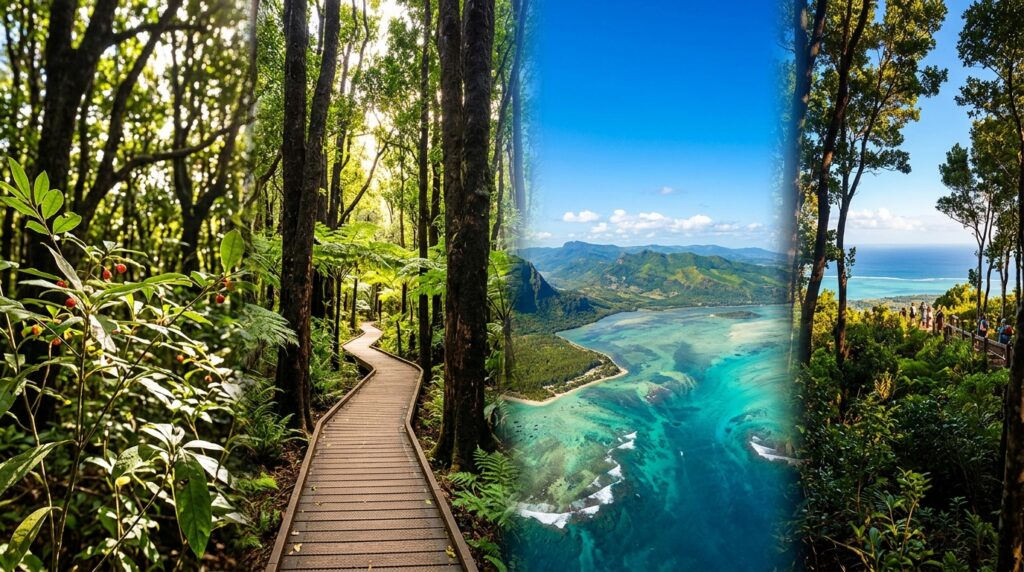
Located in Chamarel, close to Le Morne Brabant, Ebony Forest is a non-profit that has spent more than twenty years restoring native forest on this site. It now manages three forests totalling 195 hectares, where more than 200,000 endemic and native plants have been planted and over 50 hectares of forest have been weeded of invasive species and replanted. A further 118 endemic and native species have been propagated in its nurseries. The same restoration logic applies to wildlife: four endemic bird species have been reintroduced on site, which is recognised as an Important Bird Area by BirdLife International and is home to six of the nine remaining endemic land bird species, including the pink pigeon, the Mauritius kestrel and the echo parakeet. These are the same species covered in our guide to birdwatching in Mauritius.
Self-guided walk or booked tour
The simplest option, Take A Hike, needs no booking: routes run 2.3 to 6.1 km depending on which one you pick, from one hour up to four if you add the climb to Piton Canot. Rates listed on the reserve’s own site in March 2026 split resident and non-resident pricing: residents pay Rs 380 per adult and Rs 230 per child aged 5 to 17, non-residents Rs 510 and Rs 310, with free entry under age 5 — worth double-checking before you go, since these change. For a guided read of the site, two bookable options start at 9am: a 3-to-4-hour birdwatching walk covering 4.8 km, and a 3-to-4-hour guided trek covering 5 to 6 km that traces how volcanic activity, deer ranching and sugar cane shaped the neighbouring villages of La Gaulette, Case Noyale and Chamarel. The usual hiking precautions apply here as anywhere else on the island — our guides on hiking safety in Mauritius and on whether you actually need a guide set out what’s common sense and what’s a real requirement. The short, well-marked loop and gentle gradient also make it a realistic outing with kids, in the same spirit as the routes in our piece on hiking with children in Mauritius.
The national park and biosphere reserve behind Chamarel
Ebony Forest is a private initiative, but it sits right next to a far larger state-run protection scheme. Black River Gorges National Park forms the core zone of the Black River Gorges – Bel Ombre Biosphere Reserve, officially recognised by UNESCO on 28 October 2020, replacing the Macchabée – Bel Ombre Biosphere Reserve designated in 1977, one of the very first in the world according to the NPCS. The whole reserve covers 8,582 hectares: a strictly protected core zone of 6,574 hectares (the national park itself), a 497-hectare buffer zone, and a 1,511-hectare transition zone that includes the villages of Bel Ombre and St Martin. It’s managed by the National Parks and Conservation Service, under the Ministry of Agro-Industry and Food Security. In practice, the difference is one of scale and purpose: Ebony Forest is a few hours on a curated trail, while the national park spreads roughly 60 km of marked trails over 67.54 km², built for longer outings focused more on wildlife spotting than on plant conservation storytelling.
Making a day of it
Chamarel sits a short drive from Le Morne Brabant and La Gaulette, an area where the property market still leans toward villas and nature-facing homes rather than town living. Other south-west outings and what to plan for them are covered in our guide to sports and leisure in Mauritius.
Sources and verification
- Mauritian Wildlife Foundation — rare plants conservation project sheet
- National Parks and Conservation Service — Black River Gorges – Bel Ombre Biosphere Reserve pamphlet
- Ebony Forest Reserve — reserve overview and restoration figures
- Ebony Forest Reserve — visit options, distances and pricing
- Wikipedia — area, establishment date and trail length of Black River Gorges National Park (sourced to the National Parks and Conservation Service)
Planning a property project?
Let’s talk about your project in Mauritius
Westimmo guides you through the analysis, selection and securing of your property project in Mauritius.