


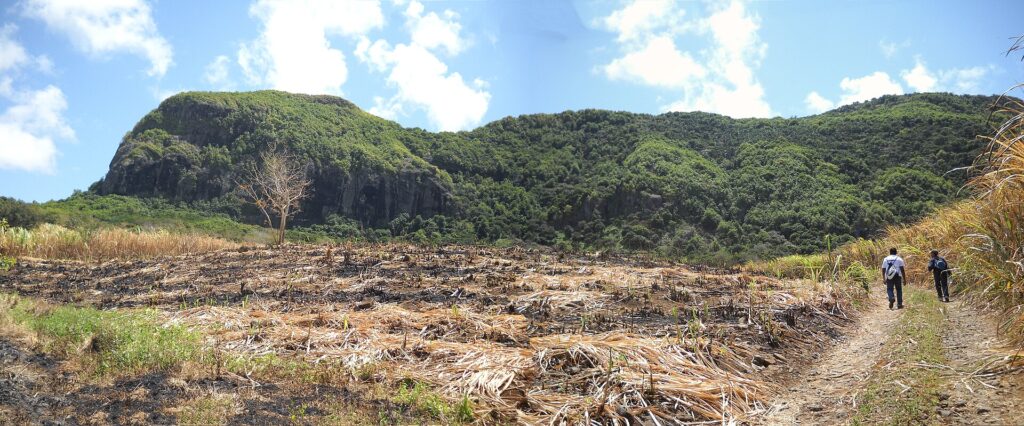
Hiking safety in Mauritius: the real risks
No dangerous animals on Mauritian trails. The real risks are heat, wet rock, timing and flash floods in canyons. Emergency numbers and the reflexes that matter.
Let us start with the reassuring part: there are no dangerous animals on the trails of Mauritius. No venomous snake, no large predator, no deadly insect. That is not where the danger lies.
Accidents in Mauritius come down to four things: heat, wet rock, timing and rising water. All four are avoidable, and all four are regularly underestimated by otherwise experienced walkers.
Night falls without dusk
This is the trap that most surprises Europeans. In the tropics, night falls between 5.45 pm and 7 pm depending on the season, in about twenty minutes, without the long blue hour people are used to further north. A descent started “while there is still light” ends in the dark.
The most frequent case involves La Tourelle de Tamarin: many climb it for the sunset, which is indeed one of the island’s finest. The descent includes sections on ropes. A head torch, not a phone.
Gates that close, your car included
Two sites work with gates, and they close them on the exact hour.
At the Black River Gorges, the park is open from 7 am to 5 pm on weekdays, from 9 am to 5 pm at weekends. The gates lock on the hour — vehicles included. This is not a figure of speech: every year visitors find themselves shut inside, their car stuck behind a barrier. If you are aiming for the Pétrin–Black River crossing, seven hours of walking, you must set off before 9 am.
At Le Morne Brabant, the gate opens at 7 am and closes at 4 pm, with the last ascent allowed around 2.30 pm. Many visitors arrive at 1 pm assuming they have the day ahead of them, and are turned away — or finish in a rush.
The local rule fits in one sentence: at the summit before midday, back down before 3 pm.
Clay and wet rock
This is the factor that turns a pleasant hike into a dangerous outing, and it is invisible from the car park.
Lion Mountain is the textbook case: its clay ground becomes extremely slippery as soon as it is wet, and the route follows an exposed ridge. The classic mistake is going the day after a shower, telling yourself the sun has dried the ground — clay holds moisture far longer than rock. The south-east also receives more rain than the west: check the forecast for the sector, not for the island in general.
On the Trois Mamelles and at Bambous Mountain, the rock sections become genuinely risky on wet rock. At Black River Peak, the ground is greasy and root-strewn on almost the whole route: this is the island’s most slippery hike, and a twisted ankle halfway into a national park ends badly.
Flash floods in the canyon
The most serious risk, and the most counter-intuitive. At the 7 Cascades, the catchment lies upstream, on the plateau. It can be bright sunshine at the start while it pours where the water rises. That is how hikers are caught out by water rising in the canyon.
Judging the weather from the car park is not enough. In stormy weather or after heavy rain upstream, you cancel — no discussion.
Heat and the absence of shade
Several Mauritian slopes offer no shelter at all. At Corps de Garde, 633 metres of ascent are climbed on a slope almost entirely without shade: setting off late in the morning with a single bottle of water is the classic dehydration scenario. Allow two litres per person, a hat and a start before 8 am.
The principle holds everywhere: a litre and a half of water minimum, even for two hours of walking, because there is no refreshment point on the trails.
What to actually take
- Closed shoes, even for outings billed as easy. City trainers on greasy ground are the leading cause of slips.
- Plenty of water: 1.5 to 2 litres per person, without exception.
- Hat and sunscreen: tropical reflection is unforgiving, including on the water during a kayak trip at Île d’Ambre.
- A head torch as soon as the outing might run into the end of the day.
- A GPS track on unmarked routes — Bambous, Trois Mamelles, La Tourelle.
- A waterproof bag for your phone in the canyon.
Tell someone
On unmarked routes, tell someone where you are going and when you expect to be back. Mobile coverage is decent on most Mauritian ridges, but not at the bottom of the gorges nor in the 7 Cascades canyon.
Emergency numbers in Mauritius
- 999 — police
- 114 — ambulance
Frequently asked questions
Are there dangerous animals on Mauritian trails?
No. The island has neither venomous snakes nor large predators. The real risks are heat, wet rock, timing and flash floods in canyons.
Can you hike in Mauritius during the rainy season?
Yes, by adapting your choice of trail and your start time. Avoid canyons in stormy weather and clay ridges after a shower. The austral winter, from May to November, remains the best period.
What is the emergency number in Mauritius?
999 for the police, 114 for the ambulance service.
Is there mobile coverage while hiking in Mauritius?
Decent on most ridges, poor at the bottom of the gorges and in the 7 Cascades canyon. Tell someone before setting off on an unmarked route.
The detail of access conditions, opening hours and difficulty is set out in our guide to the 15 best hikes in Mauritius.
Planning a property project?
Let’s talk about your project in Mauritius
Westimmo guides you through the analysis, selection and securing of your property project in Mauritius.