


Water Cuts in Mauritius: Tank, Pump and Pressure Checks Before You Buy or Rent
What the CWA regulations say about tanks and pumps, and what to check on a viewing in Mauritius while water is restricted in 2026.
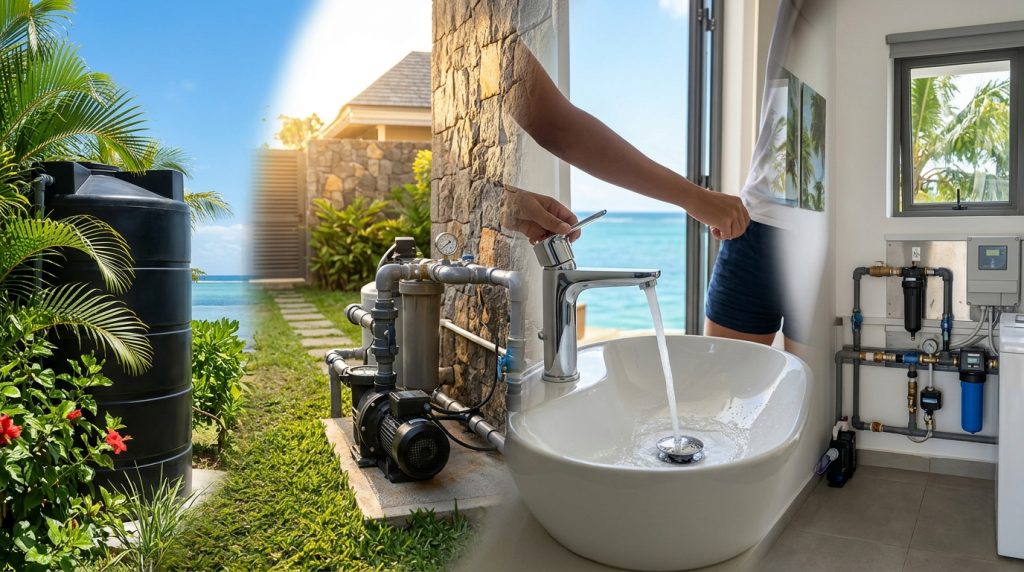
The Central Water Authority (CWA) regulations set no minimum tank size for a home, and supply was cut back across the island in August 2026. With reservoirs well below last year’s levels, the tank and the pump are part of what you are buying or renting. Before you sign, check three things: where the tank is and how much it holds, how the pump is plumbed in, and whether the area has scheduled cuts.
Why a running tap is not a given in 2026
On 10 October 2026 the island’s seven main reservoirs were 56.8 % full, against 87.04 % on the same date in 2025. Mare-aux-Vacoas, the largest, stood at 35.5 %. These are the figures the Mauritian press reported that day, and they move with the rain.
Restrictions followed. A joint notice from the Water Resources Commission and the CWA, published on 3 August, cut supply by two hours a day nationwide from 5 August. Plaines-Wilhems, the Moka district and part of Rivière-Noire were also on cuts of five to six hours a day. From 10 August, potable water was no longer to be used to fill pools or run pressure washers and car-wash centres.
In early October the Council of Ministers agreed to drill more boreholes, to call in private water tankers and the Fire and Rescue Services, and to install shared tanks of around 30,000 litres in several localities. For a buyer or tenant, the point is simple: a home with no clean water in store has no water during a cut.
The tank: what to look at during the viewing
The CWA’s domestic supply rules (Water Supply for Domestic Purposes Regulations 2011) mention the “water tank” but fix neither its size nor its position. It is up to you to judge whether the reserve will see the household through a cut. Put these questions to the owner or the agent.
- How many tanks are there, what is their capacity, and how old are they? A clean, newer tank beats a large rusty one.
- Where are they? A rooftop tank feeds the taps by gravity. A ground-level tank generally needs a pump.
- How many people live in the house, and does the reserve last a day without refilling?
- Does the tank refill by itself when the water comes back (a float valve), or does someone have to watch it?
- Does the property also have rainwater storage or a borehole? See our article on eco-friendly homes, solar power and rainwater.
Ask for the latest water bills too. They show what the household really uses.
The pump: one plumbing rule to know
The 2011 regulations are clear on one point. Under regulation 11, a consumer may not connect a pump or similar device to the part of the supply pipe that runs straight from the meter: the pump goes after the tank. Regulation 20 bars installing one on that stretch of pipe, before the tank.
If the pump in a home is fitted straight onto the meter, the installation is not compliant, and once you are the occupant the problem is yours. So look at the actual layout: meter, tank, then pump. Regulation 11 also calls for a non-return valve as close to the meter as possible, and for pipes and fittings that withstand a test pressure of 6 bar.
Keeping the supply pipe in good repair is the consumer’s job. The CWA can serve a repair notice and, if the consumer does not comply, cut off the supply at the consumer’s expense.
Pressure: what the tank changes
Pressure at the tap depends mostly on the height of the tank and on the pump. With a rooftop tank, water comes down by gravity: pressure is modest, but nothing has to run. With a ground-level tank, a pump provides the pressure and depends on electricity. In a power cut the pump stops, and so does the water in the house, even if the tank is full.
During the viewing, open several taps at once, upstairs as well, and run the shower. If the pressure is weak, ask whether there is a pump, what make it is and whether it still works.
Is the area affected?
Cuts do not hit every area equally. In August 2026 Plaines-Wilhems, Moka and part of Rivière-Noire were the worst affected; according to the Rio Times, the Council of Ministers added alternate-day distribution in upper Plaines-Wilhems on 23 October. Before choosing a neighbourhood, ask the neighbours what the real cut times are and check the schedules published on the CWA website.
The CWA also keeps the register of private water tankers and takes complaints on its site. A home that does not depend on a tanker delivery is plainly better than one that does.
Help with fitting out a home
On 9 October 2026 the Council of Ministers extended the tank and pump grant to every household without a tank. The press reports, without an official source we could consult, Rs 10,000 for two tanks, Rs 4,000 for a pump and up to Rs 1,000 for fittings, Rs 15,000 at most. Confirm the amounts and conditions with the Development Bank of Mauritius before you count on them. The press does not say whether the grant applies to a household that already has a tank.
Depending on your situation
You are renting
In a lease, make sure the tank and the pump are listed in the inventory, with their condition. Put in writing who repairs the pump if it breaks down. For the rest of the lease, see long-term rental in Mauritius.
You are buying an existing home
Make the tank and the pump connection a line item of the technical visit, alongside the electrics and drainage. If the house is not on the mains sewer, also read septic tank or sewer, and for the rest of the viewing buying an existing house. An old tank or a badly connected pump is a bargaining point; to place the asking price, see property prices in Mauritius.
You have just bought
Opening the water account in your name is one of the post-purchase formalities: see the steps after buying property in Mauritius. While you are at it, have the connection checked: meter, non-return valve, tank, then pump.
Sources and checks
- Central Water Authority (Water Supply for Domestic Purposes) Regulations 2011, GN No. 238 of 2011 (FAOLEX): regulations 11, 12 and 20.
- Central Water Authority (Water Supply for Domestic Purposes) (Amendment) Regulations 2012, GN No. 143 of 2012 (FAOLEX).
- Central Water Authority: complaints, register of private water tankers.
- L’Express via AllAfrica: two-hour daily cut and restrictions on use, August 2026.
- AllAfrica: reservoir levels and Council of Ministers measures, 10 October 2026.
- Rio Times: tank and pump grant, decisions of 9 and 23 October 2026 (secondary source).
Planning a property project?
Let’s talk about your project in Mauritius
Westimmo guides you through the analysis, selection and securing of your property project in Mauritius.