


Palm heart salad: the recipe for Mauritius’s “millionaire’s salad”
Palm heart salad with a ginger and lime dressing, fresh or tinned palm heart, and the production figures that explain why it stays rare in Mauritius.
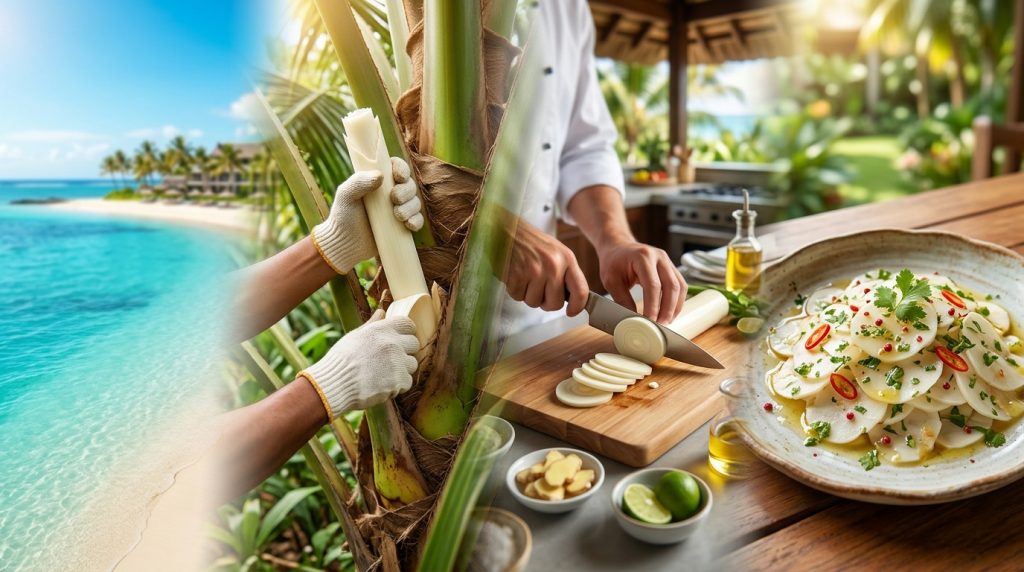
Palm heart salad is a salad of palmiste, the heart of the palm, a rare vegetable that Mauritius traditionally keeps for special occasions. It comes from the terminal bud of a palm that takes nearly seven years to mature, which is why it is nicknamed “white gold” and the millionaire’s dish. The simplest version is sliced into rounds and dressed with a sharp mix of ginger, lime, vinegar and olive oil. Below you will find that recipe with quantities, what changes between fresh and tinned palm hearts, and what the industry’s figures say about how scarce they are.
What is palmiste, and why is it called the “millionaire’s salad”?
Palmiste is the heart of the palm: the tender white terminal bud, also called palm cabbage. A culinary festival menu from a Mauritian hotel group calls it a symbol of refinement, nicknamed “white gold” in Mauritius, which takes nearly seven years to mature and is traditionally kept for big occasions. The same menu adds that Bernardin de Saint-Pierre was already praising it in Paul et Virginie in 1788.
The “millionaire” nickname comes from the same scarcity. The blog of a hotel group operating in Mauritius says a tree takes about six years to yield two or three portions, which is why some call palm heart the “millionaire’s dish”. For another dish that is cooked for special occasions but is much easier to find, see our Mauritian biryani recipe.
The palm heart salad recipe
The only recipe with quantities that we found comes from a South African food column, inspired by ingredients brought back from a family trip to Mauritius. It is written for tinned palm hearts. It is not a reference Mauritian recipe, but the dressing follows the pattern the column describes for the island: in Mauritius, it says, palm hearts are served in salads with a sharp dressing of fresh ginger, vinegar, lime and olive oil.
Ingredients
- 1 tin (400 g) of palm hearts, sliced into rounds
- 16 young green beans, blanched and chilled
- 1 small red chilli, finely chopped
- 2 spring onions, finely chopped
- 2 cm fresh ginger, grated or minced
- juice of 1 lime
- 1 teaspoon palm sugar, crushed to a powder
- 1 tablespoon red wine vinegar
- 1 tablespoon cold water
- a splash of brown sherry
- 3 tablespoons olive oil
- 2 pinches of tookmaria (basil) seeds, lightly toasted
Method
- Blanch the green beans in boiling water, refresh them in iced water and drain. Chop the spring onions.
- For the dressing, warm the sherry, vinegar and water in a small pan. Add the palm sugar and ginger, simmer gently for 3 minutes, then leave to cool.
- Stir in the olive oil, lime juice, chilli and spring onions.
- Toast the tookmaria seeds lightly.
- Layer the palm heart rounds and green beans in a shallow bowl, spoon over the dressing and scatter the seeds on top.
The sherry is not Mauritian: it is the column’s own choice. Tookmaria seeds are the same ones used in alouda, the milk drink with basil seeds. For a more traditional kick, a chatini or some vegetable achards on the side do the same job as the chilli.
Fresh or tinned palm heart: what changes
Tinned palm heart can be eaten as it comes, as in the recipe above. Fresh palm heart is a different product. A hotel recipe for a fresh heart simmers it gently in milk for about two hours until it softens, then serves it with a saffron cream sauce, Chinese cabbage, tomato and spring onion. That is no longer a salad but a hot dish.
In Mauritius, most hearts are sold as they are, and the rest vacuum-packed: in 2021, 85% of palm hearts were sold as they are and 15% vacuum-packed, against 86% and 14% in 2019. We found no published price, so ask at the market or your supplier rather than trust a second-hand figure.
Why palm heart stays rare: the industry figures
The Mauritius Chamber of Agriculture publishes an annual review of palm heart production.
| Year | Production (units) | Area under cultivation |
|---|---|---|
| 2017 | 90,698 | 455 ha |
| 2018 | 94,502 | 436 ha |
| 2019 | 92,126 | 360 ha |
| 2020 | about 30,000 | 353 ha |
| 2021 | about 30,000 | 324 ha |
Output held steady at around 92,000 units a year from 2017 to 2019, then fell to roughly 30,000 units in 2020 and 2021. The Chamber puts this down to Covid-19 health restrictions and border closures. Sales picked up once the borders reopened: October to December 2021 account for 69% of the year’s sales. The cultivated area has lost 29% between 2017 and 2021.
White palmiste makes up 94.2% of plantations in 2021 (96% in 2019). December is the peak month, with 16% of annual sales in 2019. In 2019, intermediaries, wholesalers included, took 78% of production, restaurants 9% and retail 6%. Growers mainly report thefts in remote areas and monkeys damaging plantations along rivers. We found no review more recent than the 2021 one.
Cultivated palmiste versus forest palmiste
The figures above describe plantations. The wild species is in a very different position: the red palmiste (Acanthophoenix rubra), a palm endemic to the Mascarene Islands whose cabbage is highly prized by gourmets, is classed as critically endangered. It has almost entirely disappeared from forest landscapes after being heavily over-exploited for its edible cabbage, and survives only in steep, hard-to-reach areas. Never take a palmiste from the forest, and never pay anyone who does.
Where to eat it, and with what
Palm heart is also served cooked: a 2025 culinary festival menu lists it as a braised round with a Creole-spice mousseline and river prawns. To see where the dish sits among the island’s other specialities, read our page on Mauritian cuisine.
Sources and checks
- Mauritius Chamber of Agriculture: Review of palm heart production 2019
- Mauritius Chamber of Agriculture: Review of palm heart production 2021
- Daily Maverick: Heart of palm salad (recipe)
- RIU: Palm heart with saffron sauce and Chinese cabbage
- 96 Hotels: culinary festival menu 2025
- Wikipedia: Palmiste rouge (in French)
Planning a property project?
Let’s talk about your project in Mauritius
Westimmo guides you through the analysis, selection and securing of your property project in Mauritius.