


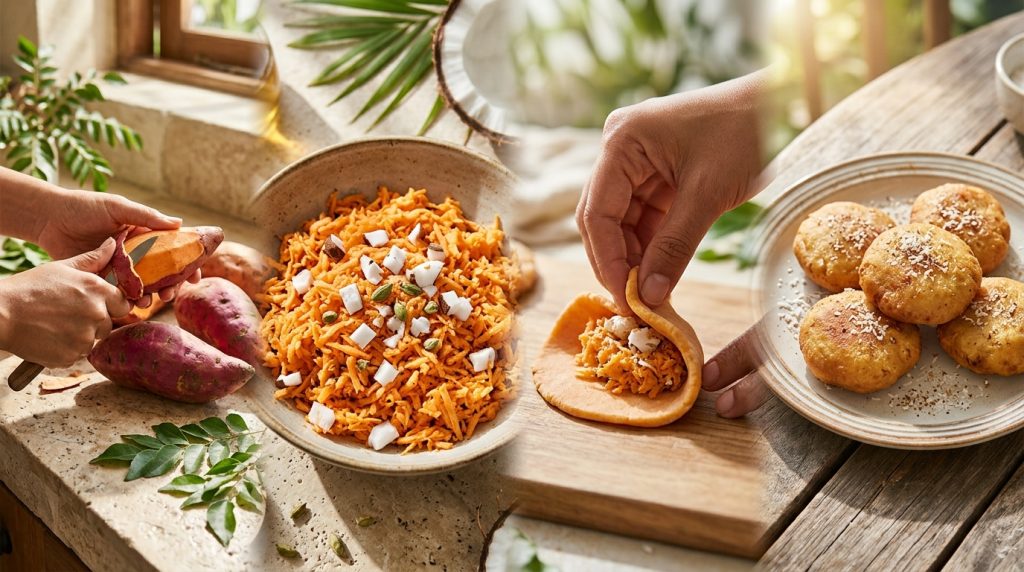
Gato patate: how to make Mauritian sweet potato turnovers
Gato patate: the Mauritian recipe for fried sweet potato turnovers filled with coconut and cardamom, with the variations and how to serve them.
Gato patate is a fried Mauritian turnover: a dough of mashed sweet potato and flour, filled with grated coconut sweetened and spiced with cardamom. For about 500 g of sweet potatoes you need 200 g of flour, 100 g of grated coconut, 80 g of sugar and 2 teaspoons of ground cardamom. Boil and mash the potatoes, knead in the flour, roll the dough out to 2 mm, fill rounds of it, fold them into half-moons and fry until golden.
What gato patate is
Despite the name, it is not a baked cake. It is a fried sweet, crisp outside and soft inside, and several sources link it to religious festivals: a Mauritian food site lists it among the favourites at Divali and Cavadee, and a recipe in an expat magazine presents it as a Divali treat. For the festival itself, see our page on how to celebrate Diwali in Mauritius.
The recipes we read say nothing about where the cake comes from, so we do not offer a history either.
The basic recipe
This one follows the recipe published by Expat.com, which is the most detailed on technique. The other pages give the same steps with different quantities, compared further down.
Ingredients
- 500 g sweet potatoes
- 200 g plain white flour
- 100 g grated coconut
- 80 g sugar
- 2 teaspoons ground cardamom
- oil for frying
Method
- Mix the coconut, sugar and cardamom in a bowl. This is the filling.
- Boil the sweet potatoes in a large pot for about 30 minutes, or about 20 minutes in a pressure cooker.
- Drain, mash and leave to cool.
- Work in the flour a little at a time by hand until the dough is thick and even. Knead for at least 5 minutes.
- Shape the dough into one large ball, then divide it into smaller balls.
- Roll each ball out on a floured surface to about 2 mm thick and cut rounds, using a bowl for instance.
- Put about a heaped teaspoon of filling in the centre of each round.
- Fold into a half-moon, pinch the edges shut and press the tines of a fork along the edge.
- Heat the oil in a large frying pan and fry the cakes until golden. Drain on paper towels.
The recipe gives neither the amount of oil nor the frying time: you stop at the colour.
Where the recipes differ
Three published recipes make the same turnover with different quantities and steps.
| Point | Expat.com | Cuizine Maurice | SBS Food |
|---|---|---|---|
| Sweet potato | 500 g | 300 g | 500 g, peeled and diced |
| Flour | 200 g | 150 g | 180 g, you may not need all of it |
| Grated coconut | 100 g | 100 g | 100 g |
| Sugar | 80 g | 80 g | 80 g brown sugar |
| Flavouring | 2 teaspoons ground cardamom | 1 teaspoon vanilla extract | 15 g green cardamom pods, seeds ground |
| Cooking the potatoes | about 30 minutes, 20 in a pressure cooker | about 30 minutes, until a knife goes in easily | about 15 minutes (diced) |
| Filling | mixed straight away | rested for 1 hour | mixed straight away |
| Frying | until they start to brown | until golden brown | oil at 180 °C, 2 to 3 minutes a batch |
Cuizine Maurice gets 20 cakes from 300 g of sweet potato, and SBS says its recipe serves 10. The SBS recipe has the most precise markers: the dough rests for 10 minutes after kneading, the rounds are 8 cm across, the edge is brushed with water before folding, and the offcuts are re-rolled. It also says the cakes contain no egg or dairy.
Flour is between 36% and 50% of the weight of the sweet potato, depending on the page: 150 g for 300 g, 180 g for 500 g, 200 g for 500 g. Cuizine Maurice does not fix the amount either, saying to add more flour only if the dough needs it, and SBS notes you may not need all of it. It is better to add it a little at a time, as the basic recipe does.
Can you bake them?
None of the recipes we read bakes them. On Cuizine Maurice a reader asks, and the author only replies that she guesses they would come out crispier, without having tried. We cannot give you an oven temperature or time, so frying remains the tested method.
Serving gato patate
SBS says they are eaten warm or cold, and Cuizine Maurice serves them with tea. None of the pages gives a storage time, so make only as many as you plan to eat.
For more Mauritian street-food sweets, try the banana fritters, the arouille taro fritters or the napolitaines. The island’s other specialities are in our guide to Mauritian cuisine.
Sources and checks
- Expat.com: Mauritian gâteau patate recipe
- Cuizine Maurice: gato patate, sweet potato cakes
- SBS Food: sweet potato cakes (gato patate)
- HIDMC: traditional desserts of Mauritius
Planning a property project?
Let’s talk about your project in Mauritius
Westimmo guides you through the analysis, selection and securing of your property project in Mauritius.