


Living in Cap Malheureux: the quiet far north between Grand Baie and Grand Gaube
Cap Malheureux is a fishing village ten minutes from Grand Baie. Daily life, wind, health, buying and how it compares with its neighbours.
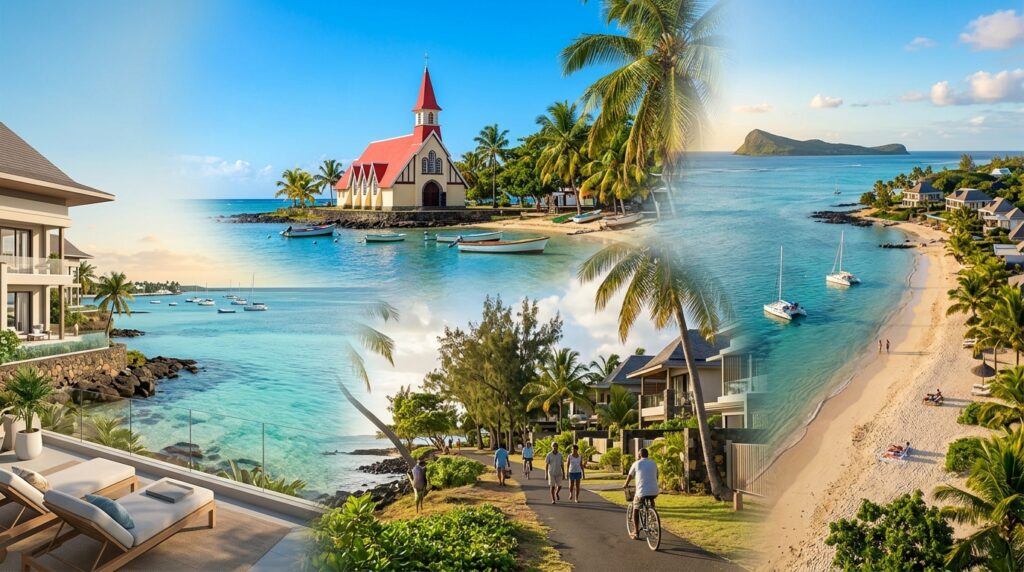
Living in Cap Malheureux means living at the end of the road. The village had 5,740 residents at the 2022 census, and for most of daily life, from big shops to services, you drive to Grand Baie, about ten minutes away according to guides. In return you get a working fishing village that people live in all year, a sheltered lagoon and a view of Coin de Mire.
A fishing village, not a resort
Cap Malheureux sits at the northern tip of the island, in the Rivière du Rempart district. Its population has grown from 4,427 in 2000 to 5,070 in 2011 and 5,740 in 2022 (Central Statistical Office). Creole is the language spoken at home for 4,759 residents, ahead of French and Bhojpuri with 377 each. It is an ordinary Mauritian village where fishing boats still come back in, not a district of hotels.
Its landmark is the red-roofed chapel of Notre-Dame Auxiliatrice, designed by Max Boullé and consecrated on 7 August 1938. The name of the cape recalls the ships wrecked on its reefs and the British landing of 29 November 1810. Coin de Mire closes the horizon about 8 km offshore.
Daily life: you need a car, and Grand Baie is ten minutes away
You are better off with a car. Grand Baie remains the commercial hub of the north, described in our guide to Grand Baie neighbourhoods. Port Louis is about an hour away.
The trade-off is peace and quiet. Life in Cap Malheureux and Bain Bœuf is calmer than in Péreybère or Grand Baie, yet only a few minutes from their amenities, as our guide to the north of the island explains.
Climate and wind on the north coast
The Pamplemousses station, which the Mauritius Meteorological Services use for the northern region, records average maximums of 31.1 °C in January and 25.7 °C in July, and average minimums of 22.2 °C in February and 16.1 °C in July. Winds are stronger in the austral winter: an average of 13.3 km/h in August, against 9.3 km/h in May and June.
That wind matters in practice. The Anse la Raie lagoon, between Cap Malheureux and Calodyne, is a well-known kitesurfing spot, wide and shallow, at its best from May to October when the trade winds blow. If you want dead calm, check how the house is exposed before you sign. If you kite, it is a bonus. The sheltered waters of Bain Bœuf beach suit children better for swimming.
Health and services
Cap Malheureux falls under the Rivière du Rempart health office, which also covers Grand Baie, Péreybère, Calodyne and Grand Gaube. The Ministry of Health lists a new Area Health Centre at Cap Malheureux among its ongoing infrastructure projects, with no published date. Until then, check where the nearest health centre is relative to your address before you move.
Buying in Cap Malheureux: a market of villas
Most of the stock is villas with 2 to 5 bedrooms, plus a few apartments, often with a pool and in a gated development. An international listings portal shows about twenty properties, from £276,943 to £7,314,765. That spread mostly reflects how varied the stock is, sea view or not. Treat these as indicative: they are asking prices, not sale prices.
The project that shapes the market is Cap Marina, a 22-hectare waterfront village developed by Evaco under the PDS (Property Development Scheme), open to foreign buyers. The number of homes quoted varies by source (about 200 in 2019, 320 on more recent portals), so ask the developer for the current masterplan. To understand the purchase schemes, see our page on new developments in Mauritius.
For budgets, see property prices in Mauritius. Westimmo lists its northern properties in Grand Baie, Péreybère and Calodyne, the three neighbouring areas.
Cap Malheureux compared with its neighbours
- Against Grand Baie: fewer services and less nightlife, but more calm and open views. Grand Baie is still where everything gets done.
- Against Péreybère: the same closeness to Grand Baie, but a fishing-village feel rather than a busy beach. Compare them in Grand Baie or Péreybère and our guide to the north’s beaches.
- Against Grand Gaube and Calodyne: a north that is quieter and more rural still, covered in Living in Grand Gaube and Calodyne.
Who Cap Malheureux suits, and who it does not
The village suits anyone who wants a quiet setting on the lagoon, has a car and can reach Grand Baie in a few minutes: retirees, families who enjoy watersports, buyers of a second home. It suits less anyone who wants to do everything on foot, a lively neighbourhood in the evening, or medical services next door without taking the road.
Sources and checks
- Central Statistical Office of Mauritius, 2000, 2011 and 2022 censuses (data reproduced by citypopulation.de)
- Ministry of Health, ongoing infrastructure projects
- Ministry of Health, health offices and localities covered
- Mauritius Meteorological Services, climate sheet for the North region (Pamplemousses)
- Legend Hill, Cap Malheureux (chapel, history, distances)
- Routard, Cap Malheureux
- La Gazette, Evaco creates Cap Marina (2019)
- Evaco, Cap Marina
- Rightmove Overseas, listings in Cap Malheureux
Planning a property project?
Let’s talk about your project in Mauritius
Westimmo guides you through the analysis, selection and securing of your property project in Mauritius.