


Living in Grand Gaube and Calodyne: the Quiet North of Mauritius
Grand Gaube and Calodyne: a fishing village in the north of Mauritius, away from Grand Baie. Setting, schools, healthcare and property reviewed.
Living in Grand Gaube or Calodyne means accepting distance from the shops and the buzz of Grand Baie, a few kilometres away, in exchange for a coastline that has stayed a fishing village rather than a tourist strip. A car becomes essential for the shopping, the school run or any medical appointment — but the setting in return is among the most unspoilt in the north of the island.
What living in Grand Gaube and Calodyne is actually like
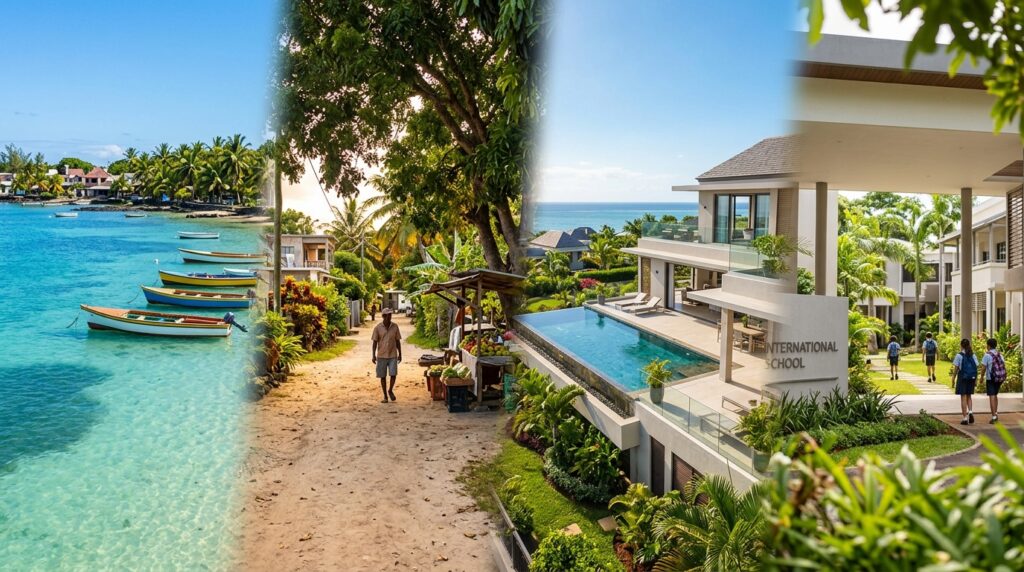
Grand Gaube is a fishing village on the north-east coast, known for the colourful pirogues drawn up on the sand and for its view of the offshore islets, including Coin de Mire. Calodyne, which administratively falls under the Grand Gaube village council in the Rivière du Rempart district, stretches just alongside on a coastline where several new residences have been built in recent years, without the area losing its rural, small-town character. The contrast with Grand Baie or Trou aux Biches, a few kilometres to the south, is obvious the moment you leave the main road: no commercial seafront, no rows of restaurants, but side roads lined with Creole houses and plots still undeveloped. For a wider view of the whole region, living in the north of Mauritius sets these two villages in the context of Grand Baie, Pereybère and Trou aux Biches. The neighbouring village of Cap Malheureux has its own guide.
The 2015 census puts the population of Grand Gaube at around 7,600 — a figure that gives the measure of a rural locality rather than a town.
The climate on this stretch of the north
Like the whole east coast of the island, this area is more exposed to the trade winds than the more sheltered west coast. Those winds, most consistent from May to September, blow mostly from the east to south-east and temper the tropical heat, at the cost of a lagoon that is sometimes choppier than at Flic-en-Flac or Tamarin. For anyone after a garden sheltered from the wind year round, the question is worth asking before buying, plot by plot, as exposure varies considerably with immediate proximity to the coast.
The logistics of daily life
Grand Baie, with its bazaar, its supermarkets and its nightlife, is about ten kilometres away. Locally, in Grand Gaube and Calodyne, the retail offer is that of a village: small shops, a few restaurants oriented towards the area’s hotels, a local market. For a range of shops, a shopping centre or a late-opening pharmacy, the reflex is to take the car south. Allow around 70 kilometres, a little under an hour off-peak, to reach SSR International Airport in the south of the island.
Healthcare and emergencies
The reference public hospital for the districts of Pamplemousses and Rivière du Rempart, which cover Grand Baie, Triolet and Goodlands among others, is the Sir Seewoosagur Ramgoolam National Hospital at Pamplemousses. Private clinics, for their part, are concentrated further south, around Grand Baie. For a resident of Grand Gaube or Calodyne, a night-time emergency therefore means a drive — something that weighs in the choice of area for a family with young children or elderly relatives.
Schools and family life
The two options most often mentioned for an international education in the north are both at Mapou, near Labourdonnais Village: École du Nord, a French school affiliated to the AEFE network, and Northfields International School, an English-medium school preparing students for the International Baccalaureate. Both are around twenty minutes’ drive from Grand Gaube and Calodyne, which makes them a realistic option for a family settled in the area, provided that daily journey is built into the routine. The Mauritian state system rounds out the offer for families not aiming at the international route, with schools in the surrounding localities.
The local property market and access for foreign buyers
Purchase by a foreign buyer goes, as everywhere in Mauritius, through approved new developments authorised by the Economic Development Board under the Property Development Scheme. Calodyne has a concrete example in Viva Calodyne, which combines new villas and apartments in immediate proximity to the sea. The segment remains sought after: closeness to the shore, the scarcity of genuinely seafront plots and the quiet of the area push demand upwards — though the local market has no official, dated price series reliable enough to quote here as a figure. To place this area within property prices in Mauritius by region, the north remains overall one of the most in-demand parts of the island.
Grand Gaube and Calodyne against Grand Baie and Pereybère
Grand Baie remains the reference for anyone who wants everything within walking distance: restaurants, nightlife, shops, a busy beach. Pereybère, further north, keeps the scale of a seaside neighbourhood with a very popular public beach, but is likewise a few minutes by car from the shops of Grand Baie. Grand Gaube and Calodyne sit one notch further along that axis: fewer shops on the doorstep, less noise, a less built-up shoreline and a fishing-village identity that Grand Baie lost long ago. Choosing between these areas is less about distance than about what each person is willing to give up in immediate access to gain in quiet.
Who Grand Gaube and Calodyne suit
The area suits anyone looking for an authentic seaside setting, who has a vehicle and does not need nightlife or a shopping centre on the doorstep: retirees seeking quiet, remote workers indifferent to the distance from Grand Baie, buyers of a second home focused on sea views and fishing. It suits less well a family without a car, anyone wanting to do everything on foot, or a profile drawn to the bustle and varied dining of Grand Baie or Trou aux Biches.
Frequently asked questions
Do you need a car to live in Grand Gaube or Calodyne?
Yes, in practice. The local retail offer is limited to village shops, and the nearest supermarkets, clinics and shopping centres are in Grand Baie, about ten minutes’ drive away.
Is the area suitable for a holiday rental investment?
The coastline attracts visitors looking for quiet and authenticity rather than nightlife, a different positioning from Grand Baie or Trou aux Biches. The presence of hotels in the area confirms tourist potential, but rental demand remains more targeted than in the busiest parts of the north.
How long does it take to reach the airport from Grand Gaube?
Allow around 70 kilometres and a little under an hour’s drive to SSR International Airport in the south of the island, outside peak hours.
Sources and verification
- Wikipedia — Grand Gaube, Rivière du Rempart district, 2015 census population
- Wikipedia — Calodyne, locality under the Grand Gaube village council
- Economic Development Board — Property Development Scheme
- École du Nord — Mapou campus and AEFE affiliation
- Sir Seewoosagur Ramgoolam National Hospital — catchment area for the northern districts
- Rome2rio — distance and journey time, Grand Gaube to SSR airport
Planning a property project?
Let’s talk about your project in Mauritius
Westimmo guides you through the analysis, selection and securing of your property project in Mauritius.