


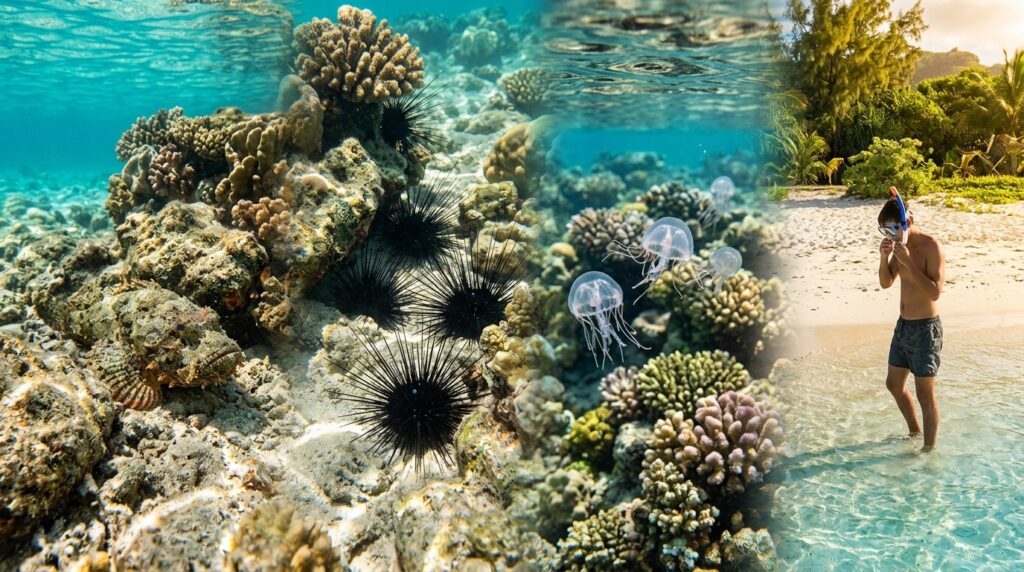
Stonefish, Sea Urchins, Jellyfish: Lagoon Dangers in Mauritius and What to Do
Stonefish, sea urchins, jellyfish and coral: what can hurt you in Mauritius's lagoon, the first aid to know and the number to call.
The dangers in Mauritius’s lagoon are mostly the ones you can’t see: a stonefish lying motionless on sand or rock, and sea urchins tucked under the coral. Serious accidents are rare, but a stonefish sting can kill, and the British Foreign Office tells anyone stung to get urgent medical help. Whatever the animal, the first move is the same: get out of the water, don’t stay alone and call 114 for an ambulance.
This guide covers what to avoid, what to do while you wait for help and which mistakes to steer clear of. It is no substitute for a doctor: a stonefish or stingray sting, or any sting that gets worse, belongs in a hospital.
Which lagoon animals can hurt you?
No Mauritian body publishes a count of lagoon stings. The pointers below come from a public-health article written in Réunion, where the same families of animals live in a neighbouring lagoon, and from general medical guidance.
| Animal | What hurts | First step |
|---|---|---|
| Stonefish | Venomous spines, mostly in the foot; camouflaged on sand or rock | Get out of the water, call 114, soak in the hottest water you can bear (45 °C at most) |
| Scorpionfish, catfish | Venomous spines | Treat as for a stonefish |
| Stingray | Venomous barb, often in the leg | Hot water (45 °C) for at least 30 minutes; no tourniquet, don’t pull out the barb |
| Sea urchin | Spines that snap off in the skin | Remove visible spines, disinfect, keep watching the spot |
| Jellyfish | Stinging tentacles | Rinse with seawater, keep an eye on it, get advice if the pain lasts |
| Coral | No venom, but cuts that get infected | Clean and disinfect thoroughly |
| Cone shell | Neurotoxic venom that can cause paralysis; no antivenom | Hospital at the first sign of paralysis; never pick one up |
Stonefish: the one to fear
A stonefish looks like a lump of rock. It hides in sand or among stones, and its spines mostly catch the feet of people wading through the lagoon. In Réunion it accounts for more than three-quarters of the lagoon stings seen in emergency rooms. For Mauritius, the Foreign Office says stonefish stings are rare but can be fatal, and that many hotels keep antivenom in stock.
The pain is often severe and can leave a swimmer unable to control their movements in the water. Swelling can spread up the whole limb within minutes. Call an ambulance straight away if you notice trouble breathing, faintness, an irregular heartbeat, spreading tingling or convulsions.
What to do after a stonefish sting
- Get out of the water without thrashing about, and don’t leave the person on their own.
- Call 114 (emergency medical services), or ask the hotel or the nearest lifeguard post for help.
- Soak the area in the hottest water the person can stand, no hotter than 45 °C. One US medical source says to soak for 30 to 90 minutes, checking that the water stays hot. Test the water on an unaffected part of the body first, so you don’t scald.
- If it is bleeding, press on the wound with a clean cloth. Don’t apply a pressure-immobilisation bandage, and don’t pull out a spine that has stayed in place: it may be plugging the wound.
- Have it checked at a hospital even if the pain eases. Hot water relieves the pain, but only a hospital can give antivenom if it is needed.
Hot water is not a complete treatment: it eases the pain while help is on its way.
Sea urchins, jellyfish, coral and cone shells
An urchin sting hurts sharply for about a quarter of an hour, according to the Réunion article. The real risk is the spine fragments left in the skin, which can cause granulomas or infection. Take out what sticks out, disinfect, then watch the spot over the following days: spreading redness, warmth or a fever means seeing a doctor.
Lagoon jellyfish sting mostly in the southern summer and are generally painful rather than dangerous. The UK’s National Health Service advises rinsing with seawater rather than fresh water, not urinating on the sting and not using ice. It also says to take out any spines with tweezers and to soak the area in water as hot as you can bear for at least 30 minutes. A sting picked up in the tropics, or a reaction that goes beyond a simple burn, deserves medical advice.
Coral carries no venom, but its cuts infect easily, so clean and disinfect them thoroughly even if they look trivial. As for cone shells, their venom is neurotoxic and no antivenom is known; the advice is never to pick one up or slip one into a pocket or swimsuit.
How to avoid an accident
- Wear reef shoes to walk in the water and on the reef, and never step on coral.
- Touch nothing: a “pebble” or a shell may be an animal.
- Keep your distance from stingrays and leave moray eels alone, as they bite deeply when disturbed.
- When snorkelling, a thin wetsuit or a rash vest also protects against jellyfish.
To choose where to swim and what to know before putting your face in the water, see our guide to snorkelling in Mauritius. The fragility of the reef is covered in the article on Mauritius’s coral reefs, and the other big worry for swimmers, sharks, has an article of its own. If you dive with a tank, the page on scuba diving in Mauritius completes this advice.
Sources and checks
- GOV.UK (Foreign, Commonwealth & Development Office): travel advice, health in Mauritius
- Santé.fr, with Ma santé.re: stings and bites in the lagoon (19 July 2024)
- Expat.com: emergency numbers in Mauritius (updated 20 February 2026)
- UF Health: stonefish sting
- myDr: first aid for stonefish and other stinging fish
- NHS: jellyfish and other sea creature stings
Planning a property project?
Let’s talk about your project in Mauritius
Westimmo guides you through the analysis, selection and securing of your property project in Mauritius.