


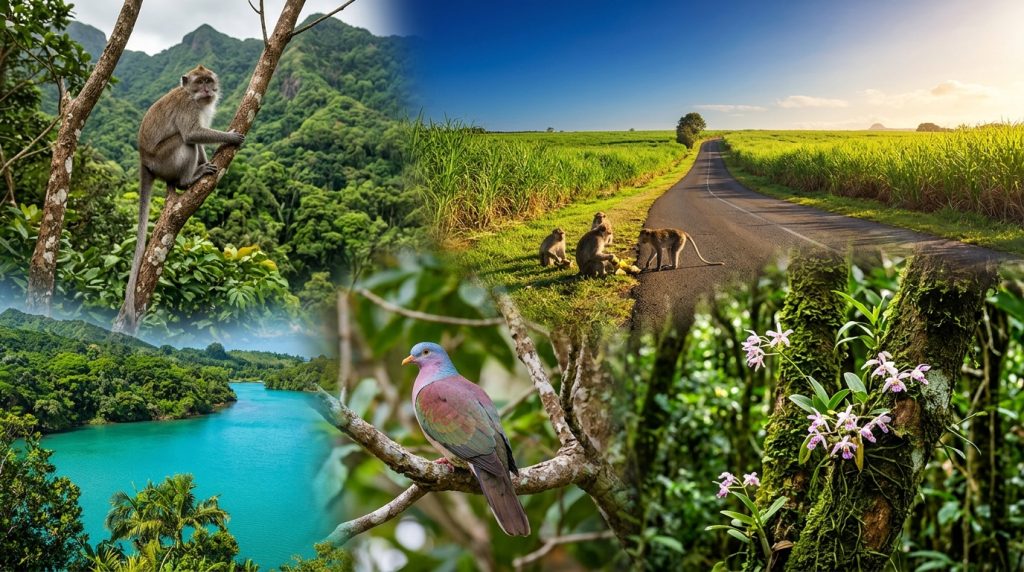
Monkeys in Mauritius: Where the Macaques Came From and Why They Are a Problem
Long-tailed macaques were introduced to Mauritius around 1602. They threaten native birds and orchids and are the subject of a contested export trade. Facts, figures and the debate.
The monkeys of Mauritius are long-tailed macaques (Macaca fascicularis), a species from South-East Asia that the Dutch brought to the island around 1602, almost certainly as pets. They are not native. On the island they count among the invasive alien species: they eat the eggs and chicks of birds, the unripe fruit of native trees and the hearts of some orchids. They have also become a commodity, as Mauritius ships several thousand macaques a year to research laboratories.
Where do the macaques of Mauritius come from?
According to Vincent Florens, associate professor of biosciences at the University of Mauritius, the Dutch introduced the macaques from South-East Asia around 1602, almost certainly as pets.
In the 1980s the monkey became a resource. The company Bioculture began breeding macaques for research in 1985, and the first exports date from the same year. At first the supply came from trapping wild animals in forests, national parks, nature reserves and riverside woodland.
How many monkeys live in Mauritius?
Nobody offers a recent, certain figure. The most quoted estimate for wild animals is 25,000 to 35,000, and Vincent Florens does not say how it was reached. He puts the captive population, in breeding farms, at tens of thousands, but it is unknown. If you see a precise number for the island’s monkeys, check its date and method first.
Why the macaque is a problem for native wildlife and plants
Mauritius is a biodiversity hotspot, and its native species evolved no defences against an omnivorous monkey. Researchers describe several effects:
- Macaques raid nests. The IUCN’s Global Invasive Species Database (GISD) records egg-eating in Mauritius and lists several threatened birds among the possible victims.
- They chew the tender heart of some plants, notably large orchids. Vincent Florens points out that 20 of the island’s 91 known orchid species appear to have vanished since 1769, without blaming macaques alone.
- They destroy the unripe fruit of native trees, including the “dodo tree” and ebony, which cuts the food available to wildlife such as the Mauritian flying fox.
- In the fields, the GISD profile says they attack sugar cane and other crops.
The setting makes it worse. According to Vincent Florens, 95.6% of the island’s native ecosystem has gone and about 80 km² of forest remains. In so small a habitat, a predator of nests and young shoots weighs heavily. It also makes restoration work fragile, such as the work you can visit at the Ebony Forest in Chamarel, and it recalls the fate of other island species already lost.
Endangered elsewhere, a pest here
The situation is paradoxical. The IUCN has listed the long-tailed macaque as Endangered since 2022 (it was previously Vulnerable), and its October 2025 assessment puts the decline of wild populations at 50 to 70% over three decades. The IUCN kept that listing after a complaint from a US biomedical lobby group, while acknowledging that the original text used overly emotive wording. That status applies to the species in its native range in South-East Asia. In Mauritius it is introduced, and the GISD profile places the island in the “control” category of management.
Breeding for research: a trade, some figures and a controversy
Figures reported in the Mauritian press give a sense of the scale:
- 10,827 macaques exported in 2020, according to Vincent Florens.
- More than 103,000 long-tailed macaques left Mauritius between 2015 and 2023, mainly for the United States, Canada and Europe (L’Express, April 2026).
- 1,248 macaques exported to the United Kingdom in 2025, from the latest figures supplied by the Mauritian government and cited by the same newspaper.
- Export revenue of about US$20 million in 2014 (close to Rs 1 billion) and US$86.628 million in 2024 (close to Rs 4 billion), according to a parliamentary reply reported by L’Express in March 2025.
Each exported monkey carries a levy earmarked for conservation: US$125 in 2022 according to Vincent Florens, US$200 in 2025 according to L’Express. The Native Terrestrial Biodiversity and National Parks Act 2015 also provides that the National Parks and Conservation Fund is fed, among other sources, by the levies that monkey export companies pay.
The trade is contested. The charity Animals International and the Mauritian collective Monkey Massacre in Mauritius are calling for exports to end and for any plan for testing on the island to be dropped, as the government aims to turn Mauritius into a biomedical hub. Their argument is that alternatives (cell cultures, organs-on-chips, modelling) are advancing and that the United States has announced a roadmap to phase down animal testing by 2035. Defenders of the trade point to its contribution to medical research and to conservation funding. On the breeding side, Vincent Florens notes that farms need several thousand wild females a year to limit inbreeding, and that intensive trapping has cut sightings where it has taken place.
The debate is less about the animal than about what is done with it. Vincent Florens argues for eventual eradication of this alien species, starting with isolated forest pockets or with lower numbers through intensive trapping or fencing. The GISD profile adds that live trapping may be seen as inappropriate on socio-religious grounds and that animals can become trap-shy. None of these positions is unanimous.
What to do if you live in Mauritius or are buying here
You are most likely to meet a macaque near forests, rivers and farmland. A few simple habits follow, offered as common sense rather than a legal duty we have checked:
- Do not feed them. A monkey that links people with food comes back, and grows bolder.
- Keep bins and food in closed containers, and do not leave fruit within reach on terraces.
- Do not seek contact. The GISD profile describes macaques in general as aggressive towards people and carriers of potentially fatal diseases, including B virus. If you are scratched or bitten, see a doctor.
- For a garden or orchard, factor them in before you buy: a property on the edge of a forest or beside a river gets different visitors from a town development.
Sources and checks
- The Conversation: Vincent Florens, University of Mauritius, “The macaque monkeys of Mauritius: an invasive alien species, and a major export for research” (22 February 2022).
- IUCN, Global Invasive Species Database: Macaca fascicularis profile.
- Mongabay: “IUCN upholds long-tailed macaque’s endangered status after complaint” (15 October 2025).
- L’Express (via AllAfrica): monkey exports and revenue in 2024 (27 March 2025, in French).
- L’Express (via AllAfrica): “Le sort des macaques mauriciens dans les labos britanniques” (24 April 2026, in French).
- FAOLEX: Native Terrestrial Biodiversity and National Parks Act 2015 (legal text).
Planning a property project?
Let’s talk about your project in Mauritius
Westimmo guides you through the analysis, selection and securing of your property project in Mauritius.