


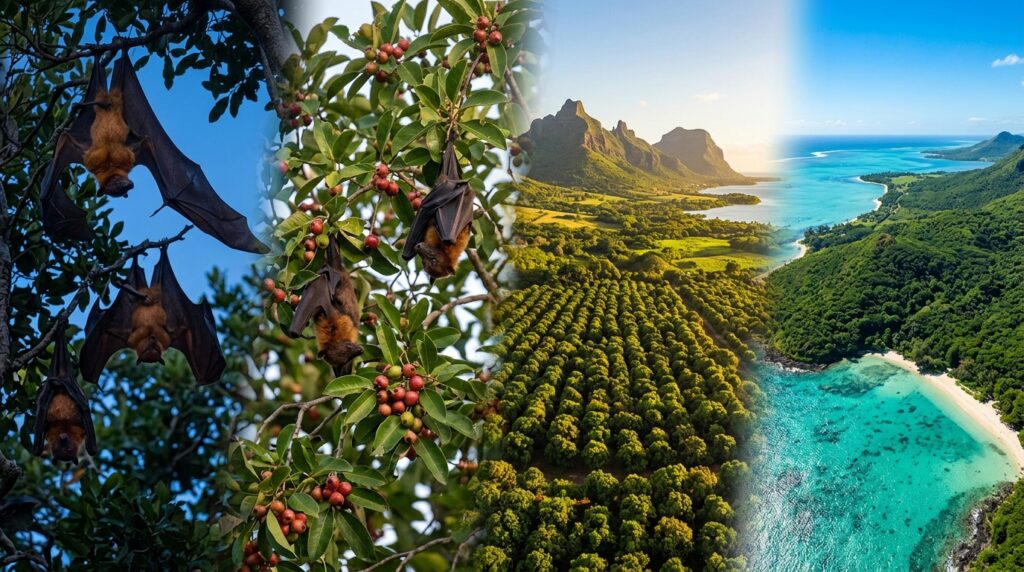
Mauritian Flying Fox: The Endemic Fruit Bat at the Heart of the Cull Debate
The Mauritian flying fox is an Endangered fruit bat that disperses native forest seeds but raids orchards. Facts, figures and non-lethal options.
The Mauritian flying fox (Pteropus niger) is the island’s largest endemic land mammal, a fruit bat the IUCN has listed as Endangered since 2018. It spreads the seeds of a large share of Mauritius’s native trees, yet it also feeds on lychees and mangoes in commercial orchards. That clash led the government to order culls in 2015, 2016, 2018 and 2019.
What is the Mauritian flying fox?
It is a big fruit bat with a wingspan of up to 80 cm, long silky golden fur and small ears. Unlike the small insect-eating bats, it does not use echolocation; it finds food by smell and sight.
It lives nowhere else in the world. By day it roosts in forest, often on the leeward side of the mountains, out of full sun and in places with restricted access. A single roost can cover a few hundred trees. The bats leave at dusk and can travel up to 24 km in a night to feed.
Colonies shift between roosts with the wind, the fruit supply and the breeding cycle. Mothers with young and bachelor males use separate roosts.
What it eats, and why the forests need it
The flying fox eats mostly fruit, both native and introduced, along with nectar. It finds it in forests, but also on plantations, smallholdings and in gardens.
Its ecological role has been measured. In six of the best-preserved wet forests in Mauritius, researchers surveyed 90 plots of 100 m². About 24.6% of native woody plant species have fruit that the bat eats and whose seeds it disperses. Those species make up 53.1% of the stems and 63.1% of the basal area of native woody plants. For roughly half of that basal area, the flying fox is the only native vertebrate that disperses the seeds. They are mostly large trees with large fruit, the ones that form the forest canopy.
So for the plants you see at the Ebony Forest in Chamarel or in the mountain forests, this bat does a job few other animals can still do. Mauritius has already lost two bat species, as well as birds such as the dodo, and the flying fox is the last of its genus on the island.
Why lychee and mango growers complain about it
The bats eat ripe fruit straight from the tree, and growers hold them responsible for heavy losses. Growers put the damage at 10 to 35% of the fruit and the cost at around US$5 million a year. The Food and Agricultural Research Council used a lower average of about 10% a year for lychees.
A study in commercial orchards in 2015 and 2016, published in Oryx in November 2018, adds nuance. Total fruit loss from all causes (birds, natural fall, fungus) ranged from 7% to 76% per tree. Across four lychee orchards, bats damaged 25.5% of the fruit on average, against 5.8% for birds. The differences between orchards were large: on tall lychee trees, bat damage ran from 9.4% to 52.8% depending on the estate.
Tree height mattered a great deal. On tall mango trees bats damaged 31.3% of the fruit, but only 0.4% on small trees. Birds tend to target the lower trees. Researchers from Oxford and Texas Tech wrote in 2020 that birds, often introduced species, cause most of the orchard damage.
The culls: what is established
Hunting the flying fox for food or sport has been banned since 1983. Growers lobbied to have the protection lifted from 2002 onwards, and they succeeded in 2015.
- 2015: 30,938 bats killed, according to government figures reported in Oryx.
- 2016: 7,350 bats killed, from the same source.
- October 2018: a new cull announced, targeting 20% of the remaining population, about 13,000 animals according to a petition quoted by Mongabay.
- 2019: another cull ordered, according to The Conversation.
- November 2020: the same authors report a new plan to cull 10% of the population.
Illegal hunting comes on top, estimated at 5,000 to 6,000 bats a year. Together, culling and poaching cut the population by more than 50%.
Even the starting count is disputed. The government put the population at about 100,000 in 2015, based on disturbance counts at roosts that researchers consider inaccurate and prone to double counting. The researchers’ own estimate for 2016 is 62,500, give or take 7%.
| Year | Estimate | Source |
|---|---|---|
| 1974 | about 10,000 | Cheke and Dahl, 1981 |
| 2015 | about 100,000 | Government of Mauritius |
| 2016 | 62,500 (± 7%) | Kingston et al., 2018 |
In 2018 the IUCN moved the species from Vulnerable to Endangered, citing an estimated 50% decline in 2015-2016 and a projected decline of more than 50% by 2035. The latest culling decisions on record date from 2020, and the species’ current numbers remain uncertain.
Can orchards be protected without culling?
The authors of the Oryx study say largely yes. A net over the treetop, big enough and well placed, cut bat damage by up to 23 times. The government covers 50 to 75% of the cost of nets, according to Mongabay. Picking earlier also helps, since the bats prefer very ripe fruit, and pruning trees to keep them low makes them less attractive.
A 2022 university thesis on the conflict concludes that every side had valid arguments, but that poor communication and a lack of mediation led to ineffective action.
Where and when to see one
You are most likely to see a flying fox at dawn and dusk, as it heads out to feed or flies back, sometimes far from its roost. The known roosts are in forest, mostly in the mountain ranges, above all in the Bel Ombre forest, with smaller groups at Combo and near Black River. Access is restricted and none are in villages.
The simplest way to see one is to look up at sunset from a garden or a trail, without trying to approach a roost. For more of the island’s native wildlife, see our guides to Mauritius’s endemic birds and to the phelsuma geckos.
Sources and checks
- Oryx (Cambridge University Press): Oleksy et al., 2018, impact of the flying fox on commercial fruit farms and effectiveness of mitigation.
- Journal for Nature Conservation: Florens et al., 2017, ecological role of the flying fox in native forests.
- The Conversation: Zimmermann, Macdonald and Kingston, November 2020.
- Mongabay: culls and non-lethal measures, December 2018.
- University of Cape Town: Naiken, 2022, thesis on the flying fox conflict.
- Belombrepedia: description, roosts and behaviour of the species.
- Wikipedia: IUCN status and roost locations.
Planning a property project?
Let’s talk about your project in Mauritius
Westimmo guides you through the analysis, selection and securing of your property project in Mauritius.