


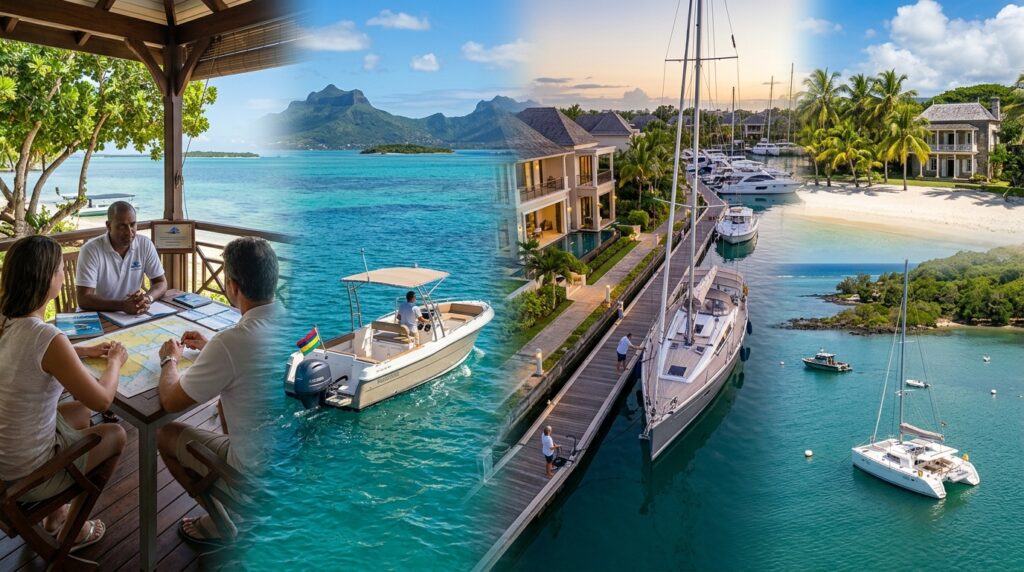
Owning a Boat in Mauritius: Licence, Mooring and Marina Rules for Property Owners
Pleasure craft licence, skipper permit, designated mooring or titled berth in a marina: the real rules for owning and keeping a boat in Mauritius.
Owning a boat in Mauritius requires two separate documents issued by the Tourism Authority: a Pleasure Craft Licence for the vessel itself, valid for twelve months, and a Skipper’s Licence for whoever operates it, valid for three years. Foreign nationals need a valid residence or work permit to obtain the Skipper’s Licence — a tourist or student visa is not enough. That legal framework, more than the boat itself, is what decides whether the project is straightforward or complicated for a property owner based in Mauritius.
What it takes to operate a boat legally
The Tourism Authority Act covers any pleasure craft used for sport fishing, water sports or leisure. Three obligations fall on the owner: registering the boat with the Tourism Authority, holding a Pleasure Craft Licence renewed every year, and carrying insurance covering third-party liability for bodily injury or property damage caused while using the boat. Operating a boat without a valid Pleasure Craft Licence is a criminal offence, not just an administrative lapse: it carries a fine of between 5,000 and 50,000 rupees and up to one year in prison, rising to between 20,000 and 200,000 rupees and up to five years for a repeat offence.
To take the helm, a Skipper’s Licence is also required, granted after a competency test, in one of three categories depending on the navigational range allowed: up to 12 nautical miles, up to 24 nautical miles, or unrestricted for the ocean-going category. The minimum age to operate a pleasure craft is 16, raised to 18 for commercial use.
Who can actually get these licences from Mauritius
The Tourism Authority issues the Skipper’s Licence to Mauritian citizens and to foreign nationals holding a valid residence or work permit. Tourist and student visa holders are not eligible. A non-resident owner who only visits Mauritius occasionally therefore has two options: hire a locally licensed skipper to run the boat, or sort out residence status first before taking the helm personally.
Designated mooring or a titled berth in a marina: two different ways to keep a boat
Mooring spots cannot simply be chosen at will — their designation and regulation are set through regulations made under the Tourism Authority Act, under the authority of the responsible minister. An owner with no marina access has to stick to officially designated mooring areas, generally watched over by the National Coast Guard, which is among the bodies tasked with enforcing pleasure craft legislation.
The alternative, increasingly chosen by foreign buyers, is to purchase a property inside a residential development built around a private marina, where the berth is part of the estate’s infrastructure rather than an individual mooring to be secured separately. That is the model behind La Balise Marina in Tamarin, the country’s only residential marina, where shared and private berths are part of what is offered to owners. The boat itself still falls under the same registration and licensing rules: the marina simplifies mooring, not the paperwork with the Tourism Authority.
Building your own jetty on your own beachfront: what the rule actually allows
The Mauritian coastline — the “pas géométriques” strip between the shore and the line reached by the sea at high tide — remains public land even where it borders a private plot. An owner cannot simply build a jetty or boat house there on their own initiative: any such structure requires a state land lease granted by the Ministry of Housing and Lands, with a minimum building setback of 30 metres from the high water mark and, for works affecting the beach or lagoon such as jetty construction, an environmental impact assessment. The Ministry also states that no new campement site leases are currently being granted on this land, which sharply limits an individual’s ability to secure private shoreline access outside an already-approved development.
In practice, an individual jetty or boat house remains a project for developers engaged in a structured tourism or residential scheme — not something the owner of a beachfront villa can simply add on their own.
Why a marina residence makes life easier for an owner
This regulatory constraint on the coastline is exactly why residences built around a private marina appeal to buyers who actually want to use a boat from home. The berth is part of the title or the common infrastructure of the residence, already authorised when the scheme was built, with no individual lease application to pursue afterwards. A project of this kind falls into the same category as other new-build property schemes in Mauritius open to foreign buyers, with the added nautical infrastructure. Tamarin and Black River concentrate most of this offer on the West coast; Grand Baie, in the North, remains the island’s historic nautical hub, with its own mooring areas and boat rental operators, but no equivalent residential marina. To compare these areas, the Tamarin real estate, Black River real estate and Grand Baie real estate pages detail what is available in each.
Insurance and upkeep, the obligations that come with the licence
The law requires an insurance policy covering liability arising from the use of the boat, on terms set by regulation, before it can be put to sea. The Tourism Authority can also require, at first application and again at certain renewals, that an approved surveyor examine the boat and its engine, check that the required safety equipment is on board, and confirm the maximum passenger capacity. Anyone buying a second-hand boat is better off checking these points before the purchase rather than at licence application stage, where a surveyor’s refusal stops the boat going to sea.
The mistakes that get expensive
Operating a boat without a valid Pleasure Craft Licence, or letting someone without a Skipper’s Licence take the helm, is a criminal offence, not merely a paperwork issue: both carry a fine starting at 5,000 rupees and a possible prison term. Letting the licence lapse without renewing it within thirty days of expiry cancels it outright, with a 50% surcharge on top of the renewal fee if it is sorted out within that window. An owner who only uses the boat occasionally should track the Pleasure Craft Licence’s own expiry date, separate from the three-year Skipper’s Licence, to avoid ending up unknowingly on the wrong side of the law.
Sources and verification
Planning a property project?
Let’s talk about your project in Mauritius
Westimmo guides you through the analysis, selection and securing of your property project in Mauritius.