


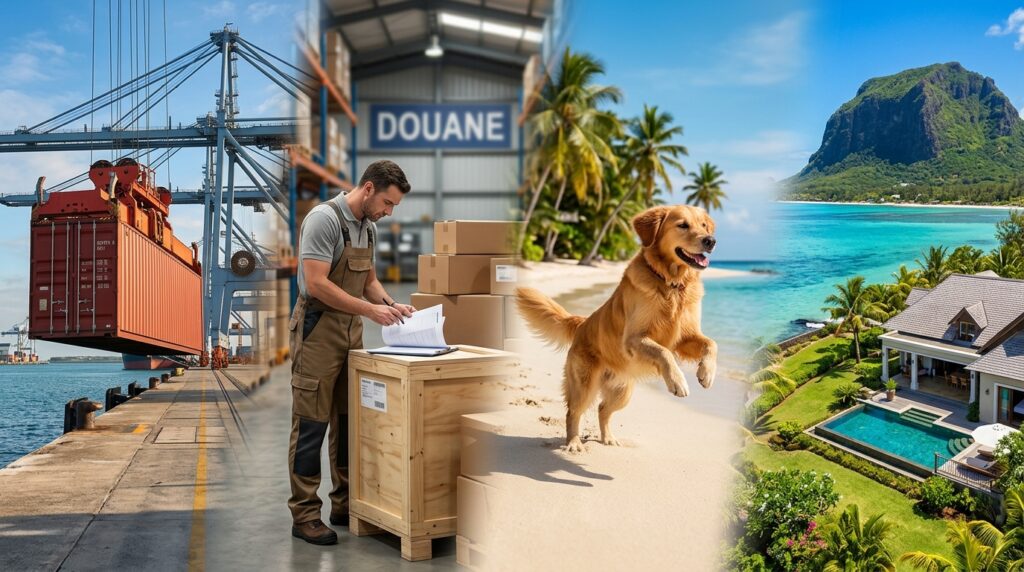
Moving to Mauritius in 2026: Container, Customs and Pets
Get your move to Mauritius right in 2026. The complete guide: sea transit times, customs exemption (MRA) and the three-month quarantine for your pets.
Moving to Mauritius calls for tight coordination between obtaining your residence permit, shipping your personal effects and completing the veterinary protocol for your pets. Allow 30 to 45 days of sea transit and at least six months of lead time to avoid customs holding charges and to accommodate the three-month animal quarantine.
The departure dilemma: ship your furniture or buy everything again?
Shipping a container makes sense for items of strong sentimental value or for a complete set of high-quality equipment. For standard furnishings, the local second-hand market lets you kit yourself out quickly and cheaply.
Before booking a carrier, the first step is to assess the real volume of your belongings. Three logistical options are open to you:
- Full container load (FCL): ideal for a whole house. You hire a 20 or 40-foot container reserved exclusively for you.
- Groupage (LCL, less than container load): sensible if you are only taking a few cubic metres (boxes, small furniture). Your things share a container with other shippers. Transit is often longer, since the container has to fill up before it sails.
- Air freight: reserved for urgent cases or essential personal effects. The cost per kilo is high, but delivery takes a few days.
If you decide to travel light, it is entirely feasible to furnish a house once you have arrived. Community support groups, such as Mums of the North on social media, are very active. They let newcomers who have come to live in Mauritius buy appliances or furniture from departing expatriates.
One timeline: synchronising visa, freight and pets
The costliest mistake is shipping your container before you are certain of getting your residence permit. If your belongings reach Port Louis before your status is confirmed, you expose yourself to punishing daily demurrage charges.
Here is the real order of operations to secure your move:
- Six months before: start the veterinary protocol for your pets (specific vaccinations and rabies serology test).
- Four months before: request international removal quotes and formally submit your residence permit application to the Mauritian authorities (EDB).
- Two months before: confirm the shipping line and prepare the detailed customs inventory of your boxes.
- One month before: obtain the final veterinary import permit for your pet.
- On arrival: present your residence permit to customs (MRA) to clear your personal effects, and transfer your animal to the quarantine station.
Customs (MRA): importing personal effects tax-free
To qualify for customs duty exemption in Mauritius, you must hold a residence permit, import your goods within six months of arrival, and not resell them for four years.
The Mauritius Revenue Authority (MRA) applies strict rules to the import of personal effects. Exemption from customs duty and VAT is granted to new permanent residents, to foreign workers holding a permit, and to Mauritian citizens returning after more than a year abroad (Returning Citizens).
The cumulative conditions for this exemption are as follows:
- The goods must have been bought abroad and must not be intended for sale.
- Importation must take place within a maximum of six months from the passenger’s date of arrival. The Director-General of Customs may only grant a waiver for just or reasonable cause (such as political unrest in the country of departure).
- Four-year retention clause: the exemption is not definitively acquired on the day you arrive. If you resell or transfer exempted goods within four years, you are obliged to notify the MRA and pay the tax pro rata.
Certain items are formally prohibited in removal boxes, notably foodstuffs of animal origin and some common French medicines (such as Di-Antalvic or methadone). Physical inspection of the container is frequent at Port Louis.
Bringing your dog or cat: a tightly controlled process
Importing dogs and cats into Mauritius requires several months of preparation, including a rabies serology test, compulsory neutering and an official three-month quarantine at the Réduit station.
The Mauritian authorities (Division of Veterinary Services) apply an inflexible health protocol to maintain the island’s rabies-free status. The slightest discrepancy in vaccination dates results in refusal of boarding or the animal being turned away on arrival.
| Criterion | Veterinary and legal obligations |
|---|---|
| Identification | ISO 11784/11785 standard microchip compulsory. |
| Dog vaccinations | Rabies, distemper, leptospirosis, parvovirus. |
| Cat vaccinations | Rabies, enteritis, rhinotracheitis, calicivirus. |
| Rabies serology test | Result >= 0.5 IU/ml. Blood sample taken 30 days after vaccination and at least 90 days before travel. |
| Reproduction | Neutering compulsory for both dogs and cats. |
| Quarantine | Three months at the government station at Réduit (per the official public website). |
Mauritian law strictly prohibits the import of nine dog breeds (and their crosses): the American Pit Bull Terrier, American Staffordshire Terrier, Staffordshire Terrier, Blue Nose Pit Bull, Red Nose Pit Bull, Japanese Tosa, Dogo Argentino, Fila Brasileiro and Boerboel.
Dogs classed as dangerous under the First Schedule (such as the Rottweiler or Dobermann) are not banned, but importing them requires a pedigree proving the absolute purity of the breed.
Sea freight logistics and costs in 2026
Average sea transit from Europe to Port Louis is 30 to 45 days. The final budget must include local landing charges and any demurrage.
The cost of an international move does not stop at the carrier’s initial invoice. Once the ship reaches Port Louis, local charges apply as a matter of course: terminal handling charges, unpacking fees for a groupage container, and customs agency fees.
Budget too for the costs tied to animal quarantine (daily boarding, veterinary visits), and check that your airline accepts animals in the hold under IATA standards (toys are generally prohibited in transport crates, and food must be attached to the outside).
The Westimmo team regularly supports new residents with the practical side of settling in and can point you towards the right administrative and logistics contacts to secure these steps.
Frequently asked questions
Which medicines does Mauritian customs prohibit in a household move?
Mauritian customs formally prohibits importing medicines containing certain opiates or psychotropics, such as Di-Antalvic or methadone. Any personal medical treatment must be accompanied by its original prescription, translated, to avoid seizure during container inspection.
Sources and verification
- Mauritius Revenue Authority (MRA)
- Attorney General’s Office (Animal Welfare Act 2013)
- Ministry of Agro-Industry (Division of Veterinary Services)
Information verified against these sources on 30 August 2026. Amounts, thresholds and conditions change: confirm them with the relevant authority before making any decision.
Planning a property project?
Let’s talk about your project in Mauritius
Westimmo guides you through the analysis, selection and securing of your property project in Mauritius.