


Pamplemousses Botanical Garden: What You Actually See, and How to Visit
Opening hours, prices and a visitor's guide to the Pamplemousses botanical garden: giant water lilies, palms, the spice corner, history and rules.
The Sir Seewoosagur Ramgoolam Botanic Garden in Pamplemousses is open every day, public holidays included, from 8.30am to 5.30pm. A foreign visitor aged 5 or over pays Rs 300, but a residence permit holder pays just Rs 25, the same as a Mauritian aged 5 to 59. These are the prices on the garden’s official website on 1 October 2026 and they can change, so check before you go.
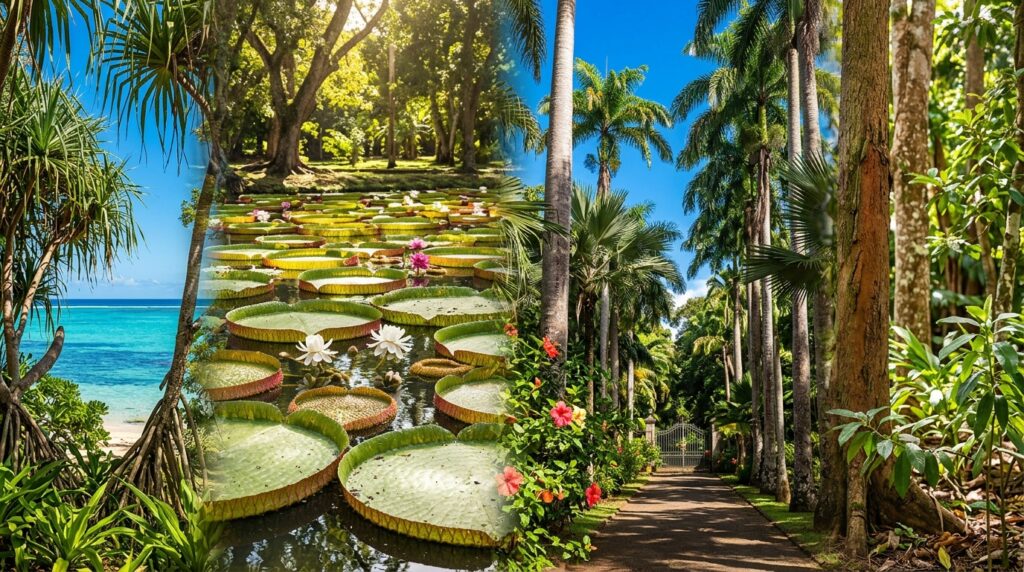
It helps to know what you are coming for. This is not a wild-flora reserve: of 823 species, 445 are exotic and only 60 are endemic. It is an acclimatisation garden almost three centuries old, and its appeal lies in the giant water lilies, the palms, the spice corner and the history of the place.
What is really worth seeing
The water lily and lotus ponds
The rectangular pond holds the giant Amazon water lily (Victoria amazonica), whose huge floating leaves have an upturned rim. Its flowers open in the late afternoon on two successive days and stay open until mid-morning the next day. They are creamy white and scented on the first evening, then pink. If you want to catch them fresh, aim for the end of the day rather than opening time. The garden also has at least three other Nymphaea species in white, pink and blue, and lotus ponds (Nelumbo nucifera), the lotus sacred to Hindus, with white, yellow and pink flowers.
The palms
The garden is a palm collection on a grand scale, with eighty species, eight of them endemic to the Mascarenes. The talipot (Corypha umbraculifera), native to India and Sri Lanka, arrived in 1825 with the Sinhalese prince Ehelepola, whom the British exiled to Mauritius. It bears the largest flower cluster in the plant kingdom and dies soon after setting seed. The first talipot planted here flowered in the 1920s. The royal palm was introduced under James Duncan, who became director in 1849.
The spice corner and the medicinal garden
Nutmeg, clove and cinnamon have been grown here since June 1770, when Pierre Poivre brought the first two spices from the island of Banda. The first cloves fruited in October 1776 and the nutmeg in December 1778. The spice corner stands near the Liénard Obelisk, at the corner of Labourdonnais and Liénard avenues. The garden points out that much of the work was done by enslaved labour: some enslaved gardeners, such as Rama, were sent to train gardeners in other French colonies. The medicinal garden was created in 1995 with the Chinese Agricultural and Technical Team, restored in May 2009, and holds about 150 species on 1,155 m².
The Grand Bassin and the animals
Cross the bridge on Rochon Avenue and you reach a kiosk on an islet in the Grand Bassin, a former marsh dotted with small islands. Moorhens live along the banks, while the islets, covered in papyrus, travellers’ palms and Indian almond trees, shelter birds and are off limits. The lake is full of tilapia and gouramis. An enclosure holds deer and giant tortoises (Aldabrachelys gigantea), and you may also see parrots, ducks, freshwater turtles and the bat Pteropus niger, Mauritius’s only endemic mammal, which roosts in the garden. The birds the garden lists are waterfowl and parrots. For endemic birds, our guide to birdwatching in Mauritius says where to go.
A little history to make sense of what you see
The site began as a vegetable garden. Mahé de Labourdonnais became governor of Isle de France in 1735 and bought the Mon Plaisir estate the following year to feed his household, Port Louis and passing ships, and he brought in cassava from Brazil. The French East India Company took the estate over in 1739 and planted it with mulberry trees for a silk industry that failed. The real creator of today’s garden was Pierre Poivre, intendant from 1767, who acclimatised nutmeg and clove trees brought from the Moluccas, followed by the botanist Nicolas Céré, director from 1775 until his death in 1810. Their work made Pamplemousses famous worldwide, and it is the oldest botanical garden in the Southern Hemisphere.
Several landmarks show up as you walk. Château de Mon Plaisir, built in 1823, is a national heritage building with a view of the Moka range and Pieter Both. The wrought-iron main gate, a gift from François Liénard, has stood where it is now since 1868. The Pont des Soupirs dates from the French period: the Citron river runs under it and water from the Riley canal runs over it. The garden also holds memorials to Sir Seewoosagur Ramgoolam, the first Prime Minister of independent Mauritius, whose name it has carried since 18 September 1988, and to Sir Anerood Jugnauth.
Prices and services
| Visitor | Price |
|---|---|
| Non-Mauritian aged 5 or over, without a residence permit | Rs 300 |
| Residence permit holder | Rs 25 |
| Mauritian aged 5 to 59 | Rs 25 |
| Mauritian aged 60 or over, or disabled visitor | Free |
| Child under 5 | Free |
Mauritians get in free on Sundays and public holidays. You pay an authorised guide directly at the end of the tour. The services page lists one rate of Rs 75 per visitor over 12, free below that age, and another of Rs 50 to Rs 100 per person depending on group size, so agree the price before you set off. A golf cart with a driver takes up to three people on a 45-minute ride: Rs 300 for adults and children over 12, Rs 100 for children aged 5 to 12. Parking is free, but not in front of the main gate. A wheelchair is available free on request.
The rules before you go in
The garden asks you to keep to the paths, hold on to your ticket and show it on request, and dress decently. You may not feed the animals, pick flowers or fruit, light fires, swim or fish, throw coins into the ponds, drink alcohol or smoke, or climb trees, monuments or buildings. The press announces closures when there are official visits.
Planning your visit
The garden lies about ten kilometres north-east of Port Louis and covers 33 hectares, with 41 named avenues. It works better in chosen stretches than in one go: the water lily ponds, the palms, the spice corner, the Grand Bassin. A rehabilitation programme has been running since January 2024 (infrastructure, science and culture), so some areas may be under works, and the interactive museum planned for Château de Mon Plaisir is still only a project. For a family outing, our guide to living in Mauritius with children sets the garden alongside other activities. For flora that has actually been replanted, see the Ebony Forest in Chamarel.
Depending on your situation
If you are just visiting, budget Rs 300 and go late in the afternoon for the water lilies. If you live here, a residence permit brings the entrance fee down to Rs 25, which makes it an inexpensive outing for a family settled in the North, though it is worth asking at the gate what proof they want to see. If you are still deciding where to settle, the garden is a neighbour of the new town described in Living in Beau Plan, and our guide to living in the north of Mauritius compares the area. For properties, see real estate in Grand Baie, new developments and property prices in Mauritius.
Sources and checks
- Sir Seewoosagur Ramgoolam Botanic Garden: Visitors’ Information (opening hours, prices)
- Sir Seewoosagur Ramgoolam Botanic Garden: Services (guides, golf cart, parking)
- Sir Seewoosagur Ramgoolam Botanic Garden: Do’s and Dont’s
- Sir Seewoosagur Ramgoolam Botanic Garden: About the Garden (area, species, rehabilitation)
- Sir Seewoosagur Ramgoolam Botanic Garden: History of the Garden
- Sir Seewoosagur Ramgoolam Botanic Garden: Ponds and the Grand Bassin
- Sir Seewoosagur Ramgoolam Botanic Garden: Palms
- Sir Seewoosagur Ramgoolam Botanic Garden: Medicinal and Spice corners
- Sir Seewoosagur Ramgoolam Botanic Garden: Fauna
- Sir Seewoosagur Ramgoolam Botanic Garden: Monuments and Samadhi
- Sir Seewoosagur Ramgoolam Botanic Garden: Avenues
Planning a property project?
Let’s talk about your project in Mauritius
Westimmo guides you through the analysis, selection and securing of your property project in Mauritius.