


Mauritian Farata Recipe: The Flaky Flatbread for Your Curries
A Mauritian farata recipe: dough rested for 30 minutes, oiled folds, pan-cooked, with quantities from four recipes and what to serve it with.
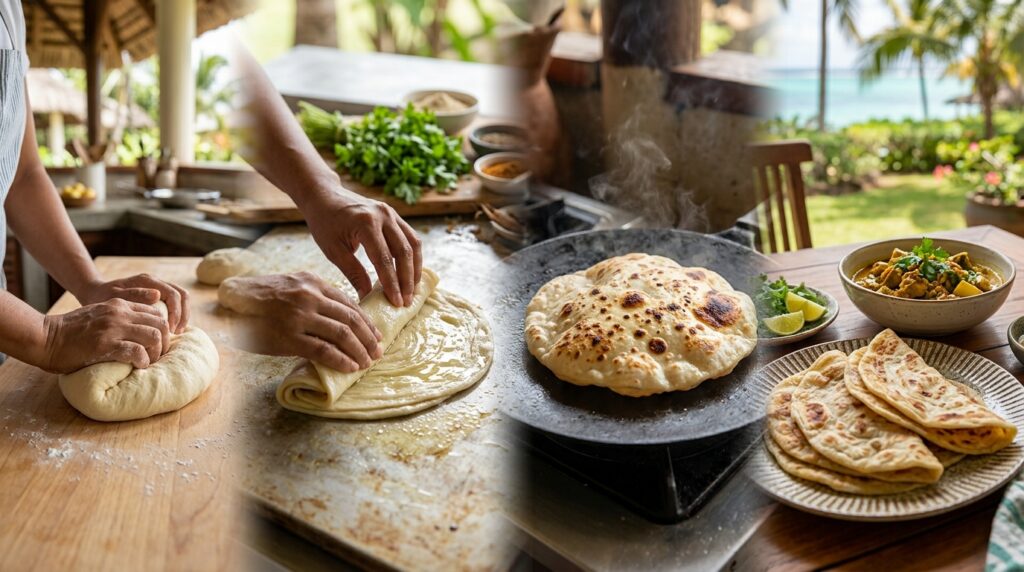
Farata is a flaky flatbread made from flour, water, salt and oil. The dough rests for 30 minutes, gets oiled and folded several times, cooks for about 3 minutes in a pan, and is then clapped between your palms so the layers separate. 400 g of flour makes 8 faratas.
Ingredients for 8 faratas
- 400 g plain flour (a French T55 works well)
- 200 ml lukewarm water
- 1 teaspoon salt
- 1 teaspoon sugar
- 4 to 5 tablespoons neutral vegetable oil, plus a little extra for oiling the dough and the pan
- Melted butter or ghee, if you like, for the layers
Step-by-step method
1. Make the dough
Mix the flour, salt and sugar, add the oil and rub it into the flour with your fingertips. Pour in the lukewarm water a little at a time, kneading until the dough is soft and no longer sticks to your hands. Shape it into a ball, oil it lightly and cover it with a cloth.
2. Rest, then divide
Leave the dough for 30 minutes. The rest makes it stretchy, so it rolls out very thin. Then split it into 8 equal balls.
3. Roll, oil and fold
On a floured surface, roll each ball into a circle as thin as you can. Oil the whole surface, fold the edges in towards the centre to make a rectangle, oil it again and fold it into a small square. Repeat the oiling and folding two or three times: the more layers, the flakier the farata.
There is another way. Roll out the oiled dough, coil it into a spiral like a snail shell, then flatten the spiral with the rolling pin. It builds layers just as well.
4. Cook
Heat a frying pan or a tawa (the round griddle used in Indian kitchens) over a medium-high heat, with no fat. Cook the farata for 1 to 2 minutes, turn it and cook for 1 minute, oil both sides, then turn it one last time for 30 seconds. It is done when golden spots cover both sides.
5. Clap it
As soon as it leaves the pan, hold the farata between your palms and clap it. This is what gives it its flaky texture.
Four recipes, one principle
Proportions differ from kitchen to kitchen, but the layers always come from the same two things: dough rested for at least 30 minutes, and fat between the folds.
| Recipe | Flour | Water | Fat | Rest |
|---|---|---|---|---|
| The one in this article | 400 g | 200 ml, lukewarm | 4 to 5 tbsp oil | 30 min |
| Softer dough | 500 g | 300 ml, hot | 2 tbsp oil | 30 min |
| Ready-made farata flour | 250 g | 140 to 160 ml | 30 g (oil, margarine or ghee) | at least 30 min |
| Ghee version | 225 g | 125 ml, cold | 150 g melted ghee | 30 min |
Two rules of thumb: T65 flour gives a flakier farata and plain flour a softer one, and ghee adds more flavour than neutral oil.
What to serve with farata
In Mauritius, farata goes first with dishes in sauce: chicken curry, lentils or sausage rougaille. It suits a Rodrigues octopus curry just as well as any other curry. You can also eat it on its own with honey or butter, or the next day with tea and butter.
For a stuffed version, spread portions of processed cheese (the “Vache qui rit” type) over the dough square before closing it, then roll it out gently so the cheese stays inside. Don’t clap this version after cooking.
Farata, roti and dholl puri: how they differ
The name varies from recipe to recipe, and several are titled “roti farata” for this plain, flaky flatbread. Dholl puri is something else: its dough encloses a split-pea purée, and it is rolled from the centre outwards rather than layered. If you like Mauritian street food, gateau piment makes a good companion.
Once you are on the island, our guide to supermarkets and markets shows where to find flour, oil and ghee, and more dishes are collected in our guide to Mauritian cuisine.
Sources and checks
Planning a property project?
Let’s talk about your project in Mauritius
Westimmo guides you through the analysis, selection and securing of your property project in Mauritius.