


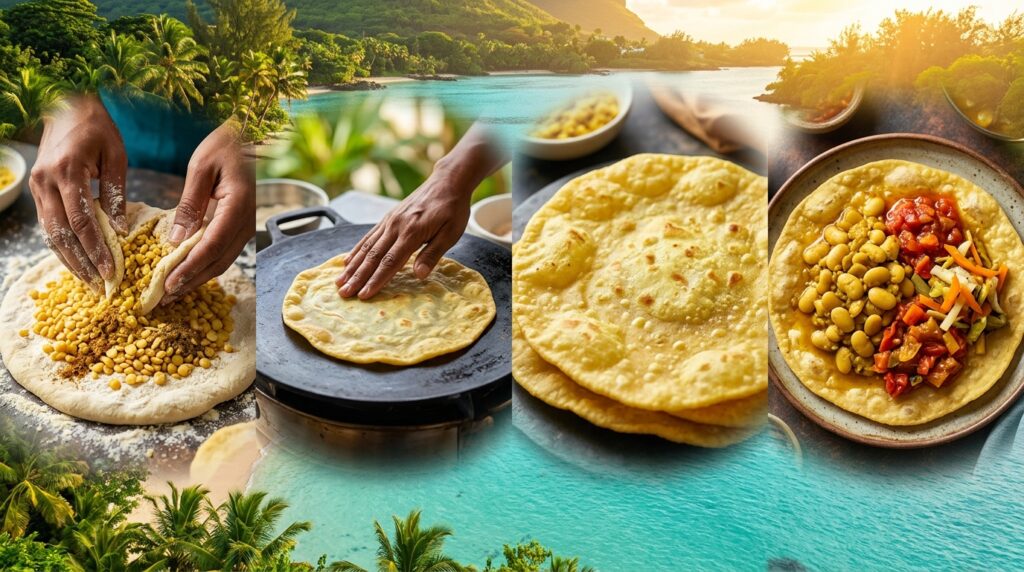
Homemade Dholl Puri: The Real Mauritian Street Food Recipe
The real dholl puri recipe, the most popular street flatbread in Mauritius: the dough, the split pea puree, tear-proof shaping and how to serve it.
Dholl puri is the most eaten street food in Mauritius: a thin flatbread filled with a turmeric-spiced split pea purée, folded and served with a curry and a chatini. Allow about an hour and a half in total, including an hour for the dough to rest — and the one gesture that separates a flatbread that tears from one that folds without breaking: roll each ball from the centre outwards, never the other way. Here is the recipe, as it is made in the island’s kitchens and on its market stalls.
The essentials:
- Dholl puri is a flour flatbread filled with a purée of split peas (dholl) with turmeric and cumin — the island’s most popular street meal.
- The gesture that changes everything: dough rested for an hour, and shaping from the centre outwards.
- Traditional serving: butter bean or bean curry, tomato rougail, vegetable achard and coconut chatini.
Ingredients (makes 10 to 12 flatbreads)
- 250 g plain flour (T65)
- 200 g dholl (yellow split peas)
- 1 tablespoon oil, plus a little more for cooking
- 110 ml hot water
- 1 teaspoon turmeric
- 1 teaspoon cumin
- Salt
The recipe, step by step
1. Cook and reduce the split peas
Rinse the dholl, then boil it in salted water with a pinch of cumin, over low heat, for about 45 minutes, until tender and almost paste-like. Drain, keeping the cooking water, let it cool, then blend finely to a smooth purée with no visible grains. Season with salt, cumin and turmeric: rolled between your fingers, the filling should hold together without crumbling.
2. Make the dough
Mix the flour and turmeric, pour in the still-hot pea cooking water and then the oil, and knead until you have a supple dough that no longer sticks to your fingers. Cover with a cloth and leave to rest for at least an hour: it is this rest that relaxes the gluten and prevents tearing when you shape it.
3. Shape the flatbreads
Form 10 to 12 equal balls of dough. Hollow out the centre of each, fill with one or two spoonfuls of the purée, and close by pinching the edges firmly so none escapes. Flour lightly and roll out, always working from the centre outwards, without forcing, until you have a thin flatbread.
4. Cook
Heat a lightly oiled pan or farata griddle over medium heat. Cook each flatbread for two to three minutes a side, lightly oiling the exposed surface before turning. As soon as it comes off the pan, crumple the flatbread gently between your hands: that is what keeps it supple and stops it hardening as it cools.
Tips from Mauritian cooks
- Dough that has not rested long enough is the most common cause of tearing: better to allow generous resting time than to rescue a punctured flatbread.
- If the filling is too wet, it will come through the dough as it cooks: adjust with a little flour or oil until it holds as a ball without sticking.
- Dholl puri can be made ahead and reheated in a dry pan; they also freeze well, separated by baking paper.
Where dholl puri comes from
Dholl puri arrived in Mauritius with the indentured workers recruited from 1834 onwards in the plains of Bihar and Uttar Pradesh, in India, to replace the workforce after the abolition of slavery. The dish evolved locally: the flatbread became thinner and quicker to cook on a hot griddle, a format suited to eating standing up, on the go. Street vendors popularised it from the end of the nineteenth century, and over the generations it became a dish shared across the island, eaten by every community regardless of origin.
Where to eat it in Mauritius
Dholl puri is found in most markets and shopping streets on the island: in Port Louis around Place d’Armes, the central market and Caudan Waterfront; on the central plateau at Rose Hill, Quatre Bornes and Curepipe during the weekly fairs; and at Goodlands, Flacq and the Monday market in Mahébourg. It is one of the cheapest street meals on the island, sold singly or in pairs, though the price does follow the year-on-year inflation of raw materials such as flour and oil.
This market cooking is part of the everyday life that new residents of the island discover, alongside the other local specialities covered in our guide to Mauritian food. To make the recipe at home, head for the Indian grocery aisles of one of the island’s supermarkets and markets for the dholl and the turmeric.
Frequently asked questions
What is the difference between dholl puri and roti or farata?
Roti and farata are plain flour flatbreads, with no filling worked into the dough. Dholl puri incorporates a split pea purée directly into the flatbread before cooking, which gives it its yellow colour and its characteristic taste.
Can you replace dholl with another kind of split pea?
Traditional dholl is a hulled yellow split pea. An ordinary yellow split pea, found in grocers or health food shops, gives a very similar result.
Does dholl puri keep?
Yes. Once cooked and cooled, it keeps in the fridge for a few days wrapped in a cloth or in paper, and freezes well provided each flatbread is separated by baking paper.
What should you serve with dholl puri for a full meal?
A butter bean or bean curry, a tomato rougail and a vegetable achard, perhaps a coconut chatini: that is the classic combination sold by street vendors.
Want to taste this street food on the island itself? Tell us about your plans and we will help you find the area that puts you closest to the best addresses.
Sources and verification
Planning a property project?
Let’s talk about your project in Mauritius
Westimmo guides you through the analysis, selection and securing of your property project in Mauritius.