


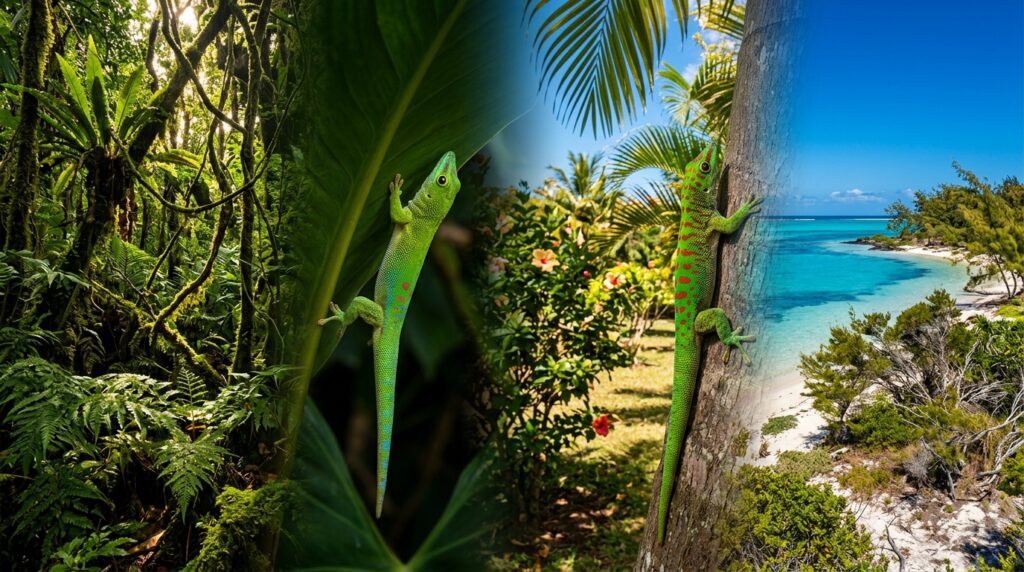
Geckos in Mauritius: the 4 endemic day geckos and where to see them
Four endemic day geckos live on mainland Mauritius: two in gardens, two in forest. Where to see them, and how to visit Île aux Aigrettes.
Four day geckos of the genus Phelsuma, all endemic to Mauritius, still live on the main island. Two turn up in gardens and on coastal walls (Phelsuma ornata and Phelsuma cepediana); the other two are forest species, rare and listed as endangered (Phelsuma guimbeaui and Phelsuma rosagularis). Round Island’s gecko, one of the largest day geckos in the world, lives only on an islet where nobody may land. To see a phelsuma without any effort, look at walls and fruit trees. For a guided visit, Île aux Aigrettes is the place to book.
The four phelsumas of the main island
The table sets the four species side by side. The first two cope well around houses; the last two depend on large forest trees.
| Species | Where to find it | Habitat | IUCN status |
|---|---|---|---|
| Phelsuma ornata | Drier coasts, up to 300 m; also Île aux Aigrettes, Round Island and Coin de Mire | Trees, vegetation, rocks | Least Concern |
| Phelsuma cepediana | Widespread across the island | Fruiting trees and bushes, gardens | Least Concern |
| Phelsuma guimbeaui | West: Chamarel, Yemen, Tamarin, Grande Rivière Noire | Large trees, palms and acacias | Endangered |
| Phelsuma rosagularis | Mountain forests of Macchabée, Les Mares, Brise Fer and Montagnes Bambous | Large trees of the native forest | Endangered |
In a garden or on a wall: ornata and cepediana
Phelsuma ornata measures 10 to 13 cm. Its head and neck are grey-brown with white stripes and a T-shaped marking on the head, and its body runs from bluish green to deep blue. It lets people come close: it will stop on a wall and look straight back at you. It feeds on insects and nectar.
Phelsuma cepediana is a little bigger, at roughly 9 to 14 cm. The male has a pale green or bluish-green body and a deep blue tail; the female is smaller and duller, with a bright green back and rust-coloured spots. It likes warm, humid spots and trees and bushes that fruit all year round (coconut, banana, papaya), which is why it does well in suburban gardens. It does not settle in farmland. Near artificial lighting, it can switch from day to night activity.
The two forest species: rare and hard to spot
Phelsuma guimbeaui lives in the west, at low and medium altitude, on large trees such as palms and acacias. The male reaches about 15.5 cm, the female 9 to 13 cm. It rarely comes near houses, and most of the lowland forest it once lived in has been replaced by sugar cane, which is the main reason it is listed as endangered.
Phelsuma rosagularis lives only in mountain forest, notably at Macchabée, Les Mares, Brise Fer and Montagnes Bambous. It basks high on the trunks of large native trees and seldom comes down to secondary vegetation. Several bird species prey on both forest geckos, which helps explain how shy they are. If you want to find one, walk with a naturalist guide rather than hoping for luck. The Ebony Forest at Chamarel lies within the range of guimbeaui, though seeing one there is not guaranteed.
Île aux Aigrettes: the guided visit to know about
Île aux Aigrettes is a 26-hectare coral islet about 850 m off the south-east coast, in Mahébourg Bay. A nature reserve since 1965, it holds the last remnants of the dry coastal forest and is run by the Mauritian Wildlife Foundation (MWF). Phelsuma ornata is one of the species living there, in restored forest. For the rest of the island’s wildlife, our article on endemic birds in Mauritius covers what you can see.
The standard visit is guided. A short boat crossing from Pointe Jérôme (the old sand jetty, about 850 m south of the Preskil hotel) is followed by a walk of 1½ to 2 hours and a museum devoted to extinct species. Bring walking shoes, water, sun cream, insect repellent, a hat and a camera.
| Rate | Adult | Child aged 4 to 11 | Under 4 |
|---|---|---|---|
| Tourist | Rs 1,000 | Rs 500 | Free |
| Mauritian resident | Rs 450 | Rs 225 | Free |
Boats leave Monday to Saturday at 9.30, 10.00, 10.30, 13.30, 14.00 and 14.30, and on Sunday in the morning only. The MWF asks you to book at least 24 hours ahead, by phone, WhatsApp or email (reservation@mauritian-wildlife.org), or at the booking office at Pointe Jérôme, subject to availability. There is also a full-day speedboat trip (Île aux Aigrettes, Île de la Passe and Île aux Fouquets) on Fridays and Saturdays, with booking five days ahead. To combine the visit with the rest of the area, see our walking itinerary of Mahébourg.
The MWF also offers a symbolic adoption of the Phelsuma ornata gecko for Rs 1,000, valid for one year and open to individuals only. It gives no rights over the animal; it is a donation towards the foundation’s conservation work.
Round Island: a giant out of reach
Phelsuma guentheri, the Round Island day gecko, is one of the largest day geckos in the world: males reach about 30 cm including the tail, although many are smaller. It once lived on the main island, before rats and cats were introduced, and today survives only on Round Island, about 22 km north-north-east of Mauritius.
Round Island (1.69 km², 280 m at its highest point) has been a nature reserve since 1957 and is run jointly by the National Parks and Conservation Service (NPCS) and the MWF. Landing is not permitted. The MWF runs a half-day boat trip around the northern islets that gives a view of Round Island from the sea, weather permitting, with one of the foundation’s biologists. Book two to three weeks ahead.
The island’s restoration has paid off. After the goats were eradicated (by 1979) and the rabbits (by 1986), the vegetation and the reptiles came back. Telfair’s skink, for instance, had fallen to about 4,000 in 1976, all of them on Round Island. By 2018 there were more than 56,000 worldwide, after it was reintroduced to Île aux Aigrettes and Gunner’s Quoin.
The Madagascar giant day gecko: a threat to the endemic species
A gecko of another species, Phelsuma grandis, arrived at Baie du Tombeau in the early 1990s through the pet trade and has spread since. A study published in 2014 compared 21 sites: 10 where it lives and 11 where it is absent. Endemic geckos are 89% less abundant where it has settled (on average 1.6 individuals recorded, against 13.3 without it). Phelsuma cepediana and Phelsuma ornata are the most exposed, because their habitats overlap with its own. The two forest species, with their small ranges, remain the most vulnerable.
In practice: never release a pet gecko or any other pet into the wild, and do not move a gecko from one part of the island to another. All Phelsuma species are listed in CITES Appendix II, which regulates their international trade.
Depending on your situation
If you are visiting, look for ornata on walls, trunks and rocks along the coast, and book Île aux Aigrettes if you want to see them in restored forest with a guide.
If you live in Mauritius and have a garden, coconut palms, banana plants or papaya trees suit cepediana. Outdoor lighting changes its rhythm. Do not expect to see guimbeaui from a terrace: the species avoids the edges of settlements.
If you are choosing where to settle, the west is where guimbeaui lives (Tamarin, Grande Rivière Noire). Our comparison Tamarin or Rivière Noire sets out the two areas, and our pages on Tamarin real estate and Black River real estate list the properties available.
Sources and checks
- Mauritian Wildlife Foundation: Île aux Aigrettes EcoTour (prices, times, booking)
- Mauritian Wildlife Foundation: Île aux Aigrettes
- Mauritian Wildlife Foundation: South East Islets Adventure
- Mauritian Wildlife Foundation: Northern Islets Seabird Tours
- Mauritian Wildlife Foundation: symbolic animal adoption
- Durrell Wildlife Conservation Trust: saving lizards at risk of extinction
- PLoS ONE (2014): effects of the giant Madagascar day gecko on endemic Mauritian geckos
- Wikipedia: Phelsuma ornata
- Wikipedia: Phelsuma cepediana
- Wikipedia: Phelsuma guimbeaui
- Wikipedia: Phelsuma rosagularis
- Wikipedia: Phelsuma guentheri
- Wikipedia: Round Island
Planning a property project?
Let’s talk about your project in Mauritius
Westimmo guides you through the analysis, selection and securing of your property project in Mauritius.