


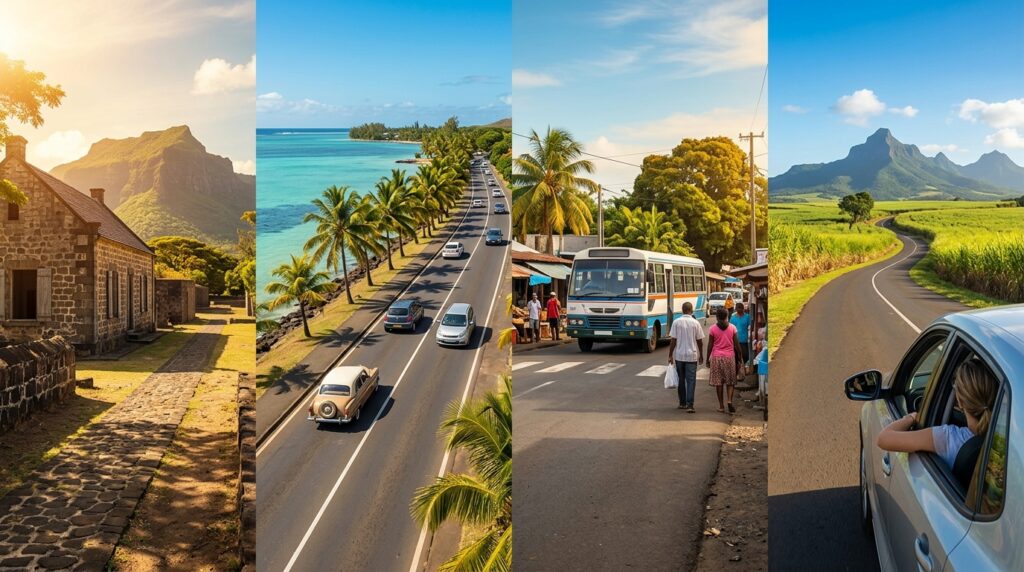
Does Mauritius Drive on the Left? History and Practical Tips
Mauritius drives on the left, a legacy of British colonial rule (1810-1968). The historical reason, what current Mauritian law says, and the habits worth adjusting on the road.
Mauritius drives on the left because the island was a British colony from 1810 to 1968, and Britain had made left-hand driving compulsory on its own roads in 1835 before spreading the rule across its empire. The current Mauritian Road Traffic Act still enforces it directly: section 123AM requires vehicles to keep to the left lane on dual carriageways, moving right only to overtake or turn at a junction.
A colonial legacy, not a geographic coincidence
Before the British, Mauritius was held by the Dutch and then the French, who already drove on the right, like the rest of continental Europe after the Revolution. The switch came with the French capitulation of 1810, when the island became a British colony and metropolitan traffic customs gradually took hold as motor vehicles appeared at the turn of the twentieth century. Britain itself had codified left-hand driving through an 1835 law, rooted in older conventions and then generalised with the rise of the motor car. Colonies and former colonies of the British Empire — India, southern and eastern Africa, Australia, the English-speaking Caribbean — kept the rule after independence, Mauritius included in 1968.
What Mauritian law says today
Left-hand driving is not just a habit here: it remains written into current Mauritian law. The Road Traffic Act (consolidated text, Issue 9) sets out lane discipline on motorways and dual carriageways in section 123AM — drive in the left lane by default, moving right only to overtake, turn right at a junction, or avoid an obstruction. The same Act sets out a few other rules that visitors usually discover on the road rather than before it:
- using a hand-held phone while driving is a specific offence under section 123AE;
- wearing a seatbelt is compulsory for the driver, under regulation 87 of the Road Traffic (Construction and Use of Vehicles) Regulations 2010;
- the legal alcohol limit is 50 milligrammes of alcohol per 100 millilitres of blood (23 microgrammes per 100 millilitres of breath, 67 milligrammes per 100 millilitres of urine) — a strict threshold, comparable to France’s.
The habits that actually need adjusting coming from a right-hand traffic country
The steering wheel itself is rarely the issue: rental and locally registered cars in Mauritius are right-hand drive, like the rest of the local fleet (the same applies to a second-hand car you import), so everything inside the cabin is mirrored consistently. The habits that genuinely take adjustment are elsewhere:
- Roundabouts. You give way to traffic already coming from the right, and you go round them clockwise — the opposite of continental Europe or the US. This is where most reflex errors happen for drivers used to right-hand traffic.
- Overtaking. It is done on the right, never on the left, including on the two-lane sections of the M1 and M2 motorways.
- Crossing on foot. The habit to correct is to look right first when stepping onto the road, since the nearest lane carries traffic coming from that side — the reverse of what right-hand traffic countries teach.
- Unmarked junctions. Right-of-way conventions from a right-hand traffic country do not transfer directly; without a sign, it is safer to slow down and look rather than assume priority.
What the road safety figures show
Statistics Mauritius, the official statistics office, publishes an annual road accident report. On the latest year covered in detail, the accident rate reached 2,917 per 100,000 population, up from 2,346 the year before — a rise driven by slight-injury accidents (+29.5%) and serious-injury accidents (+11.1%), while fatal accidents edged down slightly (-4.8%). Over that same period, 108 people died on the island’s roads, including 53 riders or passengers of powered two-wheelers and 33 pedestrians — by far the two most exposed categories, well ahead of car occupants. That imbalance should shape what to watch for once on the road: stay especially alert to motorcycles and scooters, which are numerous and sometimes hard to see at night, and never cross outside marked, clear areas.
Depending on your situation
A new arrival renting a car for a few weeks can generally just drive cautiously for the first days, avoiding the busiest roundabouts at peak hours (Phoenix, Réduit, Grand Baie) while the reflex settles in. An expat settling in for the long term and planning to buy a car should instead check the conditions for exchanging a foreign licence before driving regularly — the process and required documents vary by nationality and licence age. A pedestrian, resident or visitor, only needs to keep the one reflex that matters when stepping off the kerb: look right first.
For getting around longer-term — car rental, public transport, alternatives to owning a car — the guide to getting around Mauritius covers the practical options. For a stay that turns into a longer settlement, exchanging a driving licence is one of the steps worth planning ahead: the documents and timelines are covered in the article on exchanging a driving licence in Mauritius.
Sources and verifications
Planning a property project?
Let’s talk about your project in Mauritius
Westimmo guides you through the analysis, selection and securing of your property project in Mauritius.