


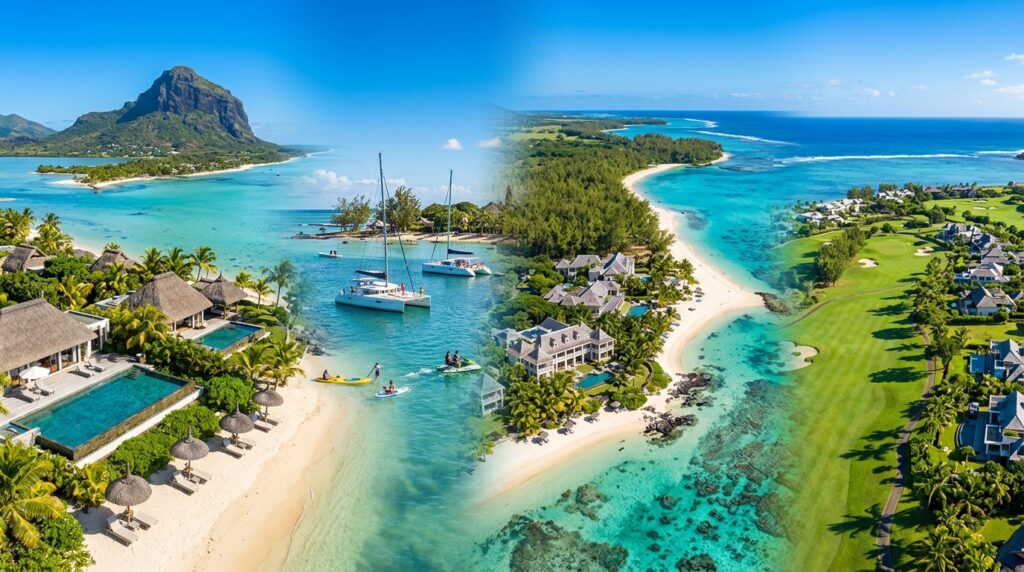
East or West Coast Mauritius: The 2026 Property and Lifestyle Comparison
East or west in Mauritius: compare the climate, the property market, coastal erosion and everyday logistics before choosing your region.
In the austral winter, the east coast of Mauritius takes winds of 20 to 30 km/h, while the west coast enjoys a sheltered, drier microclimate. Choosing between east and west directly determines your energy budget, the school run for your children and how liquid your investment will be. This head-to-head sets out the situation on the ground in 2026 to guide your choice of where to settle or buy.
The climate duel: what it does to your comfort and your budget
In the austral winter (July and August), the east coast of Mauritius is exposed to persistent trade winds blowing at 20 to 30 km/h from the east-south-east. The west coast, shielded by the central mountain ranges, keeps a dry, warm microclimate all year round. That geographic difference has direct financial consequences for residents’ daily lives.
On the western shore, accumulated heat calls for heavy use of air conditioning, particularly between November and March. That constant need weighs significantly on a household’s monthly energy budget. Modern villas increasingly build in solar solutions to offset the expense, but the electricity bill remains a major line in the running budget.
On the eastern side, by contrast, natural ventilation is much appreciated. The trade winds cool living spaces, drastically reducing dependence on air conditioning. The orientation of the terrace becomes a primary buying criterion there: the right aspect lets you enjoy the view over the vast lagoons without taking the winter gusts. You do, however, need to plan for more rigorous maintenance of joinery and outdoor equipment, as wind-driven sea air accelerates corrosion.
Lifestyle: the lively west against the authentic east
The west, taking in Black River and Tamarin, has grown up around the expectations of a working expatriate population. Infrastructure is dense: shopping centres, private clinics, sports complexes and coworking spaces follow one another along the coast road. Social life is organised around the surf spots, the sailing clubs and sunsets over the sea. That energy appeals to entrepreneurs and to families seeking quick integration into an established international community.
The east coast offers a radically different daily life, centred on wild nature and exclusivity. Residents there are after absolute quiet, far from urban bustle. Days revolve around championship golf courses and sunrises over exceptionally wide lagoons. The authenticity of the region does, however, involve more demanding logistics: specialist import shops are fewer, and reaching major healthcare facilities means more driving towards the centre of the island.
To understand what that choice means day to day, look at shopping habits. A west coast resident will find every service within a ten-minute drive. Someone who chooses to live in Belle Mare or in Flacq is prioritising space and privacy, and accepting the need to plan trips to urban areas for specific needs.
Everyday logistics: schools and the truth about traffic
The presence of international schools is often the deciding factor for families. The west concentrates several well-regarded establishments, making schooling straightforward from nursery to sixth form. That apparent proximity does, however, mask a complicated road reality at peak times.
The route linking the west coast to the employment centres in the middle of the island (such as Ebène Cybercity) is congested daily. A journey from Tamarin to Ebène at 7.30am can easily exceed an hour, when it takes only about thirty minutes mid-morning. Experienced residents optimise their trips by using the central corridor, notably the Cascavelle road, to bypass the worst bottlenecks.
Settling on the eastern side calls for a different set-up. Journeys to the best international schools in Mauritius, often located in the north or the centre, are longer. Families opting for this region frequently organise car shares or use private school buses to limit how tiring the day becomes for their children.
Property in 2026: yield, resale and coastal erosion
Obtaining a residence permit through property purchase requires a minimum investment of USD 375,000, whether the project is on the east or the west coast. Contrary to a persistent misconception, there is no regulation confining large IRS estates to the east and PDS residences to the west. Furthermore, buying an R+2 apartment, permitted from MUR 6,000,000, does not automatically confer a residence permit if the value does not reach the USD 375,000 threshold. For acquisitions under the IRS, RES, IHS, PDS and SCS schemes, the Economic Development Board requires 85% of the price to be settled in Mauritian rupees, with the remaining 15% payable in rupees or in foreign currency. That rule does not depend on any amount threshold: the USD 750,000 ceiling relates to bank financing conditions and does not govern how payment is split.
On rental yield, the market has two faces. The west shows strong liquidity and steady rental demand, supported by the continuing inflow of digital nomads and expatriate executives. The Tamarin property market rests on sustained rental demand, which makes both letting and resale easier. The east is a niche market oriented towards the very top of the range, favoured by buyers looking for exceptional villas within secure golf estates. Liquidity there is lower, but long-term capital appreciation remains solid.
The major risk factor in 2026 is coastal erosion. This natural phenomenon is reshaping certain beaches and directly affects the value of so-called waterfront properties. Before committing anywhere, it is crucial to analyse the topography of the shoreline and the protection measures in place. The value of a plot depends heavily on its vulnerability to rising water, a criterion that directly influences land prices in Mauritius from region to region.
Verdict: which coast of Mauritius fits your profile?
Geography dictates the expatriate experience. The west coast is the natural choice for working people, entrepreneurs and families seeking an active social life. Having schools, clinics and professional networks immediately to hand makes settling in quick. Watersports enthusiasts and sunset lovers find a dynamic setting there, provided they can tolerate strong summer heat and morning traffic.
The east coast speaks to those in search of serenity. Wealth-focused investors, golf enthusiasts and retirees prize the space, the security of the large estates and the natural ventilation of the trade winds. The relative distance from urban centres guarantees a rare tranquillity that amply compensates for longer journeys for certain specific errands.
To refine your plans and identify the precise areas matching your investment or residential criteria, Westimmo advisers can help you analyse the local market and select properties suited to your wealth strategy anywhere on the Mauritian coast.
Frequently asked questions
Flic en Flac or Tamarin: which town to choose in the west?
Flic en Flac offers a huge public beach and a very active rental market, ideal for short-term investment. Tamarin offers a more residential environment, centred on neighbourhood life, international schools and watersports, which fits the expectations of expatriate families over the long term.
North or west Mauritius: how do you decide for a relocation?
The north (Grand Baie) concentrates the widest offer of shops, restaurants and nightlife, on flat ground. The west stands out for the immediate proximity of sea and mountain, a more sporting atmosphere (surfing, hiking) and a dense network of international schools. The choice depends on your preference between urban buzz and spectacular natural surroundings.
Which coast should you choose in the austral winter to avoid the wind?
To escape the winter winds of July and August, the west and north-west are the most sheltered regions. The central mountains block the east-south-easterly trade winds, allowing these areas to keep a dry microclimate and mild temperatures throughout the austral winter.
Sources and verification
Information verified against these sources on 30 August 2026. Amounts, thresholds and conditions change: confirm them with the relevant authority before making any decision.
Planning a property project?
Let’s talk about your project in Mauritius
Westimmo guides you through the analysis, selection and securing of your property project in Mauritius.