


Living in Trou aux Biches and Mont Choisy: Daily Life on the Beach Coast
Trou aux Biches and Mont Choisy day to day: public beaches, the northern climate, healthcare, schools, driving and property pointers before you choose.
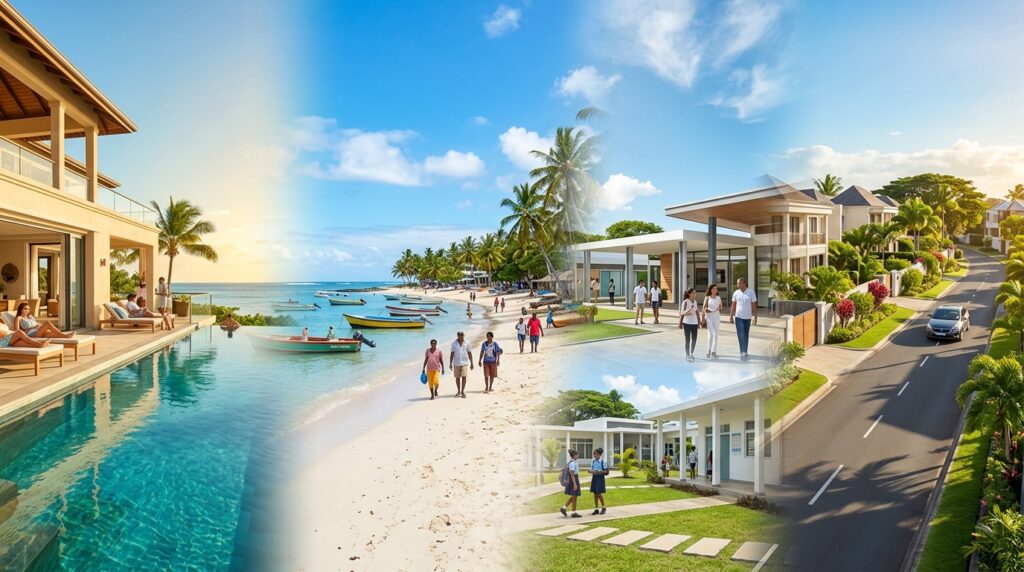
Living in Trou aux Biches or Mont Choisy means a coast of public beaches and residential developments, without the pace of Grand Baie. You will drive for the big shop, specialist care and school runs. In return you get a long white-sand beach lined with casuarinas, a village that is less commercial than its neighbour, and a northern climate that is drier than the centre of the island.
A fishing village that became a residential resort
Trou aux Biches sits in the Pamplemousses district on the north-west coast. It began as a fishing village in the 19th century, appears on Lislet-Geoffroy’s 1807 map, and opened its first major hotel in 1971, according to Wikipedia. Its long public beach is shaded by casuarinas and has reefs for snorkelling. The village has a few boutiques and a supermarket along the B38 road, but it is still far less commercial than Grand Baie.
Mont Choisy is its immediate neighbour and has a public beach of its own. The two are lived in together: you may live in one and swim, eat out and shop in the other. Neither has the range of services of Grand Baie and its neighbourhoods, which is where residents head when they need more.
The beaches are public, and that is the law
The strip between the high-water and low-water marks belongs to the State’s public domain and must stay open to everyone. A hotel or residence cannot claim it, and a lease on the land above the high-water mark does not allow anyone to restrict access to the sand. The Beach Authority lists 126 public beaches in Mauritius, 36 of them in the north, according to Expat.com, which quotes its figures. In practice, living by the sea here does not give you a private beach, and the one next door stays busy, especially at weekends.
To compare with other coves in the north, read our guide to the beaches of Pereybere and the north.
Climate: a drier north in winter
Mauritius Meteorological Services records northern data at the Pamplemousses station, for the period 1971–2000. Mean maximum temperatures run from 31.1 °C in January to 25.7 °C in July, and mean minimums from 22.2 °C in February to 16.1 °C in July. January and February have 16 days with more than 1 mm of rain, against 8 in October and November. Wind is strongest in August, averaging 13.3 km/h. These readings come from an inland station, so they do not describe the shoreline metre by metre.
Daily life: you will need a car
Plan on a car for the big shop, restaurants further afield and errands. A public bus links the village with the airport, according to Wikipedia, but its timetable is no substitute for a vehicle if you work or have children to drive to school. If you want to live without a car, Grand Baie is better equipped: our guide to living without a car in Grand Baie explains what that involves.
Healthcare: a clinic in the district
Clinique du Nord, on Baie du Tombeau Road in Pamplemousses, says it runs a medical service 24 hours a day, seven days a week, with an emergency department and an emergency line, 137. It reports more than 10,000 patients a year. The clinic is in the same district, not in the village itself, so check the route before you move, especially with young children. We have no official journey time to give from Trou aux Biches or Mont Choisy.
Schools: check before you choose the house
We found no official list of schools near the two localities. On an expat forum, one parent names Northfields International High School, in Mapou, among the cane fields, and says schools can put you in touch with private buses. That is one parent’s account, not official information: ask the school directly about bus times and routes, and compare with a school in Grand Baie.
Property: apartments and penthouses near the beach
Westimmo lists apartments and penthouses for sale in Trou aux Biches and apartments, villas and penthouses in Mont Choisy. No official source publishes prices by village. To set a budget, see our property price guide for Mauritius and, for a new-build home, the page on new developments. If you would rather rent first to test the area, see long-term rentals.
How it compares with the neighbouring areas
Grand Baie has the most shops and restaurants, with more people and traffic: see property in Grand Baie. Pereybere, further north, is known for its coves: property in Pereybere. To the south-west, the coast of Pointe aux Piments and Balaclava is more residential and more secluded: read living in Pointe aux Piments and Balaclava. For the overall picture, our guide to the north of the island compares all of these areas.
Who the area suits, and who it does not
It suits a retiree or a family who wants the beach close by, a village quieter than Grand Baie, and is happy to drive for the rest. It suits less well anyone who wants to do everything on foot, relies on frequent public transport, or needs to be a few minutes from a specialist hospital.
Sources and checks
- Mauritius Meteorological Services – Pamplemousses station readings, northern region, 1971–2000
- Clinique du Nord – address, opening hours and emergency line
- Expat.com – legal framework for beaches and Beach Authority figures
- Wikipedia – Trou aux Biches (history, beach, B38 road)
- Expat.com forum – parents’ accounts of schools in the north
Planning a property project?
Let’s talk about your project in Mauritius
Westimmo guides you through the analysis, selection and securing of your property project in Mauritius.