


Mauritian Biryani (Briani): The Recipe for Weddings and Eid
Mauritian biryani (briani): layered spiced rice with marinated meat, potatoes and eggs, slow-steamed until the flavours merge. The step-by-step recipe and its place at weddings and Eid.
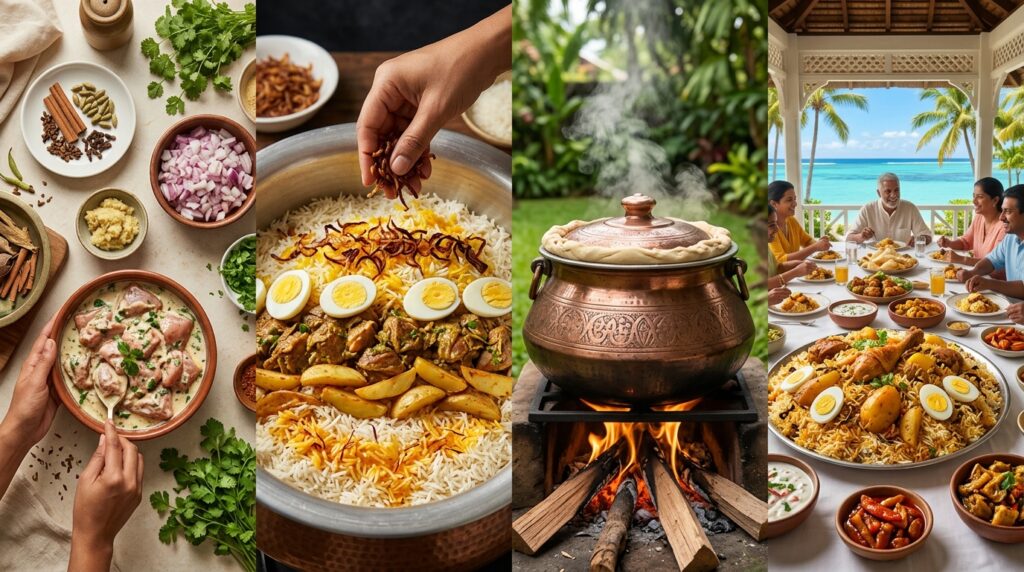
Mauritian biryani, known locally as briani, is a layered rice dish built from marinated chicken or beef, par-cooked basmati, potatoes and hard-boiled eggs, then sealed and steamed slowly so the flavours merge. It is the dish of weddings, Eid-ul-Fitr and mehfils across the island: plan on an overnight marinade, about an hour of prep, and 30 to 45 minutes of final steam-cooking for 6 to 8 people. Here is the recipe, and why on this island it means far more than a rice dish.
Where Mauritian briani comes from
The word biryani comes from the Persian “pakka birian,” meaning fried before cooking. The dish took shape in northern India in the 15th century under Mughal rule, cooked using a technique called dum pukht: par-cooked ingredients are sealed inside a heavy pot so the trapped steam finishes the cooking and carries the spices through the rice. After the abolition of slavery in the 19th century, the British colonial administration brought indentured Indian labourers to work the sugar plantations. They carried briani and curry with them, and the dish took root so deeply that it became one of the island’s culinary pillars.
The dish of every big occasion
In Mauritius, briani holds a place of its own: it appears at weddings, at Eid-ul-Fitr, and at mehfils, the religious gatherings that bring families and neighbours together. For large events, the cooking is often entrusted to a bandari, a specialist who prepares briani in giant pots called degs — a trade traditionally passed from father to son within the Mauritian Muslim community. The same dish leads a second, far more everyday life: sold at night in Port Louis from food trucks and small stalls, briani is also one of the island’s street food staples.
What makes the Mauritian version different
Mauritian briani is milder than its Indian or Middle Eastern relatives, and it always includes potatoes and hard-boiled eggs in the layering — a local signature. It also breaks from the classic pairing: instead of raita, it is typically served with chatini pomme d’amour (a tangy tomato salsa), a vinegared cucumber salad, and mazavaroo, the fiery Mauritian green chilli paste.
Ingredients (serves 6 to 8)
For the marinade
- 1.2 kg chicken thighs and drumsticks, or stewing beef, cut into pieces
- 200 g plain yogurt
- 3 tablespoons biryani spice mix
- 1 teaspoon each of ground cumin, ground coriander, turmeric
- 1 teaspoon chilli powder, to taste
- 2 tablespoons ginger-garlic paste
- Juice of half a lemon
- Salt
For the rice and layering
- 500 g basmati rice
- 3 large onions, thinly sliced and fried until deep golden (birista)
- 4 potatoes, parboiled and quartered
- 6 to 8 hard-boiled eggs (optional)
- Cardamom pods, cloves, a cinnamon stick, star anise, a bay leaf
- A pinch of saffron soaked in warm milk, or yellow food colouring
- Fresh coriander and mint, chopped
- Ghee and oil
Step-by-step method
1. Marinate the meat
Mix the yogurt, spices, ginger-garlic paste and lemon juice. Coat the meat and refrigerate overnight; four hours will do in a pinch, but the flavour will be noticeably lighter.
2. Pre-cook the garnishes
Fry the sliced onions in oil until deep golden and crisp: this is the birista, set aside for layering. In the same fat, fry the potato quarters and the hard-boiled eggs separately, then set aside.
3. Par-cook the rice
Boil the basmati with the whole spices (cardamom, cloves, cinnamon, star anise, bay leaf) until it is about two-thirds cooked — it should still be firm, since it finishes cooking under steam with the meat.
4. Brown the marinated meat
Drain the meat from its marinade and brown it in a heavy pot without stirring too much. Keep the marinade, diluted with a little water, for later.
5. Build the layers
At the bottom of the pot, arrange the browned meat, potatoes and eggs. Cover completely with the drained rice. Scatter the birista, saffron milk, coriander and mint over the top, then pour over the diluted marinade and a drizzle of ghee.
6. The dum: slow steam-cooking
Seal the pot tightly — a damp cloth under the lid helps trap the steam — and cook over very low heat for at least 30 minutes without lifting the lid. This slow steaming is what lets the rice absorb the flavour of the meat and spices.
7. Fold and serve
Just before serving, fold the layers together gently with a spoon so the meat is distributed through the rice without crushing it. Serve hot.
Traditional accompaniments
Mauritian briani is served with chatini pomme d’amour, a vinegared cucumber salad, and mazavaroo for those who want the heat turned up — a lighter pairing than the raita usually served alongside Indian biryani.
More Mauritian classics to try
Briani is only one door into Mauritian cooking. For a simpler weeknight dish, try mine frit or dholl puri, the island’s most popular street food. For a snack, gateau piment remains the go-to, and in Rodrigues, octopus curry is the local reference.
Frequently asked questions
Can briani be made ahead of time?
Yes, it reheats well over low heat and often tastes even better the next day. Avoid reheating it more than once, as the rice dries out.
What is the difference between Mauritian briani and Indian biryani?
The technique is the same — par-cooked rice, marinated meat, slow steam-cooking — but Mauritian briani is generally milder than its Indian or Pakistani counterparts, and it almost always includes potatoes and hard-boiled eggs in the layering.
Is there a vegetarian version?
Yes, replacing the meat with marinated vegetables (potatoes, carrots, green beans) or soy, pre-cooked the same way before layering.
Briani tastes even better once Mauritian cooking becomes part of everyday life rather than a holiday memory: tell us about your project to live on the island.
Sources and verification
Planning a property project?
Let’s talk about your project in Mauritius
Westimmo guides you through the analysis, selection and securing of your property project in Mauritius.