


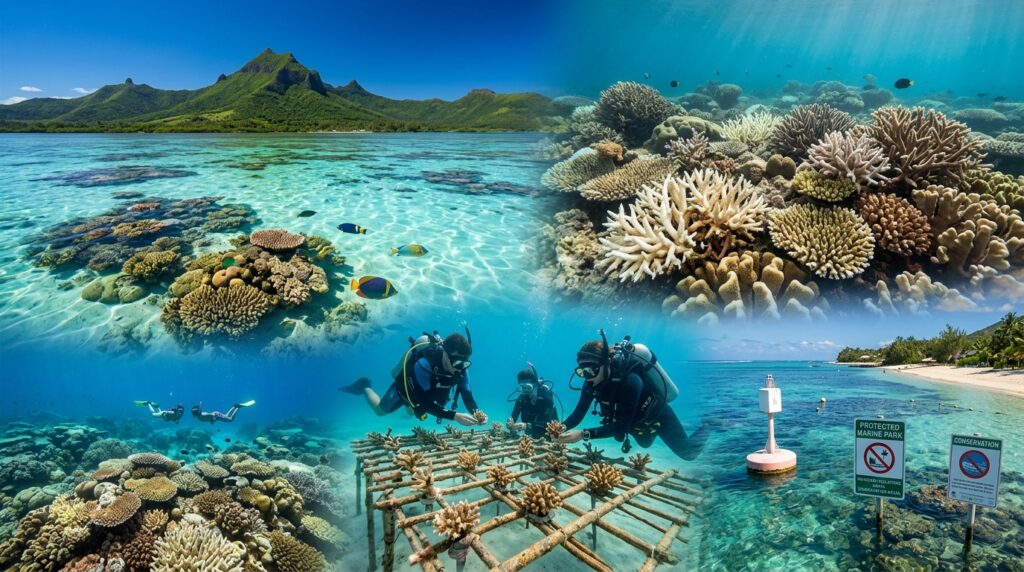
Mauritius Coral Reefs: Understand, Explore and Protect Them
80% of Mauritius's coral bleached in 2025. Marine parks, what the law prohibits, and the restoration projects now under way.
In March 2025, 80% of coral colonies in Mauritian waters bleached during a marine heatwave that pushed sea surface temperatures to 31°C, according to Pierre Edgard Daniel Marie, director of the Mauritius Oceanography Institute (MOI). This was not an isolated event: it was the latest in a series affecting the lagoon since 1998, and it led the Mauritian authorities to rethink their coral-restoration methods in 2025.
Why coral bleaches
Coral bleaching occurs when coral expels its symbiotic algae, known as zooxanthellae, which provide both its colour and much of its food. The main trigger is an abnormal rise in sea surface temperature, often associated with an El Niño event, according to the Mauritius Oceanography Institute.
The first recorded bleaching event in Mauritius dates back to 1998, when more than 10% of the island’s live coral cover was lost. Between 2001 and 2016, a series of events ranging from selective to mass bleaching caused losses of between 2% and 56% of live coral depending on the lagoon. In 2019, MOI surveys at its permanent monitoring stations (Île aux Bénitiers, La Gaulette, Grande Rivière Sud-Est, Le Morne, Flic en Flac) found more than 75% of colonies partially or fully bleached, with Acropora the most affected genus at 89%; at Île aux Bénitiers and Flic en Flac, the rate exceeded 80%. The 2023–2025 episode reached 80% island-wide in March 2025.
Marine parks where coral is protected
Two lagoon areas have held marine-park status since October 1997 as national parks, confirmed in June 2000 as marine parks: the Blue Bay Marine Park, covering 353 hectares on the southeast coast between Pointe Corps de Garde and Pointe Vacoas and also designated a Ramsar site since 31 January 2008; and Balaclava Marine Park, covering 485 hectares on the north coast in the Pamplemousses district, combining coral reef, sandy beach and salt marsh. Both are managed by the Marine Conservation Division of the Ministry of Blue Economy, which maintains coral nurseries there to help regenerate degraded areas.
At Blue Bay, mooring buoys have been installed to prevent boat anchors from damaging the reef, and around fifteen operators hold permits to offer glass-bottom boat trips or guided snorkeling outings.
What the law prohibits
The Fisheries Act 2023, which now governs marine conservation in Mauritius, prohibits under Section 20 the cutting, removal, relocation, transplanting or damaging in any way of coral without authorisation, with the same protection extending to mangroves and seagrass. Breaching this provision is a criminal offence classified at Level 5 of the Act’s penalty scale: the legal maximum is a fine of 50 million rupees and up to 10 years’ imprisonment, although that ceiling is not the penalty automatically imposed in every case. The Act also prohibits possessing, selling or exporting native coral, dead or alive, without specific authorisation.
Restoration projects under way
Since 2017, the MOI and the Albion Fisheries Research Centre have trained fishers and coastal residents in coral farming through a community project, first at Quatre Sœurs, La Gaulette, Bel Ombre and Grand Gaube, then extended to Le Morne, Poudre d’Or and Bambous Virieux with $70,000 in funding from the UN Environment Programme’s WIOSAP programme. A total of 110 participants (85% men, 15% women) were trained to install and maintain rope coral nurseries before transplanting coral to degraded sites at Albion, Flic en Flac and Trou aux Biches.
At Blue Bay, the NGO Eco-Sud has run its Blue Lagoon programme since 2010, expanded in 2020 with support from the Adaptation Fund and UNDP in partnership with the MOI and Albion Fisheries Research Centre. The goal is to restore 1.6 hectares of reef between Blue Bay and Grand Port, with monitoring at Trou Capitaine and Pointe d’Esnyand 250 people trained in coral propagation and monitoring techniques.
On the north coast, the association Reef Conservation, based in Pereybère, created the island’s first Voluntary Marine Conservation Area at Roches Noires in 2011, followed by a second at Anse-La-Raie in 2014. On the west coast, Coral Garden Conservation, active since 2015, runs the “Reviving Le Morne” initiative and manages a voluntary conservation area at Saint-Félix, monitored with underwater drones.
In May 2025, the Ministry of Blue Economy suspended coral-fragment propagation after an audit found survival rates of only 0–10%, occasionally reaching 30%, in nurseries. Official strategy is now shifting toward sexual coral reproduction, considered more resilient. In 2024, the Odysseo Foundation and the international organisation Secore International launched a three-year project using this method from the oceanarium’s laboratory.
How to observe coral without damaging it
Coral that is touched or stepped on can die within weeks even if its structure is not broken. In the lagoon, the rule is simple: keep your distance, never put a foot or fin on a colony, do not feed fish because it disrupts the reef ecosystem, and choose sunscreen without oxybenzone or octinoxate, two chemical filters already identified as harmful to coral. In the Blue Bay and Balaclava marine parks, using a licensed operator remains the best way to ensure an outing respects sensitive reef areas. For boat owners, the mooring rules explained in our guide to boating in Mauritius apply directly to coral protection: a badly placed anchor can destroy in seconds what a nursery takes years to rebuild.
Sources and verification
- Mauritius Oceanography Institute – Current Coral Bleaching in Mauritius (2019)
- Mauritius Oceanography Institute – MOI’s ongoing reef restoration initiatives
- Ministry of Blue Economy – Marine Conservation Division
- Mauritius National Assembly – The Fisheries Act 2023 (official text)
- Eco-Sud – Coral Restoration Project
- Aparté – Coral protection in Mauritius: initiatives making a difference
- Mongabay – Mauritius rethinks coral restoration as reefs suffer from another mass bleaching
Planning a property project?
Let’s talk about your project in Mauritius
Westimmo guides you through the analysis, selection and securing of your property project in Mauritius.