


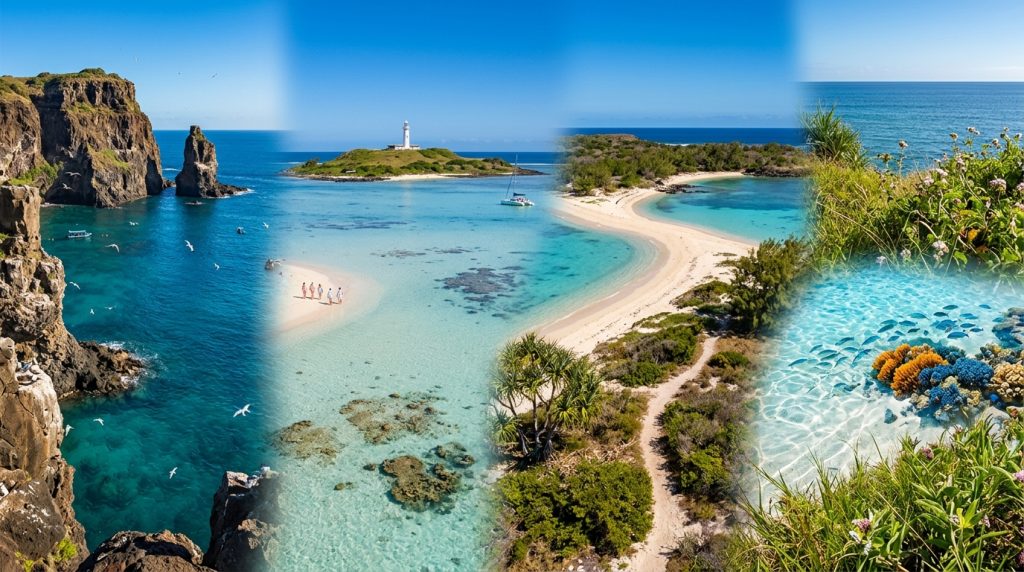
Northern Islets of Mauritius: Coin de Mire, Flat Island and Gabriel Island
Coin de Mire, Flat Island, Gabriel Island, Round Island: where you can land, what you see, and how to go from Grand Baie.
Of the islands off Mauritius’s north coast, only one is a place where you actually step ashore: Gabriel Island. Coin de Mire is a nature reserve with no landing, Round Island opens to scientific researchers only, Serpent Island is off limits, and Flat Island is mostly seen from the boat. Trips leave from Grand Baie and take about eight hours for a full day. One travel guide quotes €68 to €1,050 per person, the top of that range being a private charter.
Which are the northern islets, and which can you visit?
Five names come up on every trip: Coin de Mire, Gabriel Island, Flat Island, Round Island and Serpent Island. All are uninhabited, between a few and a few dozen kilometres off the north coast, and what you can do on each depends on its protection status.
| Island | Status | Can you land? |
|---|---|---|
| Gabriel Island | Part of the national protected areas, with Flat Island | Yes, it is the stop on catamaran trips |
| Flat Island | National protected area | Sources are unclear; boats often just sail past for snorkelling |
| Coin de Mire | Nature reserve | No, for conservation reasons |
| Round Island | Nature reserve since 1957 | No, except for scientific research |
| Serpent Island | Not specified | No |
Gabriel Island: the one stop where you go ashore
Gabriel Island is the only place where boats land, according to several operators, and the stop usually comes with a barbecue lunch. You can swim, walk the island and stretch out on a white sandbar. Birds and skinks live there. It is a treeless islet, about five minutes by boat from Flat Island.
Flat Island: lighthouse, quarantine station and grey reef sharks
Flat Island covers 2.53 km² and sits low on the water. Its lighthouse, built in 1855 on the south-west side, is one of the few still working in Mauritius. From the mid-19th century until the 1930s the island served as a quarantine station for immigrants, mostly indentured labourers and chiefly because of cholera. The buildings put up between 1856 and 1870 are still there, overgrown, and a cemetery lies on the south side. A small army base is the only human presence.
Underwater, the best-known dive is the Shark Pit near Pigeon Rock, where grey reef and silvertip reef sharks gather. For a realistic picture of the risk, read our article on sharks in Mauritius. Catamarans often sail past Flat Island for snorkelling rather than landing, so ask your operator what is planned for your day.
Coin de Mire: look from the boat, explore underwater
Coin de Mire (Gunner’s Quoin) covers about 65 hectares, roughly 8 km north of the main island. It is a nature reserve and no one may land. You view it from the boat and swim or dive around it. Seabirds are the draw: tropicbirds, sooty terns and masked boobies, with fish, sea turtles and dolphins turning up now and then. Sources differ on one point. One operator describes a swimming and snorkelling stop, while a travel guide says the islet can only be seen from the catamaran. Either way, nobody goes ashore.
For birds, our guide to endemic birds in Mauritius lists the species to look for. For the water, see snorkelling and scuba diving.
Round Island and Serpent Island: refuges best seen from afar
Round Island (2.08 km², up to 280 m high, 22.5 km north of Mauritius) has been a nature reserve since 1957. It shelters reptiles found nowhere else: the Round Island skink, day gecko and boa. The sea is often rough and the shore rocky, so you look at it from a distance. Landing is allowed for scientific research only.
Restoration work on these reptiles has also reached a neighbouring islet: a Darwin Initiative report notes that about 250 Telfair’s skinks were released on Coin de Mire. For reptiles on the main island, see our endemic geckos.
Serpent Island is the most remote of the five and landing is not allowed. Despite its name it has no snakes: the last native snake died out soon after Europeans arrived. It has an endemic gecko subspecies and, together with Round Island, is the only place where the centipede Scolopendra abnormis lives. Divers describe a wall dropping to 50 m, batfish and reef sharks at Shark Arena around it. Seabirds nest on the island.
How and when to go
Almost every trip starts in Grand Baie, either on a shared catamaran or a private charter. Prices and itineraries vary widely; the figures above come from operators and guides and are indicative only. Ask for an up-to-date quote, what it includes (meals, drinks, snorkelling gear) and whether Flat Island is on the programme.
On timing, one guide says the trade winds blow steadily from May to November, which helps navigation, and advises avoiding the cyclone season from January to March. If you also want to fish out here, our article on big-game fishing notes that Grand Baie is the base for the neighbouring islets.
Depending on your situation
If you are visiting, book the full-day trip from Grand Baie, bring sunscreen and something to cover up, and expect one real landing, on Gabriel Island. If you already live here, a boat trip is a good way to see the north coast from the sea; our article on Trou aux Biches and Mont Choisy covers daily life in the area. If you are still choosing where to settle, the north is the natural base for these trips, with our pages on Grand Baie real estate, Péreybère and Trou aux Biches.
Sources and checks
- Wikipedia, Islets of Mauritius: areas, Round Island status, Serpent Island
- Wikipedia, Île Plate: lighthouse, quarantine station, protected areas
- Mauritius Now: access and activities island by island
- Fairmoove: catamaran trips, duration, indicative prices, season
- Darwin Initiative: annual report on islet restoration (Telfair’s skinks)
Planning a property project?
Let’s talk about your project in Mauritius
Westimmo guides you through the analysis, selection and securing of your property project in Mauritius.