


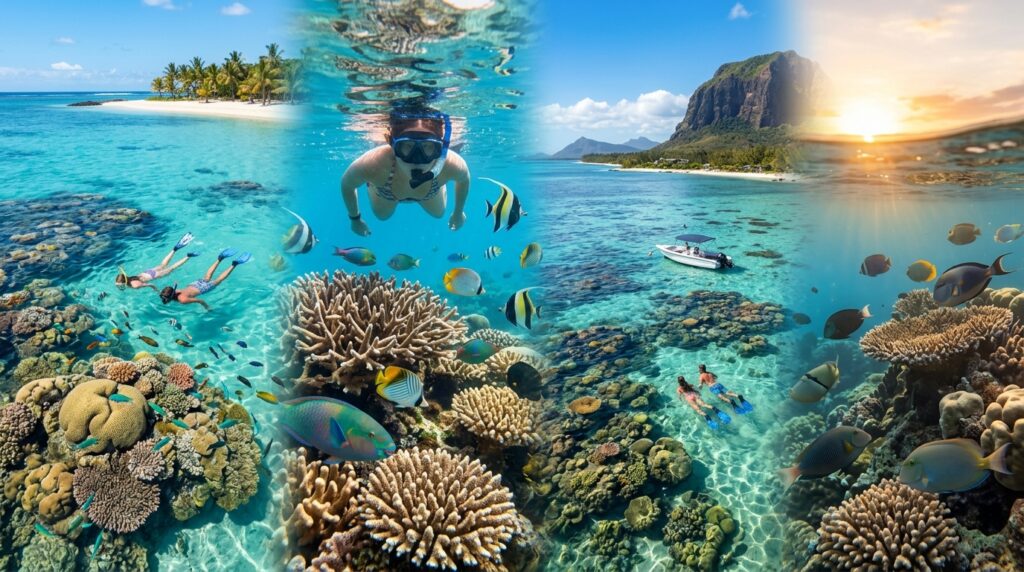
Best Snorkeling Spots in Mauritius: Where to Go and What to Know Before You Book
Where to snorkel in Mauritius: best spots by region, the rules of the Blue Bay and Balaclava marine parks, the best season, and the real state of the coral since the 2025 bleaching.
The best snorkeling in Mauritius is found in the sheltered, shallow lagoons of the North and West, roughly between May and November, when the sea is at its calmest. But since March 2025, the experience isn’t everywhere what the brochures show: an ocean heatwave bleached about 80% of the island’s coral, according to the director of the Mauritius Oceanography Institute. Some reefs have recovered since, others are still dull. Here’s where to go, what the protected marine parks actually allow, and what to know before you book a trip.
The best spots, region by region
The North: Trou aux Biches, Pointe aux Canonniers, Grand Baie
The lagoon at Trou aux Biches is wide, shallow and accessible straight from the public beach, which makes it one of the easiest entry points for beginners. A few kilometres away, Pointe aux Canonniers lets you swim out just a few strokes from the shore to see coral and colourful fish. Grand Baie mainly serves as the departure point for boat trips to Coin de Mire (Gunner’s Quoin), further out, where visibility is usually better than inside the lagoon.
The West: Flic en Flac and Ile aux Bénitiers, from Black River
Flic en Flac combines a lagoon you can snorkel from the beach with quick boat access to Ile aux Bénitiers and its reef, off Black River. This stretch of coast is also where dolphin-watching trips depart from — a separate activity, with its own rules.
The Southeast: Blue Bay, the only marine park within easy reach
Blue Bay is the reference point for coral diversity in the Southeast: the Ministry of Fisheries has recorded 38 coral species and 72 fish species there. It’s also the only site in this guide that is a designated marine park, with precise rules detailed below.
The East: Roches Noires and Ile aux Cerfs
Roches Noires has shallow, easily accessible reefs suited to beginners. Further out, the coves around Ile aux Cerfs are best reached on an organised trip from Trou d’Eau Douce.
Blue Bay and Balaclava: what the regulations actually allow, and what they ban
Blue Bay was proclaimed a national park in October 1997, then designated a marine protected area and marine park in June 2000 under the Fisheries and Marine Resources Act 1998 — a regime carried forward by the Fisheries Act 2023. In September 2008, its 353 hectares were listed as Mauritius’s second Ramsar site. Balaclava, in the northwest, covers 485 hectares under the same legal framework. Both parks are managed under the Fisheries and Marine Resources (Marine Protected Areas) Regulations of 2001, amended in 2007, which set out three tools: a zoning system, a permit system, and patrol enforcement.
The zoning isn’t just paperwork: the regulations define specific zones, each with its own restrictions. In the swimming zone, marked at sea by a line of yellow floats, no boat, pedalo, kayak or board of any kind is allowed — and within the park, swimming or snorkeling anywhere outside that zone is prohibited. In the traffic lane reserved for motorised boats, conversely, swimming, snorkeling or diving is banned. In the conservation zone, boats are capped at 3 knots with no wake; the strict conservation zone requires a permit to enter at all. More than fifteen operators hold a permit to run guided trips in Blue Bay, including glass-bottom boat tours.
There’s no entry fee to swim at Blue Bay’s public beach: fees apply to services such as a glass-bottom boat trip or scuba diving.
When to go for the clearest water
The best conditions are usually seen between May and November: flatter seas, less sediment stirred up, better visibility. Snorkeling early in the morning, before the wind picks up and boat traffic churns the water, remains the most reliable rule of thumb for clarity, whatever the season. For exact cyclone season dates and precautions outside this window, see our guide to cyclone season in Mauritius.
The coral after the 2025 bleaching: what to know before you go
In March 2025, an ocean heatwave pushed sea surface temperatures to around 31°C off Mauritius, bleaching about 80% of the island’s coral, according to Pierre Edgard Daniel Marie, director of the Mauritius Oceanography Institute. The worst-hit areas cited include Pointe aux Feuilles, Flic en Flac, the East coast and the Southeast. It’s part of a series of bleaching events recorded since 1998 (1998, 2006, 2016, 2024), driven by a measured 0.16°C per decade rise in sea surface temperature around the island since 2003.
In practice, for a trip in 2026: some reefs, notably at Blue Bay, held up better or recolonised faster than others; some areas still look dull months after the heat event. A 1.2-hectare coral restoration project is underway on the island, due to wrap up by the end of 2026. That’s not a reason to skip a trip — it’s a reason to choose an operator who sticks to marked mooring zones rather than dropping anchor freely, and not to expect the same density of colour everywhere as a decade ago.
Gear and precautions
Masks and snorkels can be rented at most popular beaches, often included in the price of a boat trip. Being able to swim is generally a condition for joining a guided trip, especially inside a marine park. Coral cuts easily: a long-sleeved rash vest or light wetsuit protects against sunburn as much as against sharp edges, and removes the temptation to put a hand down for balance — touching coral remains prohibited inside marine parks as elsewhere, and living coral takes years to recover.
Depending on your situation
With young children, Trou aux Biches and Roches Noires remain the safest choices: shallow lagoon, walk-in access, no boat required. More ideas for families are covered in our guide to children’s activities in Mauritius.
Without a boat, straight from the beach, Pointe aux Canonniers and Trou aux Biches let you get in the water without booking a trip.
For the richest reefs, an organised trip to Blue Bay or to Ile aux Bénitiers from Black River — sometimes paired with a dolphin trip on the West coast — remains the best option, provided the operator sticks to marked zones.
These areas also concentrate much of the island’s water sports and leisure options, and for anyone considering a stay of several weeks rather than a hotel holiday, our page on long-term rentals in Mauritius covers the options by area.
Sources and verification
- Ministry of Blue Economy, Marine Resources, Fisheries and Shipping — list and area of Mauritius’s marine protected areas, legal framework (Fisheries and Marine Resources Act 1998, Marine Protected Areas Regulations 2001/2007)
- Ministry of Fisheries and Rodrigues — Blue Bay Marine Park Management Plan — park proclamation (1997, 2000), Ramsar listing (2008), 38 coral species and 72 fish species recorded, zoning regulation text
- Mongabay, citing the Mauritius Oceanography Institute — March 2025 coral bleaching, sea surface temperatures, restoration programme
Planning a property project?
Let’s talk about your project in Mauritius
Westimmo guides you through the analysis, selection and securing of your property project in Mauritius.